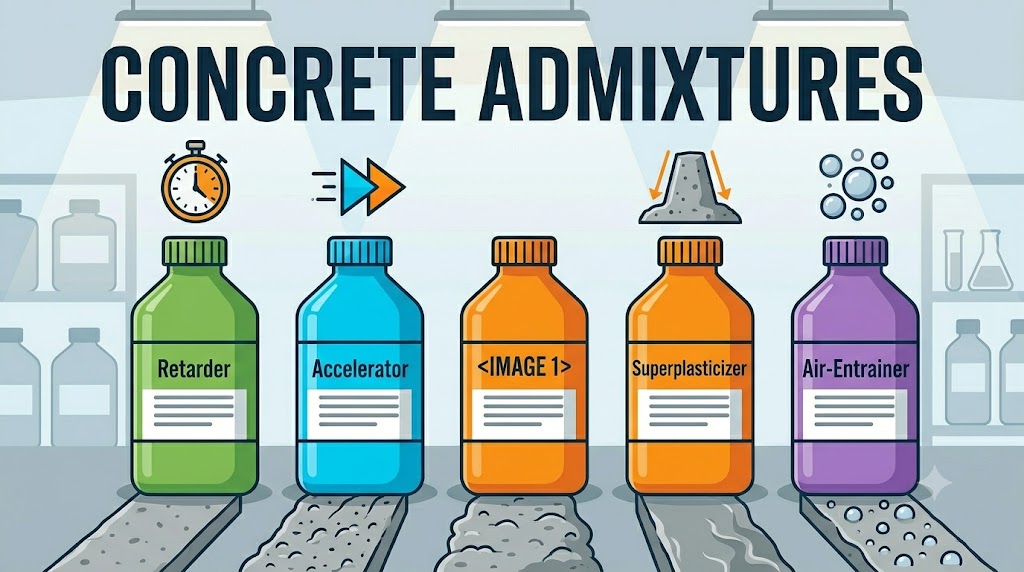
Concrete admixtures are chemical or mineral materials added to a mix — either at the plant or on site — to modify the properties of fresh or hardened concrete. The five categories used on most construction projects are water reducers, retarders, accelerators, air-entraining agents, and superplasticisers (HRWR). Each does one primary job. Using the wrong one, or using the right one at the wrong dosage, reliably causes problems.
- Each admixture solves one problem — workability, set time, or durability. Using one to fix a different problem (e.g. a retarder to fix a hot-weather thermal cracking risk) doesn’t work.
- Dosage is always a percentage of cement weight, same convention as pigment — never a fixed volume regardless of batch size.
- Admixtures optimise a correct mix design — they don’t rescue a bad one. Wrong aggregate, wrong cement content, or no compatibility trial will still cause problems.
- Never pre-blend two admixtures before dispensing — some combinations (retarder + accelerator) precipitate instantly.
The five main admixture types and their mechanism
Water reducers (plasticisers) work by dispersing cement particles through electrostatic repulsion. When cement hydrates, particles tend to flocculate — clumping together and trapping water in the floc structure. A plasticiser coats the cement surface and forces the particles apart, releasing that trapped water for workability. The result: 5–15% reduction in water demand at the same slump, or a higher slump at the same w/c ratio. This is how you improve workability without touching the water-cement ratio.
High-range water reducers (superplasticisers / HRWR) use a longer polymer chain — typically polycarboxylate ether (PCE) — that provides both steric and electrostatic dispersion. They deliver 20–40% water reduction or will fluidise a stiff mix to self-compacting concrete without affecting strength. Superplasticisers are the enabling technology for M35+ concrete: they allow low w/c ratios (0.30–0.40) to remain pourable. Dosage is typically 0.5–2.0% by weight of cement.
Retarders slow the rate of cement hydration by interfering with C3S and C3A reaction kinetics — the early-strength compounds in clinker. They extend working time from the standard 1–2 hours to 4–8 hours, or longer. Essential for hot-weather concreting above 30°C / 86°F, long-haul deliveries, large pours where all concrete must remain workable until finishing, or architectural concrete where cold joints cannot be tolerated.
Accelerators speed up cement hydration — shortening the time to initial set and accelerating early strength gain. Calcium chloride (CaCl₂) was the standard and remains permitted at low dosage in some reinforced concrete under ACI 318 (see below for the actual limits, which are more nuanced than a flat prohibition), but corrodes steel reinforcement if the dosage or exposure condition is wrong, so modern non-chloride accelerators (typically calcium nitrite or sodium thiocyanate formulations) are used instead wherever the risk isn’t worth managing. They are standard for cold-weather concreting below 5°C / 41°F, for pre-cast production where early stripping is economically important, and for repair mortars that need to carry load quickly. Cold-weather placements also need their curing schedule adjusted regardless of accelerator use — the Concrete Curing Time Estimator adjusts expected strength-gain timelines for ambient temperature.
Air-entraining agents (AEA) generate a stable network of microscopic air bubbles — 0.01–1 mm / 0.0004–0.04 in (roughly 10–1,000 microns) diameter — distributed uniformly through the paste. The bubbles act as pressure-relief chambers during freeze-thaw cycling: when pore water freezes and expands, ice crystal growth pressure is accommodated in the adjacent voids rather than cracking the paste. Correctly air-entrained concrete (4–7% air by volume, depending on aggregate size — see the dosage table below) can withstand 300+ freeze-thaw cycles without scaling; the same mix without AEA may fail in 30.
Use the Concrete Admixture Dosage Calculator to convert the manufacturer’s recommended percentage dosage into actual ml or kg per m³ for your batch volume. Manufacturer specifications are always expressed as a percentage of cement weight — so the accuracy of the dosage depends entirely on knowing your actual cement content; the Cement Quantity Calculator confirms that figure first if you’re working from a mix ratio rather than a batch ticket.
Admixture comparison: type, dosage, and when to specify
| Admixture type | Typical dosage (% by cement wt) | Primary benefit | When to use |
| Plasticiser (WR) | 0.2–0.5% | 5–15% water reduction | Standard RC mixes wanting better workability without extra water |
| Superplasticiser (HRWR) | 0.5–2.0% | 20–40% water reduction | M30+, SCC, low w/c structural mixes |
| Retarder | 0.1–0.5% | 2–6 hr extended workability | Hot weather, long hauls, large monolithic pours |
| Accelerator (non-Cl) | 1.0–3.0% | Early strength up 30–50% | Cold weather, early stripping, emergency repairs |
| Air-entraining agent | 0.005–0.05% | 4–7% air entrainment | Any exposed flatwork in freeze-thaw climates |
| Crystalline waterproofer | 0.8–1.5% | Self-sealing capillary porosity | Water-retaining structures, basement walls |
| Shrinkage reducer | 0.5–1.5% | Drying shrinkage down 25–50% | Industrial floors, slabs with crack sensitivity |
| Corrosion inhibitor | 1.0–3.0% | Delays chloride attack on rebar | Marine structures, bridge decks, car parks |
How admixtures interact with your mix design
Admixtures do not fix a poorly designed mix — they optimise a correctly designed one. A superplasticiser cannot compensate for aggregate that is too coarse, a cement content that is too low, or a batch that was mixed without adequate water to start. The dosage must match the cement content and type: PCE superplasticisers are sensitive to cement alkali content and C3A levels. A product that works perfectly with a CEM I 52.5R cement may be incompatible with a GGBS blend, causing flash set or loss of workability. Always request a compatibility trial from your admixture supplier before specifying a new combination.
Multiple admixtures can be combined, but must be dispensed separately into the mixer — never pre-blended together. Mixing a retarder and an accelerator in the dispenser hose will cause instant precipitation. The standard sequence is: aggregate, part water, cement, plasticiser, remaining water. Air-entraining agents are added with the initial water charge.
Dosage verification is critical. The Concrete Air Entrainment Calculator determines the AEA dosage required to hit a target air percentage based on your aggregate size and cement content — because the same dosage rate produces different air contents across different mixes. Once admixtures are in the mix, the effective w/c ratio can shift — recheck it against the Water-Cement Ratio Calculator rather than assuming the original design figure still holds.
Common mistakes when using admixtures
Adding superplasticiser directly to a stiff truck. Pouring neat HRWR onto stiff concrete at the delivery point produces an uneven dosage — some areas get the full hit of plasticiser, others get none. This creates variable workability through the load and can leave pockets of unexpectedly fluid concrete that segregate during vibration. Superplasticiser should be added at the plant with the mix water, with at least 60 seconds of high-speed mixing to achieve uniform dispersion.
Using calcium chloride accelerator without checking the applicable exposure limit. CaCl₂ is cheap and effective, but chloride ions penetrate to rebar depth and can initiate electrochemical corrosion. BS 8500 prohibits calcium chloride in all concrete containing embedded metal — a blanket rule. ACI 318 is more nuanced and sets water-soluble chloride ion limits by exposure condition: 0.06% by weight of cement for prestressed concrete (the strictest tier), 0.15% for reinforced concrete exposed to chlorides in service, 0.30% for reinforced concrete exposed to moisture without external chloride sources, and up to 1.00% for reinforced concrete that stays dry or protected from moisture in service. In practice, many specifiers avoid CaCl₂ in any reinforced element regardless of which limit technically applies, since actual service conditions can change over the structure’s life and the corrosion consequence is severe. Where the risk isn’t worth managing, use a calcium nitrite-based accelerator instead. Whatever accelerator you use, cover depth over the reinforcing steel is the other half of corrosion protection — a chloride-free mix with inadequate cover is still at risk.
Under-dosing air-entraining agent for aggregate size. The required AEA dosage increases as aggregate maximum size decreases — more surface area per unit volume means more air bubble nucleation sites are needed for the same entrained air percentage. For 20 mm / 0.75 in aggregate the target air is 4–5%; for 10 mm / 0.4 in aggregate it rises to 5–7%. Under-entraining a mix with fine aggregate will result in surface scaling after the first hard winter despite using AEA at all.
Using a retarder at elevated dosage to compensate for no cooling in hot weather. Retarders do not lower the heat of hydration — they defer it. If a mass pour in 35°C / 95°F weather is retarded to stay workable for 6 hours, the hydration heat release still occurs; it just occurs while the pour is being placed and compacted rather than afterward. Thermal cracking risk in mass pours requires pre-cooling (chilled water, ice, cooled aggregate), not retarder alone. Use both, or use a low-heat cement.
Related calculators you might need
Admixtures are one variable in a full mix design. The Concrete Mix Ratio Calculator gives you the base mix design before admixtures are specified. The Water-Cement Ratio Calculator is the critical check after a superplasticiser has reduced your water demand — verify that your effective w/c ratio is within the permitted range for your exposure class. For mixes with air entrainment, the Concrete Air Entrainment Calculator determines the specific AEA dosage for your aggregate size and target air content. If you’re batching multiple loads that all need the same dosage, the Concrete Batch Calculator keeps admixture-to-cement ratios consistent across every batch, the same way it does for pigment dosing. And if you are evaluating whether admixtures justify the cost increase over a standard mix, the Ready-Mix vs Bagged Concrete Cost Calculator gives you the overall material cost comparison for your project volume.
Frequently asked questions
What admixture should I add to concrete in hot weather?
Use a set retarder dosed at 0.2–0.4% by cement weight. For temperatures above 30°C / 86°F, a standard retarder extends workability by 2–3 hours; above 35°C / 95°F you may need a ‘hot weather’ retarder formulation that extends to 4–6 hours. Also pre-cool the mixing water — replacing part of the water with ice is simple and reduces concrete temperature by 3–5°C / 5–9°F per 10% replacement. Do not add extra water to compensate for stiffening.
What does a plasticiser do that adding more water doesn’t?
Both improve workability, but adding water raises the w/c ratio and permanently reduces strength and durability. A plasticiser at 0.3% cement weight achieves the same slump increase as adding 12–15 litres / 3–4 US gallons per m³ of water, with no effect on w/c ratio or 28-day strength. The cost of a plasticiser dose is typically £1–£3 / $1.50–$4 per m³ — less than the material cost of the strength loss you would incur by adding water instead.
Can I use admixtures in bagged concrete mixed on site?
Yes — liquid admixtures are simply added to the mixing water before it contacts the cement. Measure the cement weight of your batch (a 25 kg / 55 lb bag weighs 25 kg), calculate the admixture dosage as a percentage of that weight, then add that mass or volume of admixture to your measured water. For a 25 kg cement bag, a 0.3% plasticiser dosage is 75 ml (about 5 tablespoons). A pipette or measuring syringe gives acceptable accuracy for on-site use. If you’re mixing several bags across a pour, the Concrete Batch Calculator scales the dosage proportionally so every batch matches.
Are admixtures safe to handle?
Most liquid plasticisers and retarders are low-hazard — they are aqueous solutions with pH 5–9 and present no significant inhalation or ingestion risk at normal dosage handling. Air-entraining agents contain surfactants that can irritate eyes and skin on contact; wear gloves and eye protection when handling neat liquid. Calcium chloride accelerator (where still used) is corrosive at concentrations above 30%. Always read the product SDS before use, and keep admixtures away from rebar stockpiles to prevent chloride contamination.
How do I know if my concrete has enough air entrainment?
The only reliable on-site check is a pressure air meter test (ASTM C231 / BS EN 12350-7) performed on fresh concrete from the truck immediately before or during the pour. Target air content for freeze-thaw exposure is 4–7% depending on aggregate size. A visual inspection tells you nothing — the bubbles are microscopic. Specify that the driver carries a docket showing the AEA dosage used, and require fresh-concrete air testing on any pour of 5 m³ / 6.5 yd³ or more in exposed locations.
Dosage figures above are general working ranges for planning. Always confirm the recommended dosage against the specific product’s data sheet, run a compatibility trial with your actual cement source before a structural pour, and confirm chloride and exposure-class limits with your project specification or a qualified engineer — this is especially important for accelerators, corrosion inhibitors, and any reinforced element.