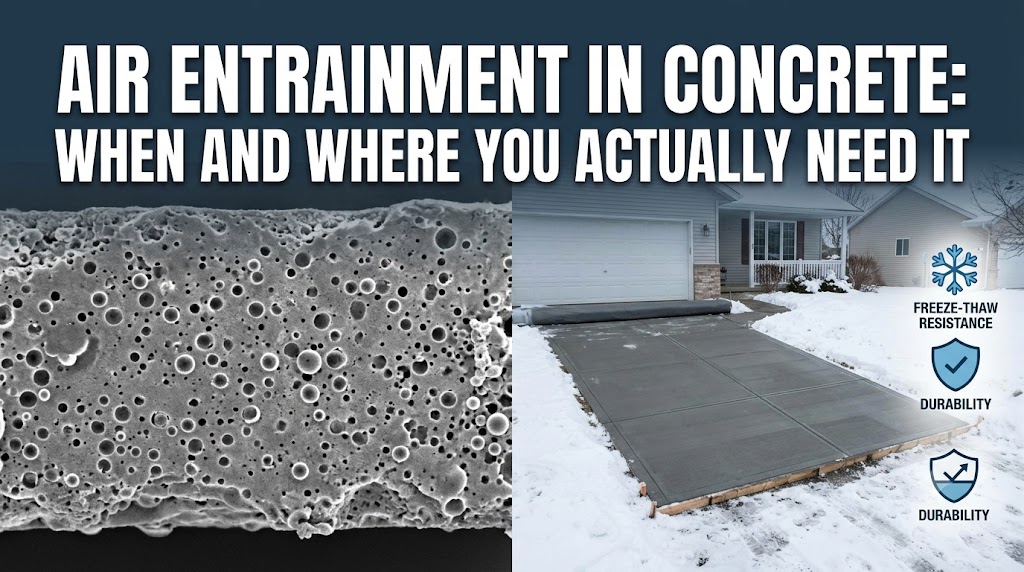
Air entrainment is mandatory for any concrete that will experience freeze-thaw cycling. Without it, water in the concrete expands when it freezes, generating internal hydraulic pressure that exceeds the tensile strength of the paste and causes progressive surface scaling and spalling. A single winter season is enough to begin visible damage on non-air-entrained flatwork in a climate that cycles between freezing and thawing — which covers most of the northern US, Canada, the UK, northern Europe, and elevated regions of Australia.
How air entrainment works and what the target air content should be
Air-entraining admixtures — typically vinsol resin, tall-oil derivatives, or synthetic surfactants — reduce the surface tension of water during mixing, causing billions of microscopic air bubbles (typically 10–300 µm diameter) to form and stabilise within the cement paste. These bubbles are not the same as entrapped air (the large, irregular voids from poor consolidation). Entrained air bubbles are small, uniformly distributed, and deliberately engineered.
When water in the concrete freezes and expands (water expands roughly 9% by volume on freezing), the entrained air voids act as pressure relief chambers. The expanding ice has somewhere to go. Without those voids, the hydraulic pressure builds until the paste cracks. The mechanism requires the bubbles to be close enough together — the spacing factor between adjacent air voids should be no more than 0.2 mm (0.008 inches) per ACI 318 and ACI 201.2R. This is a function of the total air content and bubble size distribution, not just air percentage alone.
Use the concrete air entrainment calculator to determine required admixture dosage based on your aggregate size, target air content, and concrete volume. Dosage is sensitive to mix design and ambient temperature — the calculator adjusts for these variables.
Target total air content by aggregate size, per ACI 318 Table 19.3.3.1:
| Nominal max aggregate size | Mild exposure | Moderate exposure | Severe exposure |
| 9.5 mm (3/8 in) | 4.5% | 6.0% | 7.5% |
| 12.5 mm (1/2 in) | 4.0% | 5.5% | 7.0% |
| 19 mm (3/4 in) | 3.5% | 5.0% | 6.0% |
| 25 mm (1 in) | 3.0% | 4.5% | 6.0% |
| 37.5 mm (1.5 in) | 2.5% | 4.5% | 5.5% |
Severe exposure: concrete exposed to freeze-thaw cycles in a moist condition and to deicing salts. Moderate: freeze-thaw cycles without deicing chemicals. Mild: occasional freezing with low saturation. In the UK and Ireland, BS 8500-1 uses equivalent exposure classes (XF1–XF4), with XF4 (road and bridge decks with de-icing salts) requiring 4–7% total air.
Where air entrainment is actually required — and where it is not
Required: Any outdoor flatwork in a freeze-thaw climate — driveways, footpaths, patios, parking areas, pool decks, exposed slabs. Any structural element in a freeze-thaw climate that is in a moist or saturated state: retaining walls, foundations at or above grade, bridge decks, pavements. Concrete exposed to deicing salts needs both air entrainment and a low water-cement ratio (0.40 or below per ACI 318 for severe exposure).
Not required: Interior slabs (garage floors with no external freeze exposure, warehouse floors, basement slabs). Concrete in permanently dry conditions. Concrete in warm climates where air temperature never drops below 0°C / 32°F with the concrete in a saturated state. Mass concrete where thermal mass prevents freeze-thaw cycling.
Air entrainment is also used — separately from freeze-thaw protection — to improve workability in low-slump mixes. Each 1% of entrained air reduces water demand by approximately 3–5 litres per m³ (0.5–0.9 gal/yd³), which can partially offset the water-cement ratio without reducing workability. This application is less common but relevant in stiff paving mixes.
Common mistakes
Specifying air entrainment in interior slabs. Air-entrained concrete used for interior floor slabs that will receive a hard-trowel finish is a significant mistake. The entrained air voids open at the surface during troweling if finishing happens too early or too aggressively, leaving a pitted, weak surface layer. Interior concrete on grade does not experience freeze-thaw cycling — the freeze-thaw protection is irrelevant, and the surface quality penalty is real. Specify non-air-entrained concrete for interior slabs, regardless of what the ready-mix plant offers as a default.
Not testing air content on site before placement. Air content in the delivered concrete can differ from the batch plant target due to temperature changes in transit, variation in admixture dosage, or aggregate moisture. The only way to know what you are placing is to test it. ASTM C231 (pressure meter method) and ASTM C173 (volumetric method, for lightweight or slag aggregates) both take under five minutes. Accepting a truckload without testing the air content is standard practice in residential work — and the reason many residential driveways fail within three winters.
Finishing air-entrained concrete too early. Troweling before bleed water has fully evaporated seals the surface and traps moisture below, which later forms a weak delamination layer. The correct trigger for finishing is when the bleed water sheen disappears and the surface can support the finisher’s weight without significant indentation — typically 1–3 hours depending on temperature and relative humidity. Premature finishing is responsible for the majority of surface scaling complaints on air-entrained flatwork.
Assuming higher air content is always better. Air content above the ACI maximum for a given aggregate size begins to reduce compressive strength significantly — roughly 5% strength reduction per 1% increase in total air content. An over-entrained mix at 9–10% total air on a 19 mm aggregate may meet the durability goal but drop compressive strength by 15–20% relative to the designed mix. If you need both freeze-thaw durability and high strength (for example, a driveway subject to deicing salts), the solution is the correct air content range plus a low water-cement ratio, not excess air.
Related calculators you might need
Air entrainment works best when the rest of the mix design is also dialled in. The water-cement ratio calculator is particularly important here: ACI 318 requires a maximum w/c of 0.40 for concrete exposed to deicing chemicals and freeze-thaw in a moist condition. If you are adding an air-entraining admixture alongside other chemical admixtures (a water reducer, for instance), the concrete admixture dosage calculator helps you calculate combined dosages and check compatibility. For driveways and patios specifically, the concrete driveway calculator and concrete patio calculator give you the volume to order — take that figure to the batch plant along with your specified air content range. Once the slab is placed and cured, the concrete sealer coverage calculator sizes the penetrating sealer needed to extend service life further.
Frequently asked questions
Does all concrete in cold climates need air entrainment?
Only concrete that will be in a moist or saturated condition when freezing temperatures arrive. A concrete foundation below a heated building, for instance, may not be subject to freeze-thaw cycling even in a cold climate. The critical combination is: concrete that is wet (above roughly 80% internal relative humidity) AND subject to temperatures cycling below 0°C / 32°F. Outdoor flatwork in any northern US state, Canadian province, or most of northern and central Europe meets both conditions by default. Specify air entrainment for all exposed outdoor concrete in these regions without exception.
What happens if air content is too low or too high?
Too low (below the minimum target range): freeze-thaw damage begins within 1–3 seasons in cold climates. Surface scaling appears first — a characteristic flaking of the top 1–3 mm of paste — followed by progressive aggregate exposure and structural deterioration. Too high (above the maximum target range): compressive strength drops and surface finishability suffers. At 2–3% above the maximum ACI target, strength reduction is meaningful (10–15% on some mix designs). The target range is a range for a reason — aim for the midpoint at the batch plant.
Can I add air-entraining admixture to a bagged concrete mix?
Yes, but it requires careful dosing. Standard bagged concrete mixes (Quikrete 5000, Sakrete, etc.) do not contain air-entraining admixture. You can add a liquid air-entraining admixture to the mix water at the manufacturer’s recommended dosage per bag. The challenge is that hand-mixing produces inconsistent air distribution — a drum mixer gives better results. You will not be able to verify air content without a pressure meter, so testing is impractical for small site mixes. For a driveway, walkway, or patio in a freeze-thaw climate, ready-mix concrete with specified and tested air content is a considerably more reliable option than trying to air-entrain bagged concrete on site.
How do I know if my ready-mix supplier is delivering the right air content?
Ask for the batch ticket with every load and check that the air-entraining admixture dosage is consistent with what you specified. More importantly, perform an on-site air content test using a Type B pressure meter (ASTM C231) on the first truck of every pour. Target your specified range — typically 5.5–7.5% for a residential driveway in a severe exposure climate. If the test comes in below 4.5% or above 8.5% on standard aggregate, reject or hold the load and call the plant to adjust before pouring.
Does air entrainment affect concrete colour or appearance?
Air-entrained concrete is slightly lighter in colour when fresh compared to non-air-entrained concrete of the same mix design — the additional voids reduce the density of the paste. After curing and sealing, the colour difference is minimal for most standard grey or pigmented mixes. The more relevant appearance issue is surface texture: correctly finished air-entrained concrete looks the same as non-air-entrained concrete. Incorrectly finished concrete (troweled too early or too aggressively) will show a pitted surface from air voids opening at the paste surface.
Can air entrainment fix concrete that was not air-entrained at placement?
No. Air entrainment is a mix design decision made at the batch plant. Once concrete is placed and hardened, there is no way to add or improve freeze-thaw durability through surface treatments alone. Penetrating sealers reduce surface water absorption and extend the service life of non-air-entrained flatwork in mild exposure conditions, but they are not a substitute for entrained air in a severe freeze-thaw environment. If a driveway or patio was placed without air entrainment in a climate where it was required, the realistic outcome is resurfacing (see the concrete resurfacing calculator for material quantities) or full replacement within 5–10 years.