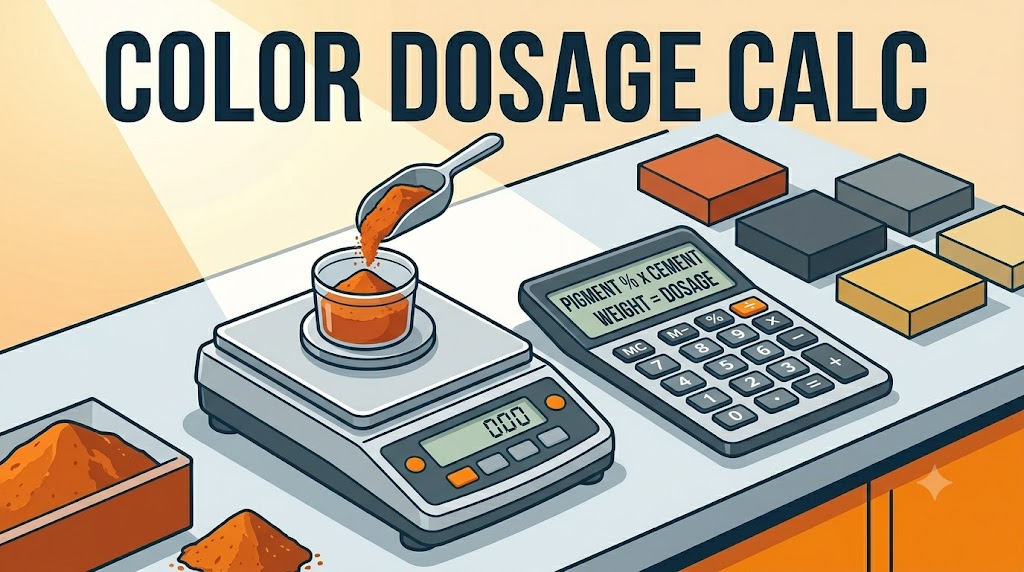
Concrete pigment is dosed as a percentage of the cement weight, not of the concrete volume. Most integral colours fall between 1% and 6% of cement weight, colour stops deepening at around 5–6%, and ASTM C979 caps the dose at 10%. So a mix with 350 kg of cement per m³ coloured at 5% needs 350 × 0.05 = 17.5 kg of pigment per m³ (about 30 lb per yd³).
Key points at a glance
- Formula: pigment weight = cement weight × dosage %. Fly ash and slag count as cement for this purpose.
- Working range: 1–6% for most iron oxide colours. Beyond about 6% you pay for pigment that adds almost no colour.
- Hard limit: 10% of cement weight under ASTM C979.
- Always weigh, never scoop. Pigment powders vary too much in density for volume measures to repeat.
- Water changes colour as much as pigment does. A wetter batch cures paler, so keep the water identical from batch to batch.
On this page: How to calculate dosage · Pigment per bag · Why the percentage matters · Pigment types · What else changes colour · Mixing order · Common mistakes · FAQ
How to calculate concrete pigment dosage
Pigment weight = cement weight × dosage percentage
Two examples, one in each unit system:
- Metric: 350 kg of cement per m³ at 5% = 17.5 kg of pigment per m³.
- US: a 6-sack mix has 564 lb of cement per yd³. At 5% that is 28 lb of pigment per yd³.
US colour charts quote the dose as pounds of pigment per 94 lb sack of cement. Because a sack is close to 100 lb, the two systems nearly match: 2 lb per sack is roughly 2%, 5 lb per sack roughly 5%.
If the mix contains fly ash or slag, base the dose on the total cementitious weight, cement plus those additions. Pigment makers specify it that way because the pigment tints the whole paste, not only the portland cement.
On cost: at an assumed retail price of $3.50–$6.00 per kg ($1.60–$2.70 per lb) for iron oxide, the 17.5 kg in the metric example adds roughly $60–$105 per m³. Pigment prices vary widely by colour and pack size, so check your supplier’s current figure.
If you know your mix ratio but not the cement weight, the Concrete Mix Ratio Calculator or the Cement Quantity Calculator gets you that number first. Then the Concrete Pigment and Color Calculator takes your concrete volume, cement content and a colour intensity from light (1.5%) to maximum (7%), and returns the total pigment, the number of pigment bags to buy and the material cost.
Dosage by colour depth
| Colour depth | Dosage (% of cement) | Pigment per bag of cement |
|---|---|---|
| Light tint | 0.5–2% | 0.25–1.0 kg per 50 kg bag 0.5–1.9 lb per 94 lb sack |
| Medium | 2–4% | 1.0–2.0 kg per 50 kg bag 1.9–3.8 lb per 94 lb sack |
| Dark, near saturation | 4–6% | 2.0–3.0 kg per 50 kg bag 3.8–5.6 lb per 94 lb sack |
| ASTM C979 maximum | 10% | 5.0 kg per 50 kg bag 9.4 lb per 94 lb sack |
General ranges for iron oxide pigments on grey cement. The dose for a named colour comes from the manufacturer’s colour chart.
How much pigment per bag of concrete mix?
Pre-blended bagged concrete is mostly sand and stone, and the cement content is not printed on the bag. As a working estimate, cement makes up roughly 12–15% of the bag, so an 80 lb (36 kg) bag holds about 10–12 lb (4.5–5.5 kg) of cement.
- At 5%: about 0.5–0.6 lb (225–270 g) of pigment per 80 lb bag, or 5–6 lb (2.3–2.7 kg) across a 10-bag pour.
- Retail colour packs: many are sold as “1 lb per bag”. On an 80 lb bag that works out to roughly 8–10% of the cement, which is the strongest shade the product is meant to give. For a lighter colour, use part of the pack and weigh it.
Where the pigment maker prints a per-bag rate, follow it; they have tested it with typical bagged mixes. The Concrete Bags Calculator gives you the bag count so the pigment order scales with it.
Why dosage percentage matters: the chemistry behind colour saturation
Concrete pigments are fine, insoluble mineral particles, not dyes. They are roughly one-tenth the size of cement grains, so they disperse through the cement paste and tint it, and the tinted paste then coats every grain of sand and stone. That is why the dose follows the cement: more paste needs more pigment to reach the same colour, while extra aggregate needs none.
Three things happen as the dose rises:
- Below about 1%, the grey of the cement dominates. You get a tint, not a colour.
- From about 1% to 5%, colour deepens steadily with each addition.
- At around 5–6%, good-quality pigments reach saturation. The paste is as coloured as it can get, and more pigment mostly adds cost.
High doses also affect the concrete itself. Pigment is an extra load of very fine powder, and fine powder needs water to wet it. If that water is added, the water-cement ratio rises and strength falls. ASTM C979 is written around this: at its maximum dose a compliant pigment may not push the water-cement ratio above 110% of the plain mix, drop 28-day strength below 90% of it, or change the air content by more than 1%. It may not speed up setting by more than an hour or delay it by more than an hour and a half. The European standard, EN 12878, has a separate category for pigments used in reinforced concrete, with limits on chlorides and a cap on strength loss.
In practice, that means a certified pigment at normal doses is not a strength problem, provided nobody adds water to compensate. If a heavily pigmented mix is too stiff, use a water reducer; the Concrete Admixture Dosage Calculator works out the dose.
Pigment types and what to know about each
| Pigment | Colours | What to know |
|---|---|---|
| Iron oxide red (Fe₂O₃) | Reds, terracotta, brick | The most widely used pigment. Stable in sunlight and in the alkalinity of cement. |
| Iron oxide yellow (FeOOH) | Buff, tan, gold | Heat-sensitive: products are rated to about 150–175°C / 300–350°F, above which the colour shifts toward red. |
| Iron oxide black (Fe₃O₄) | Greys to charcoal | Becomes a permanent part of the paste. Slightly brownish next to carbon black. |
| Carbon black | Deep, jet black | Two to five times the tinting strength of iron oxide black, but it can leach out and fade unless kept sealed, and it can reduce entrained air. |
| Brown blends | Browns, umbers | Mixtures of red, yellow and black. Shade varies between suppliers, and some contain carbon black. |
| Chromium oxide (Cr₂O₃) | Greens | Considerably more expensive than iron oxides. |
| Cobalt-based | Blues | The most expensive option. Usually paired with white cement. |
| Titanium dioxide | White, lightening | Limited effect in grey concrete. White cement usually brightens a mix more effectively. |
Dosage recommendations vary between manufacturers even within one colour family. Confirm against the data sheet for the product you have bought.
Iron oxide black or carbon black? For exterior concrete, and especially anywhere with freeze-thaw cycles, iron oxide black is the safer choice. It will not leach, and it does not interfere with the air-entraining admixture that protects the slab; see air entrainment in concrete for why that matters. Carbon black gives a deeper black for less money, which suits interior work and surfaces that will stay sealed.
Grey or white cement? Grey cement mutes every colour. The same 5% red that gives a bright terracotta on white cement gives a subdued brick-brown on grey. For pastels, clean yellows, blues and bright reds, white cement is close to essential. It costs noticeably more than grey cement, so it tends to be reserved for decorative work such as stamped slabs, exposed aggregate and countertops.
What else changes the colour besides dosage
Two pours with exactly the same pigment dose can still come out different. These are the usual reasons, in rough order of how often they cause trouble:
- Water content. The most common source of colour variation. A higher water-cement ratio cures paler. Do not add water to one load and not the next, do not sprinkle the surface, and do not finish with a wet trowel or broom.
- Cement and additions. Cement colour varies by brand and plant, and fly ash and slag shift it again. Keep the same cement, the same source and the same proportions for the whole job.
- Finishing. A broom or light texture gives the most uniform colour. Heavy trowelling and changing tools partway through both show up as shade differences.
- Curing method. Water curing, wet coverings and plastic sheeting all cause blotching on coloured concrete. Use a curing compound made for coloured concrete, applied as soon as finishing is done. Our guide to concrete curing covers the methods.
- Calcium chloride. Chloride-based accelerators discolour coloured concrete. Use a non-chloride accelerator if you need one.
- Time. Concrete lightens as it cures and dries. Judge the colour at about 28 days, not the morning after the pour.
Because so many variables are in play, the only reliable preview is a test panel: the same mix, the same finish, the same curing compound and sealer, made by the same crew, and left to cure before anyone approves the colour.
Mixing order: powder and liquid pigments
- Powder, mixing by hand or in a small mixer: blend the pigment thoroughly with the dry materials first. Then add about two-thirds of the water, mix until the colour is even, and add the rest to reach a workable consistency.
- Liquid colour: follow the product instructions, which normally have you stir it into the mixing water. The water in the colour counts as part of the mix water.
- Ready-mix: give the plant the colour name or the dose and let them batch it. Many integral colours come in bags that dissolve in the drum, so the whole bag goes in unopened.
Whatever the method, do it the same way every time. For anything larger than a small slab, one ready-mix load is far easier to keep uniform than a long run of hand-mixed batches; bags vs ready-mix concrete compares the two.
Common mistakes
1. Measuring pigment by volume instead of weight. Pigment powders differ in how densely they pack, and the same powder packs differently when scooped loosely or pressed down. A cup of one colour does not weigh the same as a cup of another. Weigh every dose on a scale that reads to 10 g (¼ oz) or better.
2. Letting the cement content drift between batches. Colour depends on the ratio of pigment to cement. If one batch has 320 kg of cement and the next has 370 kg, the same 16 kg of pigment is 5.0% in the first and 4.3% in the second, and the second will be visibly lighter. The Concrete Batch Calculator keeps every batch in the same proportions.
3. Adjusting the water from batch to batch. This undoes careful weighing faster than anything else. Fix the water quantity and measure it, exactly as you do the pigment.
4. Judging the colour before the sealer goes on. Sealers change the look. A penetrating sealer leaves the surface looking much as it was, while a film-forming acrylic, especially a solvent-based one, deepens the colour and adds sheen. Approve the colour on a sample that has the sealer you intend to use. How to seal concrete explains the types, and the Concrete Sealer Coverage Calculator sizes the order.
5. Curing coloured concrete like plain concrete. Sprinklers, wet burlap and plastic sheeting are fine on a grey slab and leave blotches on a coloured one.
6. Under-ordering pigment. Running short mid-pour means a colour break at the batch line or a reorder from a different production lot that may not match. Buy all the pigment for the job at once, from one lot, with the same overage you allow for the concrete; the Concrete Waste Factor Calculator suggests a margin.
Related calculators you might need
- Concrete Pigment and Color Calculator: total pigment, bags to buy and cost.
- Cement Quantity Calculator: the cement weight your dose is based on.
- Concrete Batch Calculator: identical proportions for every batch.
- Stamped Concrete Calculator: volume and material cost for decorative flatwork. See also stamped concrete vs plain.
- Imperial to Metric Concrete Converter: for a pigment data sheet in one unit system and drawings in the other.
- All mix design calculators.
Frequently asked questions
How much pigment do I add per bag of concrete?
An 80 lb / 36 kg bag of premixed concrete contains roughly 10–12 lb / 4.5–5.5 kg of cement. At a 5% dose that is about 0.5–0.6 lb / 225–270 g of pigment per bag, or 5–6 lb / 2.3–2.7 kg for ten bags. Retail packs labelled “1 lb per bag” give a much stronger shade, around 8–10% of the cement. If your pigment’s data sheet gives a per-bag rate, use that.
Will adding pigment weaken my concrete?
Not noticeably at normal doses, as long as you do not add extra water. Pigments certified to ASTM C979 must keep 28-day strength at 90% or more of the plain mix even at their maximum dose, which can be no higher than 10% of cement weight. The real risk is indirect: pigment makes the mix a little stiffer, someone adds water to loosen it, and the water costs the strength. If strength matters, have the mix designed and tested with the pigment in it.
Does concrete colour fade over time?
Iron oxide pigments are lightfast and do not fade in sunlight. What changes is the surface around them: efflorescence leaves a white film that makes dark colours look washed out, wear exposes sand and stone, and dirt dulls the finish. Carbon black is the exception among pigments, because it can leach out with repeated wetting and drying. Keeping the slab sealed protects against all of these. Resealing intervals depend on the sealer, typically every 1–3 years for acrylics and 3–7 years for penetrating sealers.
Can I mix two pigment colours together?
Yes. Iron oxides are compatible with one another, and most browns and tans are blends of red, yellow and black. Blend the powders dry, record the weights of each so you can repeat it, and keep the combined dose within the 10% limit. Test the blend on a cured, sealed sample before committing, because colour shifts from wet to dry and again under a sealer.
What is the difference between liquid pigment and powder pigment for concrete?
They contain the same pigments. Liquid colour is pigment already dispersed in water, which makes it easy to meter automatically, so ready-mix plants often prefer it. Powder is more concentrated by weight and simpler to store and weigh for site mixing. A litre of liquid colour contains less pigment than a kilogram of powder, so the dose is not interchangeable: use the equivalent given on the product data sheet, and count the water in the liquid as part of the mix water.
When should I judge the final colour?
After about 28 days of curing, and with the sealer applied if you plan to use one. Fresh coloured concrete looks darker and more intense than it will once it has cured and dried, so a slab that seems too strong on day two is usually closer to the sample by the end of the month.
References and standards
- ASTM International, ASTM C979/C979M, Standard Specification for Pigments for Integrally Colored Concrete: maximum dosage and limits on strength, water-cement ratio, setting time and air content.
- British Standards Institution, BS EN 12878, Pigments for the colouring of building materials based on cement and/or lime.
- Concrete Decor, Black is black, or is it?: carbon black compared with iron oxide black.
- Pennsylvania Aggregates and Concrete Association, colored concrete practice sheet: water content, finishing and curing of coloured concrete.
- Sika Scofield, integral color guide: dosage per sack of cementitious material, mock-ups and curing cautions.
Dosage figures on this page are general working ranges for planning. Always confirm the recommended dose on your pigment’s data sheet and test a sample before committing to a full pour, because colour response varies with the cement, the aggregate and the water content even at an identical dose. How we check our figures is set out in our editorial policy.