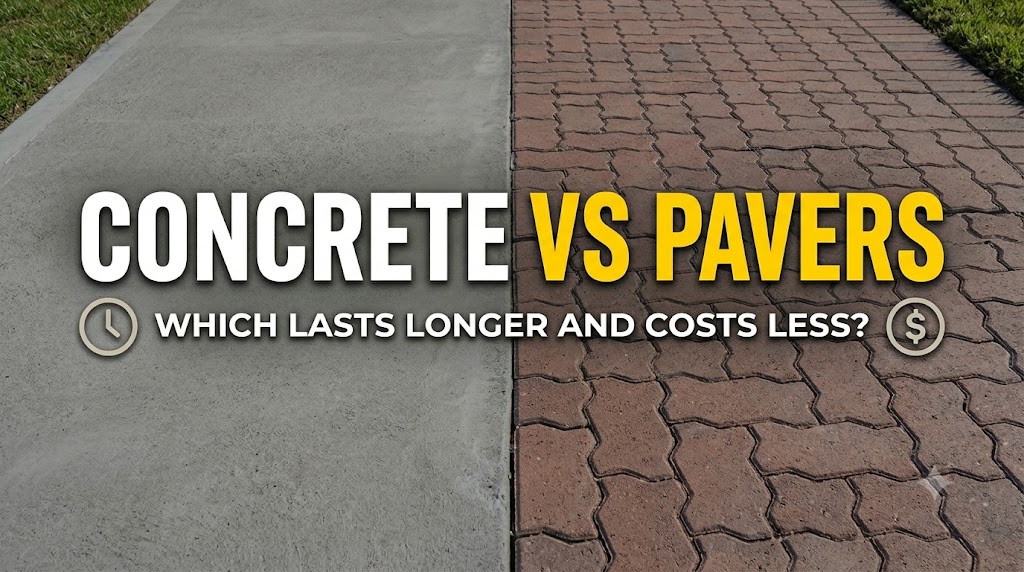
Poured concrete costs $6–$12 per sq ft / £50–£100 per m² installed and lasts 30–50 years. Concrete pavers cost $10–$20 per sq ft / £80–£160 per m² installed and last 25–50 years. Pavers cost more upfront but can be repaired unit-by-unit; a poured slab, once cracked, requires patching or full resurfacing. Which costs less over time depends on soil stability, drainage, and how much aesthetic flexibility matters.
- Concrete wins upfront, pavers often win over 20+ years on unstable, tree-lined, or clay-heavy sites where settlement is likely.
- Base preparation matters more than the surface material for how long either one lasts.
- Pavers repair invisibly; concrete doesn’t — a swapped paver disappears into the pattern, a patched slab rarely matches.
- Never pour concrete directly over an existing paver base — it’s not engineered to support a slab and will crack within a few years.
The Paver Calculator calculates the number of pavers, sand, and base material needed for your area. For poured concrete, use the Concrete Patio Calculator or the Concrete Driveway Calculator depending on the application.
How do poured concrete and pavers compare on cost and durability?
The installed cost gap between pavers and poured concrete ranges from $4 to $8 per sq ft / £30–£60 per m², depending on paver material (concrete pavers vs clay brick vs natural stone) and local labour rates. The table below uses a 400 sq ft / 37 m² patio as a reference.
| Factor | Poured Concrete | Concrete Pavers |
| Installed cost (per sq ft) | $6–$12 | $10–$20 |
| Installed cost (per m²) | £50–£100 | £80–£160 |
| Typical lifespan | 30–50 years | 25–50 years |
| Repair method | Patch or resurface | Replace individual units |
| Repair cost | $3–$5/sq ft resurfacing | $1–$5 per unit replaced |
| Settlement tolerance | Low — cracks under movement | High — re-level individual units |
| Freeze-thaw performance | Good with air entrainment | Good — joints absorb movement |
| Permeable option | Pervious concrete (specialist) | Permeable paver systems |
| Design flexibility | Limited (staining, stamping) | High — colours, patterns, shapes |
| Long-term maintenance | Sealing every 5–10 years | Joint sand replenishment; re-levelling |
Which surface holds up better over time?
Poured concrete is a monolithic surface — its strength comes from continuity. When the subgrade beneath it settles, the slab develops cracks rather than accommodating the movement. In stable soil conditions with a properly prepared base, poured concrete at 4 inches / 100 mm with air entrainment and correct joint placement reaches 30–50 years without significant structural repair — the Concrete Air Entrainment Calculator covers the dosage needed for freeze-thaw climates specifically. In areas with expansive clay soils, tree roots, or frequent freeze-thaw cycling, settlement cracking can appear within 5–10 years.
Pavers distribute loads across individual units joined by compacted sand. When settlement occurs beneath them, individual pavers drop or tilt rather than cracking. A contractor can lift and re-level a settled section, replace damaged units, and tamp the base without disturbing the rest of the surface. This repairability is pavers’ primary structural advantage. The downside is that joint sand requires periodic replenishment — typically every 3–7 years — and weed growth in joints is a maintenance reality unless polymeric sand is used.
In applications where soil stability is questionable — tree-lined areas, clay-heavy sites, or regions with high frost heave — pavers consistently outperform poured concrete on long-term maintenance cost. In stable, well-drained conditions, poured concrete is the lower-maintenance option once installed.
Common mistakes when choosing or installing either surface
Installing pavers on an inadequate base is the most common failure. The paver itself is rarely what breaks — it is the 4–6 inch / 100–150 mm compacted gravel base beneath it that determines longevity. Contractors cutting base depth to reduce cost produce paver installations that begin settling within the first winter. A proper paver base requires compacted crushed aggregate, not just sand, under the bedding layer — the Gravel / Crushed Stone Calculator sizes that base layer, and the Sand Calculator covers the bedding layer on top of it.
Pouring concrete too thin under heavy loads is equally problematic. A 4-inch / 100 mm slab handles standard passenger vehicles. Where SUVs, delivery trucks, or equipment over 3,500 lb / 1,600 kg will park, 5 inches / 125 mm is the minimum. Poured at 3 inches / 75 mm — common when contractors try to save a cubic yard — residential driveways and aprons crack within 3–5 years under vehicle loads.
Skipping polymeric sand on a paver installation is a short-term saving that causes long-term joint problems. Standard jointing sand washes out during rain, allowing weed germination and ant colonisation. Polymeric sand cures to a semi-rigid joint that resists both. The Polymeric Sand Calculator estimates the quantity needed for your joint dimensions and paver pattern.
Ignoring drainage direction on poured concrete leads to surface pooling and accelerated freeze-thaw damage. Concrete surfaces need a minimum slope of 1/8 inch per foot / 1% grade away from structures. Many DIY and some contractor pours fail this basic requirement, resulting in standing water, efflorescence staining, and surface spalling within a few winters.
Related calculators you might need
If you decide on pavers, the Paver Calculator handles unit count, base material, and sand quantities. The Polymeric Sand Calculator covers joint fill quantities based on paver size and pattern. For the concrete route, use the Concrete Patio Calculator to get volume and cost inputs, and the Stamped Concrete Calculator if you want a decorative finish that competes visually with pavers at a lower installed cost. Once a slab is down, the Concrete Sealer Coverage Calculator plans the resealing cycle that keeps it low-maintenance long-term.
Frequently asked questions
Do pavers last longer than concrete?
Both materials have similar potential lifespans — 25–50 years for pavers, 30–50 years for poured concrete. In practice, pavers often outlast poured concrete in real-world conditions because individual units can be replaced without disturbing the whole surface. A cracked concrete slab cannot be repaired invisibly; a cracked paver can be swapped in minutes. Longevity ultimately depends more on base preparation and installation quality than on the surface material.
Are pavers or concrete cheaper for a patio?
Poured concrete is cheaper upfront — $6–$12 per sq ft versus $10–$20 for pavers. For a 400 sq ft / 37 m² patio, this represents a difference of $1,600–$3,200. Over 20–30 years, pavers can be cheaper if the concrete slab requires resurfacing or extensive crack repair, since pavers allow targeted unit replacement rather than surface-wide repair. For flat, stable ground with good drainage, concrete is the better value. For sites with trees, clay soil, or freeze-thaw risk, pavers typically win on 20-year total cost.
What is the main disadvantage of pavers compared to poured concrete?
Cost and maintenance complexity. Pavers cost 1.5–2× more to install. They also require joint sand replenishment every few years, periodic re-levelling if settlement occurs, and regular sweeping to prevent organic debris from establishing in joints. For homeowners who want a surface installed and forgotten, poured concrete sealed every 5–10 years is simpler to maintain.
Can I pour concrete over existing pavers?
In most cases, no — and it is not recommended. Pavers are installed on a sand-and-gravel base that is not engineered for concrete. Pouring concrete over pavers typically produces a slab that cracks within 1–3 years as the sand base beneath shifts. The correct approach is to remove the pavers, properly compact and prepare a concrete subbase, then pour. The Concrete Demolition and Removal Cost Estimator helps budget for the removal phase.
Which surface is better for drainage?
Standard pavers with open joints drain better than solid concrete because water passes through the joints into the base. Permeable paver systems — with wider joints filled with gravel — achieve infiltration rates of 10–50 inches per hour / 250–1,270 mm per hour, which exceeds the capacity of most drainage events. Poured concrete is impermeable unless specifically designed as pervious concrete, a specialist product with coarser aggregate and no fine sand.
Which is easier to repair — pavers or concrete?
Pavers are far easier to repair. A single cracked or stained paver can be removed with two flathead screwdrivers, replaced, and re-sanded in under an hour. Concrete crack repair is more involved — products must be matched to crack width, and unless the underlying cause (settling, joint failure) is addressed, cracks typically return. The Concrete Crack Repair Calculator estimates material quantities if you are repairing an existing slab, and the Concrete Resurfacing Calculator covers the alternative of a full surface overlay rather than a targeted patch.
Cost and lifespan figures above are representative ranges and vary by region, labour market, and site conditions. Get a local quote for an accurate comparison, and consult a contractor or engineer if your site has known drainage, soil, or settlement issues before committing to either surface.