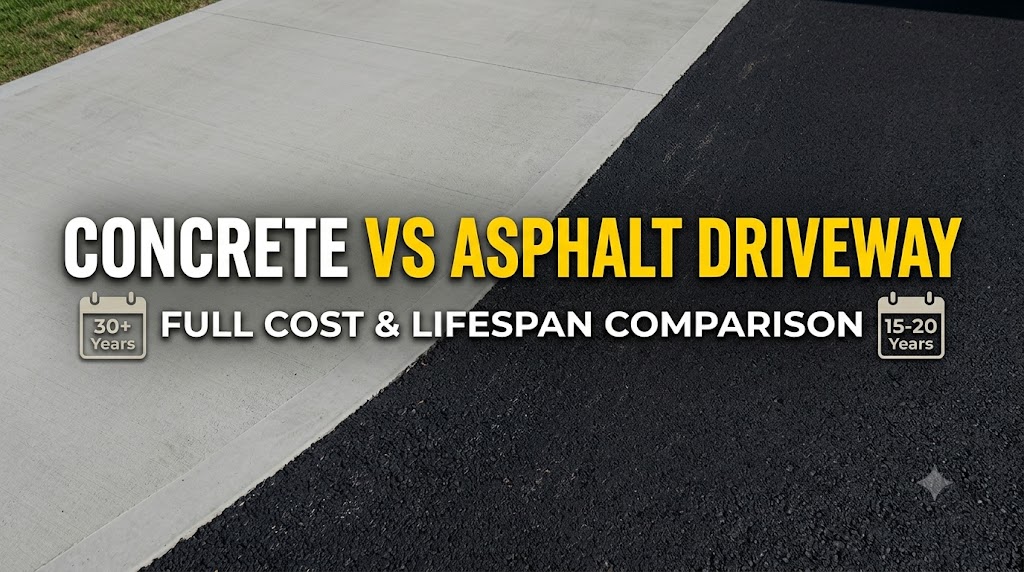
Concrete driveways cost $6–$12 per sq ft / £50–£100 per m² installed and last 30–50 years. Asphalt driveways cost $3–$7 per sq ft / £25–£60 per m² and last 15–30 years. The lower upfront cost of asphalt comes with higher long-term maintenance and a shorter service life — so which one actually costs less depends almost entirely on how long you plan to own the property.
For a standard two-car driveway of 640 sq ft / 60 m², the installed cost difference between the two materials typically ranges from $1,900 to $3,200 / £1,500–£2,500. Use the concrete vs asphalt driveway cost comparison calculator to enter your exact dimensions and get a side-by-side number for your region.
How do concrete and asphalt driveway costs compare?
The cost gap between concrete and asphalt is real but narrower than most homeowners expect once you factor in maintenance cycles. Asphalt requires sealcoating every 3–5 years at $0.15–$0.25 per sq ft ($1.60–$2.70 per m²) and crack filling at intervals throughout its life. Over 30 years, a maintained asphalt driveway accumulates roughly $1,200–$2,000 in maintenance costs for a 640 sq ft surface. Concrete’s 30-year maintenance cost for the same area runs $400–$900, primarily sealing every 5–10 years.
Replacement cost is the other factor. When asphalt reaches the end of its life at 15–20 years, you are looking at full removal and repaving at $3–$6 per sq ft. A concrete driveway on the same timeline may need resurfacing rather than replacement — concrete resurfacing costs typically run $3–$5 per sq ft / £25–£45 per m², versus full tear-out and replacement at $8–$15 per sq ft.
| Factor | Concrete | Asphalt |
| Installed cost (per sq ft) | $6–$12 | $3–$7 |
| Installed cost (per m²) | £50–£100 | £25–£60 |
| Typical lifespan | 30–50 years | 15–30 years |
| Sealcoating required | Every 5–10 years (optional) | Every 3–5 years (required) |
| Crack repair frequency | Low | Moderate–High |
| 30-year maintenance (640 sq ft) | $400–$900 | $1,200–$2,000 |
| Resists oil stains | Yes (sealed) | No — oil degrades asphalt |
| Heat tolerance | Excellent | Softens above 120°F / 49°C |
| Cold/freeze-thaw performance | Excellent, if air-entrained | Good — flexible in cold |
| Colour options | Yes (stained/stamped) | Limited — black only |
Which material lasts longer?
A well-installed concrete driveway with a 4-inch / 100 mm slab, proper subbase, and control joints every 8–12 ft / 2.4–3.7 m will outlast an asphalt driveway by 10–20 years in most climates. The key variable is installation quality: a concrete driveway poured on unstable fill or without adequate reinforcement will fail in under 10 years, while a properly compacted asphalt driveway on a good base can reach 25 years.
Asphalt’s flexibility gives it a genuine edge in freeze-thaw climates when the concrete alternative is not properly specified — asphalt bends slightly with ground movement rather than cracking outright. But this isn’t a fixed material advantage: correctly air-entrained concrete, where the mix includes engineered microscopic air voids to absorb ice expansion, performs excellently through repeated freeze-thaw cycling and is the standard specification for driveways in any climate that freezes. The comparison really comes down to whether the concrete was specified with air entrainment, not an inherent asphalt advantage. Separately, concrete softens far less in summer heat — in regions where ground temperatures exceed 120°F / 49°C, asphalt can rut under heavy vehicle loads, while concrete is more prone to cracking if the subgrade settles unevenly or control joints are improperly placed.
In freeze-thaw climates (most of Canada, the northern US, northern UK, and alpine regions), air-entrained concrete is essential — the entrained air voids accommodate ice expansion. Standard concrete without air entrainment in these climates will begin surface scaling within 5–10 winters.
Common mistakes when choosing or installing either material
Skipping the subbase preparation is the most expensive mistake on either surface. Asphalt and concrete both require 4–8 inches / 100–200 mm of compacted gravel base. Without it, settlement cracks appear within 2–5 years regardless of which surface is on top. This is not a material problem — it is a site prep problem that neither material can compensate for.
Pouring concrete too thin is a common DIY error. The minimum for residential driveways is 4 inches / 100 mm; 5 inches / 125 mm is recommended where vehicles heavier than 3,500 lb / 1,600 kg park regularly. Pouring at 3 inches / 75 mm to save material produces a slab that will crack within the first winter in cold climates or under normal vehicle loads within 3–7 years.
Ignoring expansion and control joints in concrete is another installation failure. Slabs need control joints every 8–12 ft / 2.4–3.7 m to direct cracking. Without them, thermal expansion produces random, uncontrolled cracking across the surface. The concrete expansion joint spacing calculator gives the correct spacing based on slab thickness and local temperature range.
Choosing asphalt based on initial price alone without accounting for maintenance cycles leads to cost shock 5–10 years in. Homeowners who budget only for installation often find that deferred maintenance (letting small cracks grow, skipping sealcoating) accelerates surface deterioration and ultimately requires full replacement sooner than the material’s rated lifespan.
Related calculators you might need
If you are leaning toward concrete, the concrete driveway calculator gives you exact volume, bag count, and ready-mix quantity for your dimensions. For cost modelling, the concrete cost per square foot calculator lets you input local pricing to get a project total. If the driveway is already in place and you are weighing repair against replacement, the concrete resurfacing calculator and the concrete demolition and removal cost estimator give you the numbers to make that call clearly.
Frequently asked questions
Is concrete or asphalt cheaper for a driveway?
Asphalt is cheaper to install — typically $3–$7 per sq ft versus $6–$12 for concrete. Over a 30-year period, concrete is usually cheaper when you account for asphalt’s mandatory sealcoating cycles and earlier replacement. The break-even point is approximately 12–18 years for most regions. Use the concrete vs asphalt driveway cost comparison calculator to model this for your specific driveway size.
How long does a concrete driveway last compared to asphalt?
A properly installed concrete driveway lasts 30–50 years. Asphalt lasts 15–30 years with regular maintenance. In cold climates with hard freeze-thaw cycles, both materials perform closer to the lower end of those ranges unless installed correctly — concrete needs air entrainment, asphalt needs a well-compacted base and regular sealing.
Does concrete crack more than asphalt?
Concrete can crack if control joints are improperly placed or the subgrade settles. Asphalt also cracks but is more flexible, so cracks tend to be smaller and easier to fill in the short term. Over time, asphalt crack damage is cumulative — water enters cracks, erodes the base, and accelerates surface failure. Properly jointed concrete directs cracking to predictable locations and resists moisture penetration better.
Which driveway surface performs better in hot climates?
Concrete performs significantly better in hot climates. Asphalt softens at surface temperatures above 120°F / 49°C, which can cause rutting under parked vehicles. In the US Southwest, Australia, and the Middle East, asphalt driveways frequently show tyre marks and surface deformation in summer. Concrete does not soften in heat and maintains structural integrity across a wider temperature range.
Can I resurface an old concrete driveway instead of replacing it?
Yes, if the existing slab is structurally sound with no deep cracking or significant settlement. Resurfacing overlays typically add 1–2 inches / 25–50 mm of material and cost $3–$5 per sq ft / £25–£45 per m² — considerably less than full replacement. Resurfacing does not fix structural problems underneath; if the base has failed, replacement is the correct approach.
What is the maintenance difference between concrete and asphalt driveways?
Asphalt requires sealcoating every 3–5 years — this is not optional if you want the surface to reach its rated lifespan. Concrete can be sealed every 5–10 years but tolerates neglect better. Asphalt also requires annual inspection and crack filling to prevent water infiltration. Concrete maintenance is primarily cosmetic unless structural cracks develop, which are less common in properly installed slabs.