Author: Concrete Calculator Writing Team

  • Pouring Concrete in Hot Weather: Guide for Gulf, AU & India

    Pouring Concrete in Hot Weather: Guide for Gulf, AU & India

    Above 90°F / 32°C, every stage of concreting accelerates — hydration, evaporation, stiffening. ACI 305R defines hot weather concreting as any combination of high air temperature, low humidity, high wind speed, and solar radiation that produces a concrete evaporation rate above 0.2 lb/ft²/hr (1.0 kg/m²/hr). In the Gulf states, Western Australia, and central India from April to September, that threshold is routinely exceeded by 10 AM.

    Hot weather concreting thresholds and mix temperature limits

    ACI 305R and AS 1379 (Australia) both specify a maximum fresh concrete temperature at point of delivery of 95°F / 35°C. IS 7861 (India) adopts the same figure. The practical target is 85°F / 29°C or below at discharge — every additional degree above 85°F reduces workability by roughly 10–15 mm slump and cuts setting time. Use the Concrete Admixture Dosage Calculator to estimate retarder doses that compensate for temperature-accelerated set.

    Concrete temp at dischargeSet time reduction vs 70°FMax slump retention (min)Key risk
    70°F / 21°C (baseline)90None
    85°F / 29°C~25% faster60Plastic shrinkage cracking begins
    90°F / 32°C~40% faster45Cold joint risk if placement delayed
    95°F / 35°C~60% faster30Flash set, cold joints, structural failure risk
    >100°F / 38°CUncontrolled<20Do not pour without chilled batch water + ice

    Region-specific conditions: Gulf, Australia, and India

    Gulf States (UAE, Saudi Arabia, Qatar, Kuwait)

    The Gulf presents peak concrete placement temperatures of 104–113°F / 40–45°C from June to August, combined with relative humidity ranging from 10% (inland Saudi Arabia) to 85% (coastal UAE). The combination of extreme heat and variable humidity creates radically different evaporation rates day to day. Gulf specification bodies — UAE Fire & Life Safety Code, Qatar Civil Aviation Authority structural standards, and Saudi Aramco Engineering Standard SAES-Q-001 — all require concrete placement temperatures not exceeding 95°F / 35°C and typically mandate pre-cooling of aggregates and batch water.

    Practical measures mandated or strongly recommended in Gulf concrete practice: batch water chilled to 35–40°F / 2–4°C; ice substitution of up to 75% of mix water by mass; aggregate stockpile shading; chilled steel formwork; transit mixer drum insulation; and placement scheduled before 8 AM or after 6 PM. Night pours are common for major placements from June through September.

    Australia (Northern Territory, Queensland, Western Australia)

    Australian Standard AS 1379-2007 and the associated AS 3600 structural concrete code align with ACI 305R on the 35°C maximum delivery temperature. Darwin averages daily maximums of 91–95°F / 33–35°C year-round; Karratha and Port Hedland in WA regularly exceed 104°F / 40°C from November to March. The additional complication in northern Australia is the wet season: relative humidity exceeds 80% from December to March, which reduces evaporation rate but adds bleed water problems and inhibits surface finishing.

    Concrete specifications for major infrastructure projects in the Pilbara and Darwin regions routinely include ice batch water requirements, maximum w/c ratios of 0.40 for durability in cyclone-zone construction, and a minimum 7-day ponding cure rather than curing compound, given the dust and wind conditions.

    How to reduce concrete temperature on-site

    The rule of thumb: every 10°F / 5.5°C reduction in concrete temperature gains approximately 1 extra hour of workable life. Temperature reductions come from the mix components in proportion to their heat capacity and mass. Aggregates make up ~70% of mix mass, so cooling them has the most impact — shading aggregate stockpiles can achieve 5–10°F / 3–6°C reduction alone. Chilled mix water (35°F / 2°C) delivers another 5–8°F / 3–4°C. Replacing part of the mixing water with flake ice provides the most aggressive cooling — ice absorbs 144 BTU/lb (334 kJ/kg) as it melts, compared to only 1 BTU/lb/°F for liquid water.

    Calculate the adjusted mix: the Water-Cement Ratio Calculator accounts for total water contribution including ice. The combined weight of ice + liquid water must equal the total design water content; do not add ice as extra water.

    Common mistakes in hot weather concreting

    1. Adding water at the site to restore slump. Slump lost due to temperature cannot be recovered by adding water without compromising design strength. A w/c increase from 0.45 to 0.52 reduces 28-day compressive strength by approximately 15–20%. Use a mid-range or high-range water reducer (superplasticizer) dosed at the plant to maintain workability without increasing w/c. The Concrete Admixture Dosage Calculator provides correct dosage ranges by admixture type.

    2. Placing concrete on dry, sun-baked subgrade. Hot, dry subgrade absorbs water from the fresh concrete mix at an accelerated rate — effectively reducing the w/c at the base of the slab, which increases bleed water in the upper zone and creates a stratified strength profile. Dampen the subgrade to field capacity (surface is moist, no standing water) immediately before placement, and keep it shaded until placement begins.

    3. Finishing before bleed water evaporates. High ambient temperatures and wind cause the surface to appear ready to finish before bleed water has fully risen. Finishing at this stage traps bleed water and weak laitance near the surface, producing a dusting failure layer within the top 3–5 mm. Wait for bleed water to clear entirely. If the surface stiffens too fast, use an evaporation retarder — not misting — to slow surface drying.

    4. Using Type III (high-early) cement in hot conditions. Type III cement generates significantly more heat of hydration than Type I/II. In hot weather, this amplifies the already-elevated concrete temperature and accelerates set unpredictably. For hot-weather pours, specify Type I/II or Type II (moderate heat) with an SCM replacement (30–40% fly ash or 25–35% slag) to reduce heat of hydration without sacrificing long-term strength.

    Related calculators you might need

    Before ordering concrete for a hot-weather pour, confirm volume requirements precisely with the Concrete Slab Calculator — overage wastes money, but running short and forming cold joints in 40°C heat is a structural problem. The Concrete Curing Time Estimator adjusts the curing timeline for your specific ambient temperature, so you know exactly when traffic loads are safe. For projects where sealing after cure is planned, the Concrete Sealer Coverage Calculator prevents under-application — critical in UV-intense environments like the Gulf and northern Australia where penetrating sealers degrade faster.

    Frequently asked questions

    What temperature is too hot to pour concrete?

    There is no absolute cut-off, but above 95°F / 35°C at the point of discharge, structural risk rises sharply enough that most standards — ACI 305R, AS 1379, IS 7861 — require enhanced controls or cessation of placement. Practically, above 100°F / 38°C ambient air temperature without chilled batching, ice substitution, and night-pour scheduling, meeting specification requirements becomes extremely difficult.

    How do I keep concrete cool in hot weather?

    Cool the ingredients, not the poured concrete. Shade aggregate stockpiles, use chilled batch water (35–40°F / 2–4°C), substitute up to 75% of mix water with flake ice, and schedule placement in early morning or post-sunset hours. White-painted or insulated transit mixer drums reduce temperature gain in transit. Spraying cold water on forms and the subgrade immediately before pour also helps.

    Can I pour concrete in direct sunlight in summer?

    Yes, but it requires active temperature management. Direct solar radiation can increase concrete surface temperature by 10–20°F / 5–11°C above ambient within minutes of placement. Shade the freshly placed surface immediately using shade cloth at 1 ft / 300 mm above the slab — not in contact with it. Apply an evaporation retarder before finishing. Begin wet curing or apply a curing compound within 20–30 minutes of finishing completion.

    What admixtures help in hot weather?

    Set retarders (ASTM C494 Type B or D) are the primary tool — they extend the initial set time by 1–4 hours depending on dosage and ambient conditions. Mid-range water reducers (Type A or F) maintain slump without adding water. For extreme heat, a combination retarder-water reducer (Type D or G) is often specified. In Gulf and Australian practice, carboxylic acid-based superplasticizers are preferred for their temperature stability up to 45°C.

    How long does concrete take to cure in 40°C / 104°F heat?

    Early strength gain is accelerated — concrete may reach 1,500 psi / 10 MPa within 48 hours. However, 28-day strength is reduced by 5–10% versus baseline curing conditions. The Concrete Curing Time Estimator provides a temperature-adjusted curve. Full curing requires continuous moisture retention — at 40°C without curing compound or wet curing, surface moisture loss can halt hydration within 4–6 hours of placement.

  • Concrete Crack Repair: Causes, Types & How to Fix Them

    Concrete Crack Repair: Causes, Types & How to Fix Them

    The repair method for a concrete crack is determined by what caused it, not just how wide it is. A 1/8 inch (3 mm) crack from alkali-silica reaction needs a different fix than an identical-width crack from shrinkage — one is stable, the other is active and will re-open any rigid filler within months.

    Before buying materials, use the Concrete Crack Repair Calculator to estimate filler volume by crack length, width, and depth. Underestimating means a second trip; overestimating means wasted product that has a limited shelf life once opened.

    How to diagnose your crack type before repairing it

    Crack width alone does not tell you what you are dealing with. These four tests take under 10 minutes and determine both cause and correct repair approach.

    Chalk line test (active vs dormant): Draw a chalk line across the crack perpendicular to its length. Check again in 2 weeks. If the line has shifted or the crack has widened, it is an active crack under ongoing movement — rigid fillers will fail. If it is unchanged, the crack is dormant and can be filled with any compatible product.

    Depth check: Push a thin wire into the crack. Hairline cracks less than 1/4 inch (6 mm) deep are surface-level. Cracks penetrating to the full depth of the slab (typically 4 inches / 100 mm for residential slabs) affect structural integrity.

    Staining pattern: Rust-coloured staining along a crack indicates corroding rebar — the steel has expanded and split the concrete. This is not a surface repair issue. The rebar must be exposed, treated for corrosion, and the concrete restored with a structural epoxy mortar or full section replacement.

    Pattern recognition: Map cracks (fine random network, also called crazing or craze cracking) are surface-only and caused by rapid surface drying during curing. They look alarming but are cosmetic. A single long diagonal crack at a slab corner typically indicates differential settlement. Parallel cracks running the length of a driveway panel suggest poor or missing expansion joints.

    Crack types, causes, and correct repair methods

    Crack TypeWidthCauseRepair Method
    Hairline / map cracking< 1/16 in / < 1.5 mmRapid surface drying, over-trowellingConcrete sealer or thin overlay
    Shrinkage crack1/16–1/4 in / 1.5–6 mmNormal drying shrinkage, poor joint placementPolyurethane sealant (flexible)
    Settlement crack> 1/8 in / > 3 mm, steppedSoil movement, poor compactionMudjacking or foam lifting + epoxy fill
    Structural crackVariable, often > 1/4 in / 6 mmOverload, rebar corrosion, freeze-thawEpoxy injection or section replacement
    Expansion joint failureGap at joint faceJoint filler degradedBacker rod + polyurethane or polysulfide sealant

    Hairline and map cracking

    These are the most common and least urgent cracks. No structural action is needed. If sealing for aesthetics, apply a penetrating silane/siloxane sealer that does not film-form over the cracks — acrylic film-forming sealers can highlight crazing by creating a sheen that shows the crack network. For a cleaner finish, a thin polymer-modified overlay at 1/4 inch (6 mm) bonds well to sound concrete and hides the pattern entirely.

    Shrinkage and working cracks

    These need a flexible filler, not a rigid one. Concrete slabs move — thermally, seasonally, and under load. A rigid epoxy filler in a moving crack will debond at the edges within one freeze-thaw cycle in northern climates (Canada, northern US, UK Scotland, Scandinavia). Self-levelling polyurethane sealant (e.g. NP1, Sikaflex 1a) bonds to concrete, remains flexible from -40°F to 200°F (-40°C to 93°C), and accepts foot and vehicle traffic once cured (24–48 hours).

    Prep is non-negotiable: rout the crack to a minimum 1/4 inch (6 mm) wide × 1/4 inch (6 mm) deep U-shaped profile using an angle grinder with a crack chasing blade or a dedicated crack router. Blow out dust and debris. Install backer rod (closed-cell polyethylene foam) to control fill depth — the sealant should fill to 1/4 inch (6 mm) below the surface, not flush. Flush fill causes three-sided adhesion, which prevents proper joint movement and leads to cohesive failure in the sealant.

    Step-by-step repair for the most common crack scenarios

    Dormant hairline crack (< 1/8 in / 3 mm), no movement: Clean with a wire brush and compressed air. Apply a low-viscosity epoxy crack filler (water-thin consistency) that wicks into the crack by capillary action. Spread kiln-dried sand over wet epoxy to match the surrounding surface texture. Cure time: 12–24 hours before foot traffic, 72 hours before vehicle traffic.

    Active shrinkage crack (any width, confirmed movement): Rout to U-profile. Clean. Install backer rod sized 25% wider than the crack (it compresses to fit and holds position). Apply polyurethane sealant by gun, tooling to a concave finish. Do not paint over within 48 hours — most polyurethane sealants need full cure before coating.

    Settlement crack with vertical displacement (stepped crack): Routing and filling the crack alone does not address the cause — one side of the slab has moved and will continue to move unless the substrate is stabilised. Options: polyurethane foam injection (slabjacking) for slabs with void beneath; mudjacking with a cementitious slurry for larger areas. After levelling, seal the filled crack with a flexible sealant to accommodate residual movement.

    Common mistakes that make the repair fail

    Filling without routing. Pouring filler into a raw crack leaves a V-shaped void. The filler bonds only at the surface, with no mechanical key and minimal contact area. It falls out under traffic within weeks. Every crack wider than 1/16 inch (1.5 mm) must be routed or chiselled to a uniform U-profile before filling.

    Using rigid epoxy on an active crack. Epoxy has zero flexibility after cure — typical elongation at break is 2–5% versus 150–300% for polyurethane. Applying epoxy to a crack that still moves (seasonal slab movement in climates with a 40°F / 22°C temperature range is typically 1/16–1/8 inch / 1.5–3 mm across a 10 ft / 3 m slab) guarantees re-cracking at the fill edges within one year.

    Skipping backer rod. Without backer rod, sealant fills the full depth of the crack. This creates a thick bead that is too rigid to flex without tearing, and it wastes expensive sealant. Backer rod controls the depth of sealant to a 1:1 width-to-depth ratio, which is the optimal geometry for joint movement.

    Repairing in cold weather without precautions. Epoxy and polyurethane both have minimum application temperatures: most require 40–45°F (4–7°C) minimum substrate temperature. Applying below this threshold results in poor cure, soft filler, and adhesion failure. In cold conditions, warm the crack with a heat gun immediately before application and tent the area for at least 6 hours during cure.

    Related calculators you might need

    If the crack resulted from an improperly placed or missing joint, the Concrete Expansion Joint Spacing Calculator will give you the correct joint spacing for your slab dimensions and thickness going forward. For a full cost picture — including whether repair vs replacement makes more financial sense — use the Concrete Demolition and Removal Cost Estimator alongside the Concrete Cost Calculator. If you are dealing with settlement and are assessing whether to pour a replacement slab, the Concrete Slab Calculator gives you volume and bag count for any slab dimensions.

    Frequently asked questions

    How do you fix cracks in concrete? The method depends on crack type and activity. Dormant hairline cracks under 1/8 inch (3 mm) are filled with low-viscosity epoxy. Active or wide cracks need routing to a uniform U-profile, backer rod installation, and flexible polyurethane sealant. Structural cracks with vertical displacement require substrate stabilisation before any surface fill.

    Can concrete cracks be permanently fixed? Dormant cracks in stable substrates can be permanently filled — epoxy injections used in structural repair have bond strengths exceeding the tensile strength of the surrounding concrete. Active cracks cannot be “permanently” filled with a rigid product; flexible sealants that accommodate movement are the correct long-term solution and will need replacement every 5–10 years.

    What is the best product for filling concrete cracks? For dormant hairline cracks: low-viscosity epoxy. For active or wide cracks: self-levelling polyurethane sealant (NP1, Sikaflex, or equivalent). For structural cracks requiring load transfer: two-component epoxy injection system. There is no single best product — the crack type dictates the chemistry required.

    How wide does a concrete crack have to be before it is structural? There is no single threshold, but cracks wider than 1/4 inch (6 mm), cracks with vertical displacement (one side higher than the other), and cracks associated with rebar staining all warrant engineering assessment before repair. Width alone is a poor indicator — a narrow crack caused by rebar corrosion is a structural issue regardless of its opening width.

    How long does concrete crack repair last? Epoxy fills in dormant cracks: 10–20 years if properly prepared. Polyurethane sealants in active joints: 5–10 years, depending on movement cycles and UV exposure. Repairs that fail within 1–2 years almost always trace back to inadequate surface preparation or wrong product selection. Use the Concrete Crack Repair Calculator to estimate material quantities before starting.

  • How to Seal Concrete: Products, Coverage Rates & Application

    How to Seal Concrete: Products, Coverage Rates & Application

    Most concrete surfaces need sealing within 28 days of curing — and then every 1–5 years depending on product type, traffic, and exposure. Skip this step and you get water infiltration, freeze-thaw spalling, staining, and surface degradation that shortens slab life by a decade or more.

    Before ordering sealer, calculate your coverage needs precisely. The Concrete Sealer Coverage Calculator takes your surface area and selected product type and returns exact gallons (or litres) required, including a standard 10% waste factor for edges and re-coat overlap.

    Which concrete sealer do you actually need?

    The sealer category determines everything: penetration depth, surface sheen, durability, and whether you need to strip and reapply or can simply recoat. The four main types are not interchangeable.

    Sealer TypeMechanismBest ForReapply Interval
    Acrylic (solvent-based)Surface filmDriveways, patios, decorative concrete1–3 years
    Acrylic (water-based)Surface filmIndoor slabs, low-traffic areas1–2 years
    Penetrating silane/siloxaneSubsurface absorptionExposed aggregate, pavers, bridge decks3–7 years
    PolyurethaneThick surface filmGarage floors, commercial floors3–5 years
    EpoxyChemical bond surface coatWarehouses, workshops, high-load floors5–10 years

    Solvent-based acrylics penetrate slightly better and enhance colour more aggressively than water-based equivalents — useful on stamped or exposed aggregate surfaces. But they off-gas VOCs, require solvent cleanup, and are restricted in some US states (California, specifically). Water-based acrylics are lower-odour and clean up with water, but offer less UV resistance on outdoor surfaces.

    Penetrating sealers (silane, siloxane, or blended silane-siloxane) do not form a film — they chemically react with calcium silicate in the concrete and become part of the matrix. The surface looks unchanged after application. These are the right choice anywhere you need water repellency without altering appearance: exposed aggregate driveways, stamped concrete in HOA-controlled communities, or architectural concrete where sheen would look wrong.

    Coverage rates and how much sealer to buy

    Coverage varies by product and surface porosity. Manufacturers publish theoretical coverage rates, but actual coverage on rough or porous concrete is 30–50% lower than the label figure.

    Product TypeTheoretical CoveragePractical Coverage (rough/porous)Coats Required
    Solvent acrylic200–300 sq ft/gal (4.9–7.4 m²/L)150–200 sq ft/gal (3.7–4.9 m²/L)2
    Water-based acrylic250–400 sq ft/gal (6.1–9.8 m²/L)200–300 sq ft/gal (4.9–7.4 m²/L)2
    Silane/siloxane penetrating100–200 sq ft/gal (2.5–4.9 m²/L)80–150 sq ft/gal (2.0–3.7 m²/L)1–2
    Polyurethane300–400 sq ft/gal (7.4–9.8 m²/L)250–350 sq ft/gal (6.1–8.6 m²/L)2
    Epoxy200–250 sq ft/gal (4.9–6.1 m²/L)150–200 sq ft/gal (3.7–4.9 m²/L)2

    Worked example: a 500 sq ft (46.5 m²) driveway sealed with a solvent-based acrylic at a practical rate of 175 sq ft/gal needs 500 ÷ 175 = 2.86 gallons per coat, or roughly 6 gallons total for two coats. Add 10% for waste and you are ordering 6.6 gallons — round up to 7.

    Step-by-step application: what the manufacturer instructions skip

    Surface preparation

    New concrete must cure for a minimum of 28 days before sealing — 3 days is inadequate regardless of what some product labels suggest. The slab needs to reach full hydration so sealer does not trap bleed water or inhibit strength gain. On existing concrete, remove all oil stains with a degreaser, acid-etch efflorescence with a 10% muriatic acid solution (diluted 1:10 with water), and pressure wash at 3,000 psi (207 bar) minimum. Allow 24–48 hours of drying time after washing — moisture in the slab will cause acrylic sealers to turn white (blushing).

    Application method by product type

    Solvent-based acrylics: apply with a 3/8 inch (9.5 mm) nap roller or pump sprayer. Rollers give better penetration on rough surfaces. Work in 10 ft (3 m) sections and maintain a wet edge to avoid lap marks. For stamped concrete, a pump sprayer followed by a short-nap roller works back-coded sealer into the pattern grooves.

    Penetrating sealers: low-pressure pump sprayer only — rollers spread the product too thinly for absorption. Apply liberally until the surface is wet but not puddling. Wipe back any excess with a dry brush within 15–20 minutes to avoid surface crystallisation.

    Polyurethane and epoxy coatings: these require two-part mixing (for epoxy) or careful humidity control (for polyurethane, which reacts with atmospheric moisture). Apply at temperatures between 50°F and 90°F (10°C and 32°C). Do not apply polyurethane if humidity exceeds 85% — the coating will bubble.

    Common mistakes that waste product and wreck the finish

    Applying to wet concrete. Blushing — the white, cloudy film that appears under acrylic sealers — is almost always caused by residual moisture in the slab. Wait 48 hours after any rain or washing. Test with plastic sheeting: tape a 18 x 18 inch (450 x 450 mm) sheet to the concrete for 16 hours. If condensation forms underneath, it is too wet to seal.

    Over-applying in one heavy coat. One thick coat traps solvent and creates a sticky, peeling finish. Two thin coats at the correct coverage rate bond better and last longer. Allow the first coat to tack off (30–60 minutes for acrylics) before applying the second.

    Sealing over contaminated concrete. Engine oil and food grease polymerise into the concrete surface. Sealer applied over them creates a film that peels in sheets within months. Use a commercial degreaser at full concentration, scrub with a stiff-bristle brush, and rinse. A simple water rinse does nothing to oil — you need the degreaser.

    Using the wrong sealer for the exposure. Acrylic sealers on garage floors exposed to road salts and fuel spills fail within 18 months. Polyurethane or epoxy coatings are the minimum for vehicle traffic. Penetrating sealers are not decorative products — applying one expecting a sheen produces no visible result.

    Related calculators you might need

    If you are sealing a freshly poured slab, start with the Concrete Slab Calculator to confirm your pour volume before moving to sealer quantities. For stamped concrete specifically, the Stamped Concrete Calculator factors in pattern complexity and base slab area together. If you are pricing the full job, the Full Concrete Project Estimator covers materials, labour, and finishing costs in one pass. For resurfacing older concrete before sealing, the Concrete Resurfacing Calculator estimates overlay material quantities by area and depth.

    Frequently asked questions

    How long after pouring concrete can I seal it? Wait a minimum of 28 days. Concrete reaches approximately 70% of its design strength at 7 days and continues hydrating for months. Sealing too early traps bleed water and inhibits hydration, which reduces surface strength and causes the sealer to delaminate.

    How many coats of concrete sealer do I need? Film-forming sealers (acrylic, polyurethane, epoxy) require two coats. The first coat partially absorbs into the surface; the second builds the protective film. Penetrating sealers are typically one coat on smooth concrete, two coats on porous or rough surfaces. More than two coats of acrylic traps solvent and creates a peeling film.

    What is the coverage rate for concrete sealer? Expect 150–300 sq ft per gallon (3.7–7.4 m²/L) depending on product and surface porosity. Smooth, dense concrete covers at the high end; rough, open-textured surfaces absorb more and cover less. Use the Concrete Sealer Coverage Calculator to get a project-specific quantity with waste factor included.

    Can I seal concrete myself or do I need a contractor? Acrylic sealers are routinely applied by homeowners. The process — surface prep, roller or sprayer application, two coats — requires no specialist equipment. Epoxy coatings on garage floors are also DIY-feasible but demand more precise mixing and faster application. Two-part polyurethane and commercial-grade coatings benefit from contractor application due to pot life limitations and humidity sensitivity.

    Why is my concrete sealer turning white and cloudy? This is blushing, caused by moisture trapped under the sealer film during application. The fix depends on severity: light blushing on acrylics sometimes resolves as the moisture escapes through a thin film. Heavy blushing requires stripping the sealer with a xylene solvent or chemical stripper, allowing the slab to dry completely (48–72 hours minimum), and reapplying.

    How long does concrete sealer last? Acrylic sealers last 1–3 years on driveways with vehicle traffic. Penetrating silane/siloxane sealers last 3–7 years. Polyurethane coatings last 3–5 years. Epoxy floor coatings last 5–10 years but are susceptible to UV yellowing if not topcoated with polyurethane.

  • Stamped Concrete vs Plain: Cost and Finish Comparison

    Stamped Concrete vs Plain: Cost and Finish Comparison

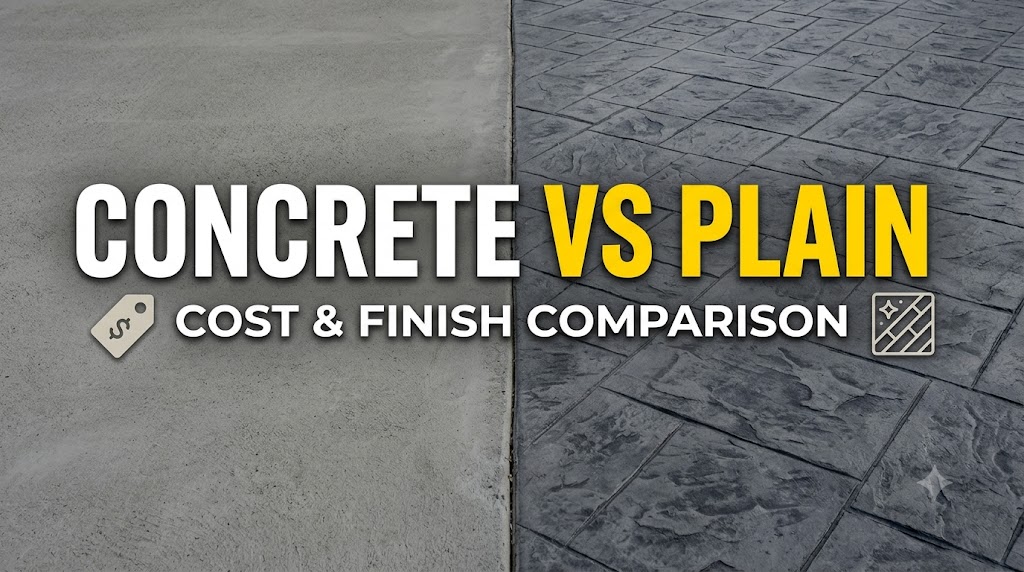
    Stamped concrete costs $12–$22 per sq ft ($129–$237 per m²) installed, versus $5–$8 per sq ft ($54–$86 per m²) for plain broom-finished concrete. The gap is driven by colour hardener, release agent, stamps, and significantly more labour — not by any difference in the underlying mix design.

    To compare your specific project, run both scenarios through the Stamped Concrete Calculator and the Concrete Cost per Square Foot Calculator. The gap widens with pattern complexity, number of colours, and total area — smaller jobs absorb the stamp setup cost less efficiently.

    Side-by-side cost and specification comparison

    FactorStamped ConcretePlain Broom-Finished Concrete
    Installed cost (US)$12–$22/sq ft ($129–$237/m²)$5–$8/sq ft ($54–$86/m²)
    Installed cost (AU)AUD $110–$195/m²AUD $65–$90/m²
    Installed cost (UK)£85–£150/m²£45–£75/m²
    Materials premium+$3–$6/sq ft for colour, release, sealerStandard concrete only
    Labour hours (500 sq ft / 46 m²)40–60 hours (crew of 3)16–24 hours (crew of 2)
    Sealing requirementEvery 1–3 years (mandatory)Every 3–5 years (recommended)
    Lifespan (well maintained)25–40 years30–50 years
    Repair visibilityHigh — colour matching is difficultLow — patches blend with grey
    Slip resistanceModerate (pattern-dependent)Good (broom finish)
    Freeze-thaw performanceMore susceptible (sealer critical)More resilient

    What drives the cost difference between stamped and plain concrete?

    Materials

    The underlying concrete mix is identical — typically 3,000–4,000 psi (20–28 MPa) for residential flatwork. The cost difference comes from three finishing materials that plain concrete does not require:

    Colour hardener: Broadcast dry-shake colour hardener hardens the surface to 6,000–8,000 psi (41–55 MPa) and provides the base colour. Applied at 60–100 lbs per 100 sq ft (2.9–4.9 kg/m²), it costs $0.80–$1.50 per sq ft ($8.60–$16.15 per m²) for materials.

    Release agent: Powder or liquid release prevents stamps from bonding to the fresh concrete while adding a secondary accent colour. At 1 lb per 10 sq ft (0.49 kg/m²), it adds $0.30–$0.60 per sq ft ($3.25–$6.45 per m²)

    Sealer: Stamped concrete must be sealed immediately after finishing to protect the colour and pattern. Acrylic sealer costs $0.20–$0.50 per sq ft ($2.15–$5.40 per m²) in materials per application and needs reapplying every 1–3 years. A 500 sq ft (46.5 m²) driveway accumulates $500–$1,250 in sealer costs over a decade — an ongoing expense that plain concrete largely avoids.

    Labour

    Stamping requires a full crew working quickly: concrete is stampable for approximately 20–40 minutes depending on temperature and mix design, and the entire surface must be stamped in one continuous operation. Each tool (stamp mat) covers 2–4 sq ft (0.19–0.37 m²). A 500 sq ft (46.5 m²) patio requires constant, coordinated work from at least 3 experienced finishers. A broom finish on the same slab needs 2 workers and a fraction of the skill. Labour accounts for 50–60% of the total cost premium for stamped work.

    Finish options and where each works

    FinishAppearanceTexture / Slip ResistanceBest Application
    Broom finish (plain)Uniform grey, parallel linesHigh — 5 mm groovesDriveways, sidewalks, utility slabs
    Exposed aggregate (plain)Stone texture, varied colourHigh — natural stone profilePool decks, walkways, patios
    Stamped — ashlar slateLarge stone blocksModerate — shallow texturePatios, courtyards
    Stamped — cobblestone/fanInterlocking round patternModerateDriveways, walkways
    Stamped — wood plankTimber board grain effectLow to moderatePool decks, covered patios
    Stamped — flagstoneIrregular natural stoneModerateGarden paths, patios

    Exposed aggregate is often the better choice when you want visual interest at closer to plain concrete cost. It achieves texture through washing the surface before cure to expose the coarse aggregate — no stamps, no colour hardener, just a surface retarder and pressure washing. Installed cost is typically $6–$10 per sq ft ($65–$108 per m²), splitting the difference between plain and stamped.

    Where stamped concrete fails and plain concrete holds up

    Freeze-thaw cycling is the primary durability weakness of stamped concrete. Colour hardener is broadcast on the surface — it is not a full-depth treatment. Surface delamination (the hardener layer separating from the base concrete) occurs when water infiltrates and freezes beneath the hardened cap. This is most common in USDA hardiness zones 5 and below (Canadian prairies, northern US states, most of the UK outside London).

    Sealing prevents the problem when done on schedule. Miss one cycle — a missed re-seal after winter — and spalling can begin within one season. Plain broom-finished concrete does not carry this vulnerability because there is no applied surface layer to delaminate.

    Repair is the other significant practical difference. A cracked or spalled section of plain grey concrete is repaired with a colour-matched patch — which is to say, grey concrete. It blends. A matching repair on stamped concrete requires the same colour hardener, the same release agent, the same stamp pattern, and an experienced finisher. Even then, new vs weathered colour is visible for years. Do not choose stamped concrete for any application where heavy vehicle loads, point loads from heavy equipment, or tree root intrusion is likely.

    Common mistakes when choosing between stamped and plain concrete

    Choosing stamped without accounting for ongoing maintenance cost. The installed price is the headline figure, but a 500 sq ft (46.5 m²) stamped driveway that needs sealing every 2 years at $0.40/sq ft materials plus 4 hours labour adds up to $1,000–$1,500 in maintenance costs per decade. Over 20 years, that narrows the gap with higher-end alternatives like pavers significantly.

    Specifying stamped concrete in a freeze-thaw climate without a sealing commitment. This is the most common failure path. If you will not reliably seal every 1–2 years, the correct choice in a northern climate is plain concrete or exposed aggregate — both of which are more tolerant of the occasional missed maintenance cycle.

    Using standard concrete mix for stamped work. Stamped concrete should be specified at 4,000 psi (28 MPa) minimum with a water-cement ratio below 0.45 and no more than 3–4 inches (75–100 mm) of slump. High-slump, wet mixes reduce colour hardener bond strength and increase bleed water — both of which cause finish defects. Contractors who quote low prices often achieve them by pouring a cheaper, wetter mix.

    Underestimating the repair cost at the quote stage. A cracked stamped panel is not a $50 fix. Matching and re-stamping a 4 sq ft (0.37 m²) section can cost $200–$400 in labour alone because of the colour matching, mobilisation for a small job, and skill required. Factor realistic repair contingency into your project budget.

    Related calculators you might need

    If you are still deciding on scope, the Concrete Patio Calculator and Concrete Driveway Calculator give you base concrete volumes for the most common stamped applications. For a full financial comparison that includes labour, materials, and delivery, run both options through the Full Concrete Project Estimator. If you are comparing stamped concrete against an asphalt driveway instead, the Concrete vs Asphalt Driveway Cost Comparison runs both scenarios side by side.

    Frequently asked questions

    Is stamped concrete worth the extra cost? For patios and decorative applications where aesthetics drive value: generally yes, if you maintain it. For driveways in cold climates or anywhere you are unlikely to seal consistently: probably not. The 2x–3x cost premium buys appearance only — the underlying structural performance is identical. Exposed aggregate is worth considering as a middle option.

    How long does stamped concrete last? A well-maintained stamped slab lasts 25–40 years. The colour hardener surface layer starts to show wear at 10–15 years without regular sealing, at which point resurfacing or full replacement becomes the only realistic options. Plain concrete in the same conditions lasts 30–50 years

    Can stamped concrete be repaired to match the original? Partially. Colour matching is the primary obstacle — concrete colour changes as it ages and as the sealer weathers. A repair done within 2–3 years of the original pour has a reasonable chance of matching. After 5+ years, an exact match is effectively impossible. Some contractors mitigate this by resealing the entire surface after a repair to create uniform colour across old and new material.

    What PSI concrete is used for stamped concrete? A minimum of 4,000 psi (28 MPa) is recommended for stamped concrete, which is the same specification used for garage floors and light commercial flatwork. Residential plain concrete is often poured at 3,000 psi (21 MPa). The higher strength specification helps the colour hardener bond properly and reduces the likelihood of surface delamination under freeze-thaw cycling.

    Does stamped concrete get slippery when wet? It can. Deep-pattern stamps (cobblestone, rough slate) have sufficient texture for safe foot traffic when wet. Shallow patterns (wood plank, smooth stone) approach the slip resistance of polished stone — which is to say, dangerous around pool areas when wet. If the application is a pool deck, specify an anti-slip additive in the sealer or choose a deep-texture pattern. Use the Concrete Pool Deck Calculator if you are pricing a pool surround.

  • Bags vs Ready-Mix Concrete: Which Saves More Money?

    Bags vs Ready-Mix Concrete: Which Saves More Money?

    Ready-mix concrete is cheaper per cubic yard once you cross approximately 1 cubic yard (0.76 m³) of material — but that threshold shifts depending on local delivery fees, short-load surcharges, and your labour costs. Below that volume, bagged concrete is typically the lower total-cost option when all factors are included. Neither answer applies universally; the correct choice depends on your volume, your location, and whether you’re supplying your own labour.

    The real cost comparison: materials, delivery, and labour

    Ready-mix is quoted per cubic yard or per cubic metre from the plant. In the US, ready-mix prices in 2024 ranged from $125–$180 per cubic yard for standard 3,000 PSI / 20 MPa residential mix, with significant regional variation. Delivery adds $75–$150, and most plants charge a short-load fee of $40–$100 per cubic yard under the minimum (usually 5–8 yd³). A 2 yd³ pour from a plant with a 5 yd³ minimum can therefore attract $120–$300 in short-load surcharges alone.

    Bagged concrete (3,000–4,000 PSI / 20–27 MPa general purpose mixes) runs $5–$7 per 60 lb bag (US retail) and yields 0.45 cu ft per bag. At that price, 1 cubic yard from bags costs approximately $350–$475 in materials — versus roughly $200–$250 delivered for the same volume in ready-mix (materials + delivery amortised, no short-load). Use the Ready-Mix vs Bagged Concrete Cost Calculator to run this comparison at your local prices.

    Labour is the variable most DIYers undercount. Mixing 45 bags of concrete by hand (the quantity for 1 cubic yard) takes 2–3 hours with a rented electric mixer and 4–5 hours by hand. At a contractor labour rate of $45–$65/hr, that makes bagged concrete cost-equivalent to ready-mix at volumes well under 1 yd³.

    Cost scenarios side by side

    The table below shows total estimated project costs across four volume scenarios using 2024 US national averages. Ready-mix delivery cost assumed $100 flat; short-load fee assumed $60/yd³ for loads under 5 yd³; labour at $50/hr.

    VolumeBags (materials only)Bags (+ labour)Ready-Mix (+ delivery)Verdict
    0.25 yd³ (0.19 m³)~$95~$170$175–$280 (short-load)Bags
    0.5 yd³ (0.38 m³)~$185~$285$215–$300 (short-load)Bags or toss-up
    1 yd³ (0.76 m³)~$370~$520$225–$340 (short-load)Ready-mix
    5 yd³ (3.8 m³)~$1,850~$2,850$900–$1,100 (no short-load)Ready-mix

    These figures are directional. For an accurate number at your location, the Concrete Cost Calculator allows input of local material prices, delivery rates, and labour costs and returns total project cost in both scenarios.

    When bags win — and when they don’t

    Bags are the right choice when:

    The pour is under 0.5 yd³ (0.38 m³) and you can supply the labour. Patch repairs, single post holes, small steps, and equipment pads under 10 sq ft (0.93 m²) all fall here. Bags also win when site access prevents a truck: steep or narrow driveways, backyards accessible only through a gate, and upper-floor deck footings where wheelbarrows can’t reach the pour.

    Bags also give you control over timing. You can mix one bag at a time and work at your own pace — important in hot weather when ready-mix begins to set within 60–90 minutes of discharge. For coloured or decorative work, bagged mixes allow consistent pigment-to-concrete ratios across the job; the Concrete Pigment/Color Calculator helps maintain colour consistency batch-to-batch.

    Ready-mix is the right choice when:

    Volume exceeds 1 yd³ (0.76 m³), the pour needs to be placed and finished within a tight window, or the specification calls for a mix design that isn’t available in bagged form — such as air-entrained concrete for freeze-thaw climates, low water-cement ratio structural mixes, or fibrous concrete. Ready-mix also reduces physical labour significantly: a 5 yd³ pour from bags involves moving, cutting, and mixing 225 × 60 lb bags.

    The short-load fee — the cost most people miss

    Ready-mix plants set minimum loads of 5–8 cubic yards (3.8–6.1 m³). Orders below the minimum are subject to a short-load fee, typically structured as a per-yard penalty for each yard below the minimum. A plant with a 7 yd³ minimum and a $55/yd³ short-load fee will charge an extra $275 on a 2 yd³ order — pushing the effective material cost from $150/yd³ to $287.50/yd³.

    The Short Load Fee Estimator calculates this exact penalty for your plant’s pricing structure. In many cases, combining a driveway approach with a walkway repair or adding a small pad to reach the minimum order threshold is cheaper than paying the surcharge.

    Common mistakes when choosing between bags and ready-mix

    1. Ignoring the short-load fee when pricing ready-mix. Most online ready-mix quotes are for full truckloads. Call the plant and ask for their minimum order and short-load rate before comparing. A $130/yd³ quoted price can become $230/yd³ effective cost on a small pour.

    2. Underestimating how many bags 1 cubic yard actually is. 45 × 60 lb bags weigh 2,700 lb (1,225 kg). Mixing that by hand in summer heat is not a practical option for most people. Rent a towable mixer for any job over 20 bags.

    3. Buying bagged concrete retail when a contractor can access trade pricing. Contractors frequently pay $3.50–$4.50 per 60 lb bag through builders’ merchants — 30–40% less than retail box store pricing. If you’re a contractor comparing bids, use trade pricing in your calculations.

    4. Not accounting for bag waste and partial mixes. The last bag on a job is almost always a partial — wet concrete left in the mixer or mixing trough that hardens before it can be used. Budget 1–2 extra bags per 10 bags ordered for small pours.

    Related calculators you might need

    Before committing to either option, verify your volume estimate with the Concrete Slab Calculator or the relevant project-specific tool. Once you know your volume, the Concrete Bags Calculator converts it into bag counts for 40 lb, 60 lb, and 80 lb bags so you can check pricing at your local supplier. For the delivery side of the equation, the Concrete Delivery Cost Calculator estimates total ready-mix costs including plant price, delivery fee, and short-load surcharge. And if you want to see both options summarised against your full project scope, the Full Concrete Project Estimator rolls materials, delivery, and labour into one number.

    Frequently asked questions

    At what volume does ready-mix become cheaper than bags?

    The crossover point is typically 0.75–1.25 cubic yards (0.57–0.95 m³) in most US markets when you include short-load fees and labour. In markets with high retail bag prices (UK, Australia), ready-mix becomes competitive even below 0.5 m³. Short-load fees push the crossover point higher — the heavier the penalty, the more bags make sense for mid-range volumes of 1–2 yd³.

    How many 60 lb bags equal a yard of concrete?

    Approximately 45 bags at the standard yield of 0.45 cu ft per bag. If you’re mixing by hand rather than with a mechanical mixer, budget 50 bags (about 11% extra) to account for uneven water addition and mixing losses. For 80 lb bags, the equivalent is approximately 34 bags per cubic yard.

    Does bagged concrete have the same strength as ready-mix?

    Standard general-purpose bagged concrete mixes (e.g. Quikrete 5000, Sakrete High Strength) are rated at 4,000–5,000 PSI / 27–34 MPa at 28 days, which meets or exceeds the 3,000 PSI / 20 MPa minimum for residential driveways and footings. Where bagged mixes fall short is in specialty applications: air entrainment for freeze-thaw resistance, low-shrinkage mixes, and high-early-strength formulations are difficult to achieve reliably from bags.

    Is it worth renting a concrete mixer for a small job?

    Yes, above 15 bags (roughly 0.33 yd³ / 0.25 m³). Mixer rental runs $50–$85/day from most tool hire companies. The labour time savings more than justify the cost, and mechanical mixing produces a more consistent water-cement ratio than hand mixing — which directly affects final strength. Don’t mix more than 2–3 bags at a time in a standard 3.5 cu ft drum mixer.

    What does a short-load fee typically cost?

    Short-load fees vary by plant, but typical structures in the US charge $40–$75 per cubic yard under the minimum order. A plant with a 6 yd³ minimum and a $60/yd³ short-load rate will add $240 to a 2 yd³ order. Some plants charge a flat short-load fee of $100–$200 regardless of how far below the minimum you are. Always confirm the exact fee structure before ordering.

  • Concrete Patio Planning: Size, Thickness & Cost Guide

    Concrete Patio Planning: Size, Thickness & Cost Guide

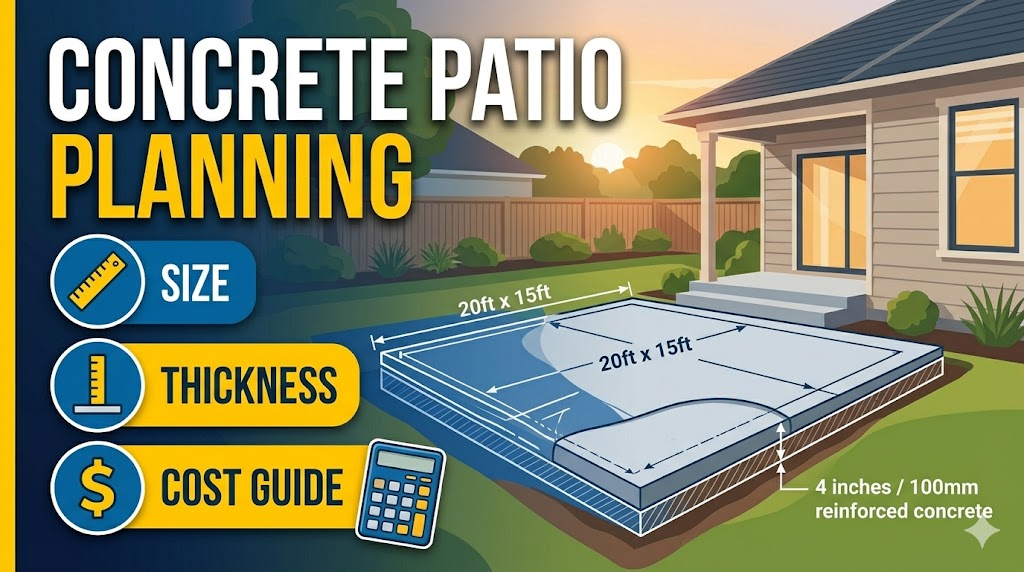
    A standard residential concrete patio — 12 ft × 16 ft (3.6 × 4.9 m) at 4 inches (100 mm) thick — requires 2.9 cubic yards (2.2 m³) of concrete and costs $1,400–$2,800 installed, depending on location, finishes, and reinforcement. That range is wide because finishing choices (broom, exposed aggregate, stamped) vary in both material and labour cost more than the concrete itself. Understanding which variables drive cost gives you actual control over your budget.

    Calculating concrete volume for a patio

    The formula is: Volume = Length × Width × Thickness. For imperial: convert thickness from inches to feet (divide by 12). For metric: convert thickness from mm to metres (divide by 1000).

    Example — imperial: 14 ft × 20 ft × 4 in thick = 14 × 20 × 0.333 = 93.3 cu ft ÷ 27 = 3.46 yd³. Add 10% waste: order 3.8 yd³.

    Example — metric: 4.3 m × 6.1 m × 100 mm = 4.3 × 6.1 × 0.1 = 2.62 m³. Add 10% waste: order 2.9 m³.

    The Concrete Patio Calculator handles both unit systems and outputs volume in cubic yards and cubic metres, plus bag counts and estimated cost ranges. Enter your patio dimensions and it returns the order quantity with waste factored in.

    Recommended patio sizes — and how they affect concrete volume

    ‘What size should my patio be?’ is a function of intended use. The table below shows common functional sizes with corresponding concrete volumes at 4 inches (100 mm) thick, the standard for pedestrian patio applications. All volumes include 10% waste.

    Use CaseRecommended SizeArea (sq ft / m²)Volume (4 in / 100 mm)
    Small seating area (2 chairs)8×10 ft / 2.4×3 m80 sq ft / 7.4 m²1.1 yd³ / 0.82 m³
    4-person dining set12×12 ft / 3.6×3.6 m144 sq ft / 13.4 m²2.0 yd³ / 1.5 m³
    6–8 person dining + grill14×20 ft / 4.3×6.1 m280 sq ft / 26 m²3.8 yd³ / 2.9 m³
    Large entertaining patio20×30 ft / 6.1×9.1 m600 sq ft / 55.7 m²8.1 yd³ / 6.2 m³
    Pool surround (rectangular)12 ft border / 3.6 m border480 sq ft / 44.6 m²6.5 yd³ / 5.0 m³
    Covered porch slab10×16 ft / 3×4.9 m160 sq ft / 14.9 m²2.2 yd³ / 1.7 m³

    A 10 ft clearance on all sides of an outdoor dining table is the practical minimum for comfortable movement. Tables up to 42 inches (1.06 m) wide need 5 ft (1.5 m) of clear space on the chair-pull side.

    Patio thickness: when 4 inches is enough and when it isn’t

    Standard 4 inch / 100 mm slab

    4 inches / 100 mm is correct for patios with pedestrian use only — seating areas, dining, outdoor kitchens that won’t see vehicle access. This thickness meets the ACI 302.1R recommendations for interior and exterior slabs on grade under light foot traffic loads. Rebar is optional at this thickness on a well-compacted granular subbase, though wire mesh (6×6 W1.4×W1.4 / 150×150 mm 4.5 gauge) is standard practice and costs approximately $0.15–$0.25 per sq ft in materials.

    When to upgrade to 5 or 6 inches

    Upgrade to 5 inches / 125 mm if: the patio will be used for vehicle access at any point (even occasional), the subgrade is clay or poorly draining soil, or the patio connects directly to a driveway section. Upgrade to 6 inches / 150 mm for patios that include a vehicle pullout or parking area, or in areas with expansive clay soils (Atterberg Plasticity Index > 15).

    Each additional inch / 25 mm of thickness adds approximately 0.31 yd³ per 100 sq ft (0.024 m³/m²) to your concrete volume. On a 300 sq ft (27.9 m²) patio, going from 4 to 5 inches adds 0.93 yd³ (0.71 m³) — roughly $115–$165 in additional material at average ready-mix pricing.

    Patio concrete cost breakdown

    The full cost of a concrete patio has four components: material, delivery, labour, and finishing. The table below shows typical cost ranges per square foot for the most common residential patio options in the US (2024 figures, national average).

    Finish TypeMaterial + Labour ($/sq ft)Total Cost (12×16 ft patio)
    Broom finish (standard)$6–$10$1,150–$1,920
    Exposed aggregate$8–$12$1,536–$2,304
    Stamped (single pattern)$12–$18$2,304–$3,456
    Stamped (multi-colour)$16–$25$3,072–$4,800
    Coloured/integral pigment$10–$15$1,920–$2,880
    Resurfaced/overlay (existing slab)$4–$7$768–$1,344

    The Concrete Cost Per Square Foot Calculator lets you enter your local labour rates and material costs to get a project-specific figure, rather than relying on national averages.

    Expansion joints and surface drainage — the details that determine longevity

    Concrete patios fail early almost always due to two causes: missing or incorrectly spaced expansion joints, and improper surface drainage slope.

    Expansion joints should be placed at intervals no greater than 2–3 times the slab thickness in feet — so a 4 inch slab needs joints every 8–10 ft (2.4–3 m). Joints cut wider than 1 inch (25 mm) or deeper than 1/4 of the slab thickness serve no purpose and become debris traps. The Concrete Expansion Joint Spacing Calculator determines the correct spacing and depth for your slab thickness and local temperature range.

    Surface slope of 1/8 to 1/4 inch per foot (1–2%) away from the house is required for drainage. A 12 ft deep patio at 1/4 in/ft slope has its far edge 3 inches lower than the house wall edge. This is not optional — water pooling against a house foundation accelerates both foundation damage and slab frost heave.

    Common mistakes when planning a concrete patio

    1. Not getting a permit for a large patio. In most US jurisdictions, patios over 200–300 sq ft (18.6–27.9 m²) require a building permit, particularly if they’re attached to the house or include structures (pergola footings, outdoor kitchen base). Unpermitted flatwork can create title problems at sale. Check with your local building department before pouring.

    2. Placing concrete directly on uncompacted fill. Freshly placed fill, topsoil, or organic material will settle. Minimum compaction standard is 95% Proctor density for the top 6 inches (150 mm) of subgrade. On fill over 12 inches (300 mm) deep, allow at least 90 days after compaction before pouring.

    3. Pouring a stamped or coloured patio in direct sun above 90°F / 32°C. Hot, dry conditions accelerate surface drying relative to the slab interior, causing plastic shrinkage cracking that is impossible to repair invisibly in decorative concrete. Pour early morning, use evaporation retarder, and erect shading if ambient conditions exceed 85°F / 29°C with wind.

    4. Skipping the curing compound or wet curing. Concrete gains 70% of its design strength in 7 days and 90% at 28 days — but only if moisture is maintained. Unsealed concrete in low-humidity conditions loses surface moisture within hours of placing, reducing surface strength by 15–25%. Apply a curing compound immediately after finishing, or keep wet-cured under plastic for a minimum of 7 days.

    Related calculators you might need

    Before finalising your order, verify your total concrete volume with the Concrete Patio Calculator. If you’re adding a stamped or coloured finish, the Stamped Concrete Calculator estimates the additional material cost for stamps, release agents, and sealers. For budget planning, the Full Concrete Project Estimator combines material volume, delivery, labour, and finishing in one figure. If you’re working with an existing slab that needs repair rather than replacement, the Concrete Resurfacing Calculator calculates material quantities for overlay applications.

    Frequently asked questions

    How much does a 12×12 concrete patio cost?

    A 12×12 ft (3.6×3.6 m) concrete patio at 4 inches thick requires 2.0 cubic yards (1.5 m³) including 10% waste. At national average pricing, installed cost runs $865–$1,440 for a standard broom finish. Stamped or coloured finishes add $6–$15 per sq ft, bringing the total to $1,730–$3,310 for 144 sq ft. Regional pricing varies substantially — the Concrete Cost Per Square Foot Calculator lets you enter local rates for an accurate estimate.

    What is the best thickness for a concrete patio?

    4 inches / 100 mm is the standard and sufficient for patios with pedestrian use only. If your patio connects to a driveway, will ever have vehicle access (even a golf cart or wheelbarrow), or is built on clay soil, use 5 inches / 125 mm. Pool decks and patios with heavy planters or outdoor kitchen islands should be 5 inches minimum, with the kitchen island area at 6 inches if it will see concentrated point loads.

    How long before I can walk on a new concrete patio?

    Foot traffic is safe at 24–48 hours for standard mixes in normal weather conditions (65–75°F / 18–24°C). High-early-strength mixes (Type III cement) can accept foot traffic at 10–12 hours. Furniture and heavy loads should wait until 7 days. Do not allow vehicle traffic for 28 days. In cold weather (below 50°F / 10°C), all timelines extend by 1.5–2× depending on temperature.

    Do I need rebar in a concrete patio?

    Wire mesh (6×6 W1.4×W1.4 welded wire fabric) is standard for residential patios on stable subgrade. Rebar (#3 or #4 / 10 mm or 13 mm) is preferable for patios on fill, clay soils, or sites with frost depth greater than 18 inches (450 mm). Rebar at 18 inch (450 mm) centres both ways adds approximately $0.40–$0.65 per sq ft to material cost but meaningfully reduces cracking risk over the slab’s service life.

    How much slope should a concrete patio have?

    1/8 inch per foot (1%) is the minimum slope for a covered patio. 1/4 inch per foot (2%) is the standard for exposed patios that receive rainfall directly. This means a 16 ft deep patio at 1/4 in/ft pitch has its outer edge 4 inches lower than the house-side edge. Confirm the required cross-slope with your local building department — some jurisdictions specify a minimum in code for patios adjacent to foundations.

  • How Much Concrete Do I Need? The Global Calculator Guide

    How Much Concrete Do I Need? The Global Calculator Guide

    The amount of concrete you need equals the volume of the space you’re filling. Calculate that volume, add 10% for waste, then convert to cubic yards or cubic metres depending on your supplier. Most residential projects — slabs, footings, driveways — fall between 1 and 10 cubic yards (0.76–7.65 m³). Get that number wrong and you’re either stopping work to reorder or paying for concrete you can’t use.

    How to calculate concrete volume — the core formula

    The formula is the same for every project: Volume = Length × Width × Thickness. Use consistent units throughout. For slabs and flatwork, thickness in imperial is usually expressed in inches, which must be converted to feet before multiplying (divide inches by 12). In metric, thickness in millimetres must be converted to metres (divide by 1000).

    Worked example — imperial: A slab 12 ft × 20 ft × 4 in thick = 12 × 20 × (4/12) = 80 cu ft. Divide by 27 to convert to cubic yards: 80 ÷ 27 = 2.96 cubic yards. Add 10% waste: 3.26 cubic yards — order 3.5 yds to be safe.

    Worked example — metric: A slab 3.6 m × 6 m × 100 mm thick = 3.6 × 6 × 0.1 = 2.16 cubic metres. Add 10% waste: 2.38 m³. Round up to 2.5 m³ when ordering.

    Use the Concrete Slab Calculator to handle the arithmetic automatically — input length, width, and thickness in any unit and it returns cubic yards, cubic feet, cubic metres, and bag counts simultaneously.

    Concrete volumes for common project types

    Different projects have standard thickness requirements that directly drive volume. The table below shows representative scenarios across the most common project types. These are real-world dimensions, not minimums.

    ProjectTypical DimensionsThicknessApprox. Volume
    Residential driveway16 ft × 20 ft (4.9 × 6.1 m)5 in / 125 mm5.9 yd³ / 4.5 m³
    Standard patio12 ft × 16 ft (3.6 × 4.9 m)4 in / 100 mm2.9 yd³ / 2.2 m³
    Sidewalk (50 linear ft)50 ft × 3 ft (15.2 × 0.9 m)4 in / 100 mm1.9 yd³ / 1.4 m³
    Garage floor22 ft × 24 ft (6.7 × 7.3 m)4 in / 100 mm6.5 yd³ / 5.0 m³
    Column footing24 in × 24 in × 12 in deep (0.6 × 0.6 × 0.3 m)12 in / 300 mm0.44 yd³ / 0.34 m³
    Shed pad10 ft × 12 ft (3 × 3.6 m)3.5 in / 90 mm1.3 yd³ / 1.0 m³

    For complex shapes — L-shaped patios, round piers, stepped footings — break the area into rectangles or cylinders, calculate each section separately, then add the volumes. The Concrete Volume Multi-Shape Calculator handles composite shapes in one pass.

    Imperial vs metric: unit conversion that matters

    Ordering errors happen most often at the unit conversion step. In the US, concrete is ordered in cubic yards. In the UK, Canada, and Australia, suppliers quote in cubic metres. The conversion factor is: 1 cubic yard = 0.765 cubic metres; 1 cubic metre = 1.308 cubic yards.

    For bagged concrete: a standard 60 lb / 27 kg bag yields approximately 0.45 cu ft (0.0127 m³) of mixed concrete. An 80 lb / 36 kg bag yields roughly 0.60 cu ft (0.017 m³). At those yields, a 10 yd³ pour requires approximately 450 × 60 lb bags — which is why ready-mix becomes cost-effective above 1 cubic yard (0.76 m³) for most regions. The Concrete Bags Calculator converts your required volume directly into bag counts by bag size.

    When working across unit systems, the Imperial to Metric Concrete Converter avoids manual conversion errors — particularly useful when a US project spec is being quoted to a metric supplier.

    How the 10% waste factor works — and when to adjust it

    The 10% waste allowance accounts for spillage, over-excavation, subbase irregularities, and the difficulty of mixing the last fraction of a batch consistently. It is not optional — undercounting leads to short pours where the top lift hardens before you can finish it.

    Adjust the waste factor upward in these situations:

    Irregular or sloped subgrade: Use 12–15%. Soft spots that require additional fill can consume 20% more material than planned on poorly surveyed sites.

    Forms with complex curves or angles: Budget 12% — curves are harder to fill completely without voids.

    Hand-mixing from bags: Add 15% because batch-to-batch variation in water content affects yield by up to 5%.

    Pumped concrete: Pump lines hold 0.2–0.5 yd³ (0.15–0.38 m³) of concrete that cannot be recovered — factor this as a fixed addition to your total.

    The Concrete Waste Factor Calculator lets you set a custom waste percentage and see the adjusted order quantity and its cost impact in a single calculation.

    Common mistakes when estimating concrete volume

    The four errors that account for the majority of mis-orders:

    1. Not converting thickness to the right unit before multiplying. Calculating 12 × 20 × 4 (where 4 is inches, not feet) gives 960 cu ft — 12× too much. Always divide inch measurements by 12 before the multiplication.

    2. Forgetting the waste factor entirely. A 2% short-pour on a 5 yd³ slab means finishing crews are scrambling. Always add a minimum of 10% and round up to the nearest quarter-yard or 0.25 m³.

    3. Treating the slab area as if the subgrade is perfectly flat. Even a 1 inch (25 mm) average low spot across 400 sq ft (37 m²) adds 0.62 cu ft (0.018 m³) — about a tenth of a yard. Survey your subgrade before calculating.

    4. Using manufacturer-stated bag yield without accounting for mixing losses. Bags are rated at full dry yield. Real mixed yield after water addition and mixing loss runs 3–5% below the stated figure. Use 0.43 cu ft per 60 lb bag (not 0.45) for hand-mixed work.

    Related calculators you might need

    Once you have your concrete volume, the next step depends on how you’re sourcing the material. If you’re mixing on-site, the Concrete Bags Calculator converts cubic yards into 40 lb, 60 lb, and 80 lb bag counts — and shows you the cost difference between bag sizes. If you’re ordering ready-mix, the Concrete Truck Load Calculator tells you how many full and partial truck loads your volume requires. Short loads below about 5 yd³ (3.8 m³) typically trigger a short load surcharge — the Short Load Fee Estimator quantifies that cost so you can decide whether to add a neighbouring project or pay the premium. For total budget planning, the Full Concrete Project Estimator combines material volume, delivery, labour, and finishing into a single project cost figure.

    Frequently asked questions

    How much concrete do I need for a 10×10 slab?

    A 10 ft × 10 ft (3 × 3 m) slab at 4 inches (100 mm) thick requires 100 sq ft × 0.333 ft = 33.3 cu ft = 1.23 cubic yards (0.94 m³). With a 10% waste allowance, order 1.4 cubic yards (1.04 m³). At 5 inches / 125 mm thick for vehicle-rated slabs, that becomes 1.73 yd³ including waste. A single ready-mix truck minimum load is typically 1 yd³, so this project qualifies for truck delivery.

    How many bags of concrete do I need for 1 cubic yard?

    One cubic yard of concrete (27 cu ft) requires approximately 45 × 60 lb bags, 34 × 80 lb bags, or 60 × 40 lb bags. These figures assume standard bag yield (0.45 cu ft per 60 lb bag) before waste. For hand-mixed work, use a 15% buffer — bump to 52 × 60 lb bags per cubic yard. The Cubic Yards to Bags Converter handles these conversions for any bag size.

    What is the standard concrete thickness for a driveway?

    Residential driveways in the US should be 4 inches / 100 mm minimum for passenger vehicles, and 5 inches / 125 mm if SUVs, pickup trucks, or light delivery vehicles will use it. For RV parking or areas that will see occasional 3-axle trucks, 6 inches / 150 mm with added rebar is the standard. In freeze-thaw climates (Hardiness Zone 5 and colder), thicker slabs — 5 to 6 inches — reduce frost heave damage.

    How do I calculate concrete for a round footing?

    Volume of a cylinder = π × radius² × depth. For a 12-inch / 300 mm diameter tube footing 36 inches / 900 mm deep: π × (0.5 ft)² × 3 ft = 2.36 cu ft = 0.087 yd³ (0.067 m³). Multiply by the number of footings and add 10% waste. For multiple sonotube footings on a deck or post frame, the Concrete Tube/Sonotube Calculator calculates all footings simultaneously.

    Is it cheaper to use bags or ready-mix concrete?

    For volumes under 0.5 cubic yards (0.38 m³), bagged concrete is usually cheaper once you account for ready-mix minimum order charges and delivery fees. Above 1 cubic yard (0.76 m³), ready-mix is typically 15–30% less expensive per cubic yard when all costs are included. Labour is the deciding factor — mixing by hand above 1 yd³ is impractical. The Ready-Mix vs Bagged Concrete Cost Calculator compares both options at your local prices.

  • Concrete for Garage Floors: Full Planning Guide

    Concrete for Garage Floors: Full Planning Guide

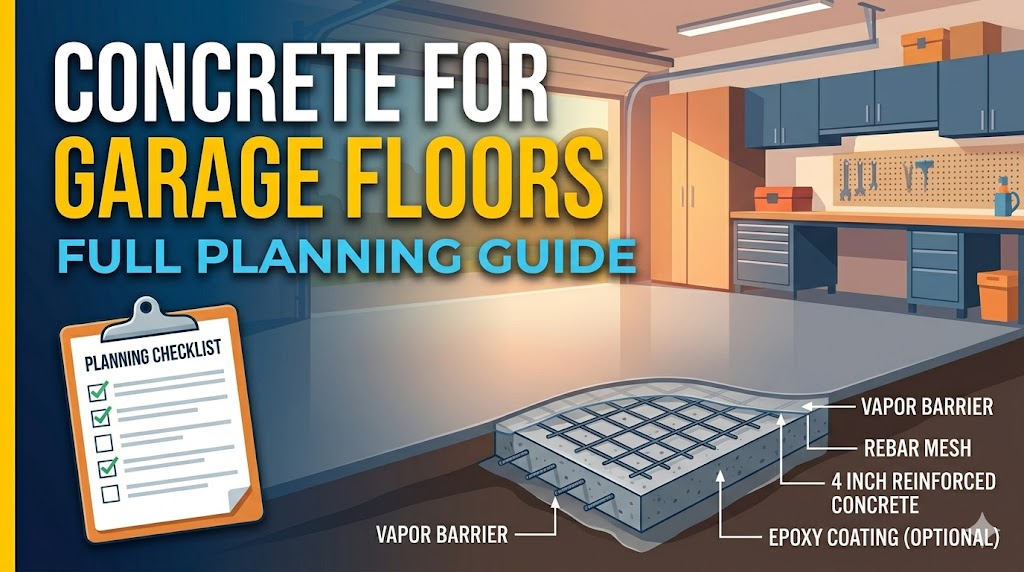
    The minimum specification for a residential garage floor is 4 inches / 100 mm thick, 3,000 psi / 21 MPa concrete, with 6×6 / W1.4×W1.4 welded wire mesh or equivalent reinforcement. A two-car garage measures roughly 20×22 ft / 6.1×6.7 m and requires approximately 5.4 cubic yards / 4.1 m³ of concrete at 4-inch thickness. Every deviation from those baseline numbers — heavier vehicles, softer subbase, colder climate — changes the spec.

    How to calculate concrete volume for a garage floor

    The formula is straightforward:

    Volume (cubic yards) = Length (ft) × Width (ft) × Thickness (in) ÷ 324

    The divisor 324 converts the result from cubic feet at inches of thickness directly to cubic yards. For metric: Volume (m³) = Length (m) × Width (m) × Thickness (m).

    Worked example for a standard 20×22 ft / 6.1×6.7 m two-car garage at 4 inches / 102 mm:

    20 × 22 × 4 ÷ 324 = 5.43 cubic yards / 4.15 m³

    Add a 10% waste factor for form overpour, subbase variation, and spillage: 5.97 cubic yards / 4.56 m³ — round up to 6 yards for ordering.

    Use the concrete garage floor calculator for irregular shapes, multiple bays, or when you need outputs in both cubic yards and bags in a single step.

    Concrete volume by garage size and slab thickness

    Garage size4 in / 102 mm (yd³)5 in / 127 mm (yd³)6 in / 152 mm (yd³)
    12×20 ft / 3.7×6.1 m (1 car)2.963.704.44
    18×20 ft / 5.5×6.1 m (1.5 car)4.445.566.67
    20×22 ft / 6.1×6.7 m (2 car)5.436.798.15
    24×24 ft / 7.3×7.3 m (2 car)6.408.009.60
    24×30 ft / 7.3×9.1 m (3 car)8.0010.0012.00
    30×40 ft / 9.1×12.2 m (4 car)13.3316.6720.00

    Volumes above do not include a waste factor. Add 10% for standard residential pours; 5% if the subbase is laser-levelled and forms are precisely set.

    What thickness does a garage floor need?

    Standard residential vehicles

    A 4-inch / 100 mm slab supports standard passenger cars and light trucks. This covers nearly all residential garages where vehicles do not exceed 10,000 lb / 4,500 kg gross weight. The 4-inch minimum assumes a compacted granular subbase of at least 4 inches / 100 mm and a subgrade with no soft spots.

    Heavy vehicles, workshops, and commercial use

    Step to 5 inches / 127 mm for: pickup trucks over 3/4-ton, recreational vehicles, camper trailers, and any garage used as a workshop where forklifts, heavy machinery, or car lifts are installed. Car lifts anchored to slab require a minimum 6-inch / 152 mm slab with #4 rebar at 12-inch / 305 mm centres in both directions around the anchor bolt locations. A 5,000 lb / 34 MPa mix is recommended for anchor bolt zones.

    The concrete slab thickness selector determines minimum thickness based on vehicle weight and subbase bearing capacity, taking the guesswork out of this specification decision.

    Concrete mix specification for garage floors

    The minimum acceptable mix for a residential garage floor in a temperate climate is 3,000 psi / 21 MPa. In freeze-thaw climates (any location where temperatures drop below 32°F / 0°C regularly), use 4,000 psi / 28 MPa with 5–7% air entrainment. Air-entrained concrete resists scaling caused by de-icing salts and freeze-thaw cycling.

    Water-cement ratio for garage floors should not exceed 0.50. A lower ratio — 0.40 to 0.45 — produces a denser, less permeable surface. Every 0.10 increase in the water-cement ratio above 0.50 reduces 28-day strength by approximately 1,000 psi / 7 MPa. The water-cement ratio calculator models this relationship.

    Fibre reinforcement — polypropylene fibres at 1.5 lb/yd³ / 0.89 kg/m³ — reduces plastic shrinkage cracking during the first 24 hours of curing. It does not replace structural rebar or mesh for heavy-load applications, but it is a low-cost addition on any pour.

    Reinforcement: mesh, rebar, or fibres?

    Welded wire mesh (6×6 / W1.4×W1.4 or 6×6 / W2.0×W2.0) is the standard for residential garage floors and sits on chairs at mid-slab depth. It controls crack width if cracking occurs but does not add significant structural strength. Many contractors argue that correctly placed control joints and fibre reinforcement outperform mesh in practice — mesh that sits on the subbase instead of mid-slab contributes nothing.

    Rebar — typically #3 bar at 18-inch / 457 mm centres or #4 bar at 24-inch / 610 mm centres — is used for slabs carrying heavy point loads (car lifts, lathes, press equipment) or where the subbase is weak. The rebar and reinforcing steel calculator calculates total rebar length and weight for the floor area.

    For fibres, the dosage depends on fibre type: synthetic macro fibres at 3–5 lb/yd³ / 1.8–3.0 kg/m³ can substitute for mesh in non-structural applications. Steel fibres at 25–40 lb/yd³ / 15–24 kg/m³ are used in industrial applications and are excessive for residential garages.

    Subbase, control joints, and slope

    A properly prepared subbase is as important as the concrete specification. Remove all organic material and soft spots. Compact to a minimum 95% Standard Proctor density. Install 4–6 inches / 100–152 mm of compacted gravel (crushed stone or dense-graded aggregate) — this provides drainage and a consistent bearing surface.

    Control joints are saw-cut or tooled into the slab to direct where cracking occurs. Space them no further apart than 2–3 times the slab thickness in feet — so a 4-inch / 100 mm slab needs control joints every 8–12 feet / 2.4–3.7 m. Joints should be cut to one-quarter of the slab depth (1 inch / 25 mm for a 4-inch slab). Saw-cut within 6–12 hours of finishing before shrinkage cracking initiates.

    Garage floors slope 1/8 to 1/4 inch per foot / 10–21 mm per metre toward the door or a floor drain. A 20-foot / 6.1 m deep garage needs a 2.5–5 inch / 63–127 mm elevation change from back to front. Confirm the slope direction before pouring — it is extremely expensive to correct after the fact.

    Common mistakes in garage floor concrete projects

    Pouring on a frozen or frost-heaved subbase. A subbase that appears firm in winter may have frost lenses 6–12 inches / 152–305 mm below the surface. When the frost thaws, the slab loses uniform support and cracks. Never pour on frozen ground. In cold climates, install a vapour barrier and confirm subgrade temperatures are above 40°F / 4°C to a depth of 6 inches / 152 mm before beginning.

    Overworking the surface finish. Re-trowelling garage floors after bleed water has fully risen brings water and fine particles to the surface, creating a weak, dusty, high-permeability layer. This is the primary cause of surface scaling and dusting in new garage floors. Stop trowelling when bleed water is no longer visible and the surface can be walked on without leaving deep impressions.

    Skipping curing. Concrete loses up to 40% of its potential strength if it is allowed to dry out in the first 7 days. Residential contractors frequently strip forms and walk away. The correct approach is to cure for a minimum 7 days using curing compound, wet burlap, or plastic sheeting. In hot or windy conditions, begin curing within 20 minutes of finishing. The concrete curing time estimator adjusts curing duration by temperature.

    Undersizing the mix for the climate. Using a non-air-entrained 3,000 psi / 21 MPa mix in a location that regularly uses rock salt or calcium chloride de-icers causes surface scaling within two winters. The scaling is permanent and cannot be repaired cost-effectively — the floor eventually needs to be ground and resurfaced. Air-entrained 4,000 psi / 28 MPa concrete with a low water-cement ratio is the correct specification for any garage in a freeze-thaw climate.

    Related calculators you might need

    After sizing the slab, the concrete cost per square foot calculator gives you a cost-per-square-foot figure that is easy to compare against contractor quotes. For rebar layout, the rebar spacing calculator optimises bar spacing to hit a target area of steel. If you are pricing the subbase as well, the gravel and crushed stone calculator calculates aggregate volume and tonnage for the compacted base layer. For a complete project cost breakdown including labour, the full concrete project estimator is the most comprehensive starting point.

    Frequently asked questions

    How thick should a garage floor be?

    4 inches / 100 mm is the residential minimum for standard passenger vehicles. Use 5 inches / 127 mm for 3/4-ton pickups and heavier trucks, and 6 inches / 152 mm for any slab that will have a car lift installed. Thickness should be measured at the thinnest point — not the average — so subbase levelling matters.

    What PSI concrete for a garage floor?

    3,000 psi / 21 MPa minimum in mild climates. 4,000 psi / 28 MPa with 5–7% air entrainment in any climate where de-icing salts are used or temperatures regularly drop below freezing. Higher-strength mixes add modest cost per yard but significantly extend the floor’s service life in harsh conditions.

    How many yards of concrete does a 2-car garage need?

    A 20×22 ft / 6.1×6.7 m slab at 4 inches / 100 mm requires approximately 5.4 cubic yards / 4.1 m³. Add 10% waste factor and round up — order 6 yards. A 24×24 ft / 7.3×7.3 m garage at the same thickness needs 6.4 yards; order 7. Use the concrete garage floor calculator to get exact volumes for your specific dimensions.

    Do I need rebar in a garage floor?

    Welded wire mesh is sufficient for standard residential garage floors with passenger cars. Rebar is required when installing a car lift, when the subgrade is weak or poorly compacted, or when vehicles over 10,000 lb / 4,500 kg will use the space. Fibres added to the mix reduce plastic shrinkage cracking and complement mesh or rebar — they do not replace structural reinforcement.

    How long does a garage floor need to cure before parking on it?

    At 70°F / 21°C, standard concrete reaches sufficient strength for light foot traffic in 24 hours and can accept vehicle traffic at 7 days. Full design strength takes 28 days. In cold conditions — below 50°F / 10°C — extend vehicle traffic to 10–14 days. The concrete curing time estimator gives temperature-adjusted timelines so you can plan around the weather.

    Should I seal a garage floor after pouring?

    Yes, for any garage in a freeze-thaw climate or where de-icing products are tracked in from vehicles. Apply a penetrating silane/siloxane sealer 28 days after the pour — earlier application traps moisture and can cause discolouration. Acrylic topical sealers provide a gloss finish and chemical resistance but require reapplication every 2–3 years. Penetrating sealers last longer and are more appropriate for working garages.

  • How to Calculate Concrete for a Driveway (Imperial & Metric)

    How to Calculate Concrete for a Driveway (Imperial & Metric)

    A standard two-car residential concrete driveway — 16 ft wide by 38 ft long at 5 inches thick — requires approximately 9.4 cubic yards (7.2 m³) of concrete. That figure shifts based on width, length, thickness, and whether you include the apron. Getting the calculation wrong in either direction means either a short pour mid-job or overpaying for concrete and disposal of unused material.

    The driveway concrete formula — imperial and metric

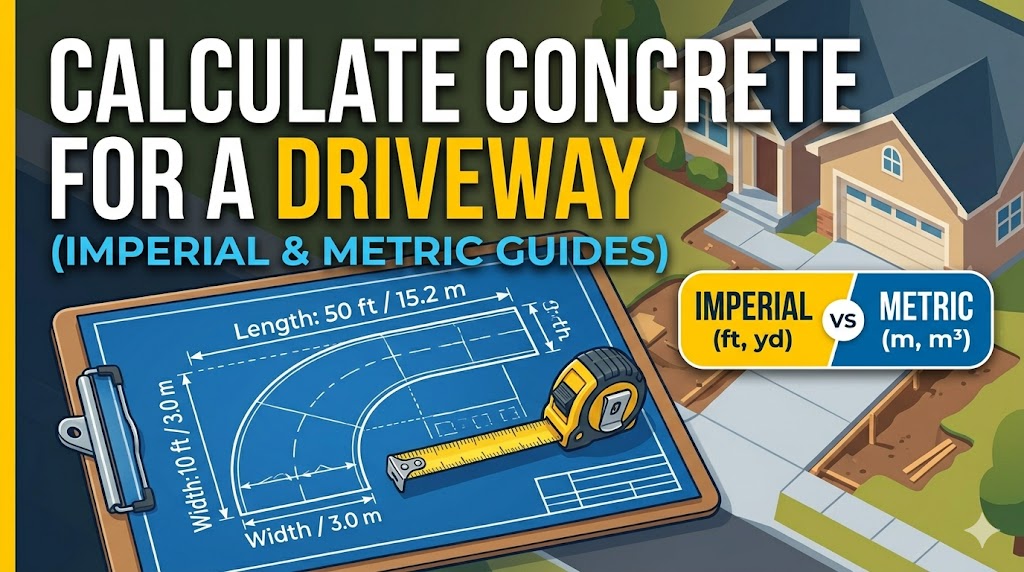
    The core calculation is: Volume = Length × Width × Thickness (all in the same unit).

    Imperial: Convert all dimensions to feet. Thickness in inches ÷ 12 = thickness in feet. Then: Length (ft) × Width (ft) × Thickness (ft) = Volume in cubic feet ÷ 27 = cubic yards.

    Metric: Convert all dimensions to metres. Thickness in mm ÷ 1000 = thickness in metres. Then: Length (m) × Width (m) × Thickness (m) = cubic metres.

    Example — imperial: A driveway 18 ft wide × 40 ft long × 5 in thick = 18 × 40 × (5/12) = 300 cu ft ÷ 27 = 11.1 yd³. Add 10% waste: order 12.2 yd³, round to 12.5 yd³.

    Example — metric: Same driveway = 5.5 m × 12.2 m × 0.125 m = 8.4 m³. Add 10% waste: order 9.2 m³, round up to 9.5 m³.

    The Concrete Driveway Calculator handles both unit systems and outputs cubic yards, cubic metres, and bag counts simultaneously — useful when comparing quotes from suppliers using different units.

    Standard driveway dimensions and resulting concrete volumes

    The table below covers the most common residential and light commercial driveway configurations. All volumes include a 10% waste factor.

    ConfigurationDimensions (ft / m)ThicknessVolume (incl. 10% waste)
    Single car (1 lane)10×20 ft / 3×6.1 m4 in / 100 mm3.3 yd³ / 2.5 m³
    Single car (1 lane)10×30 ft / 3×9.1 m4 in / 100 mm4.9 yd³ / 3.7 m³
    Double car (2 lane)16×20 ft / 4.9×6.1 m5 in / 125 mm6.5 yd³ / 5.0 m³
    Double car (2 lane)20×40 ft / 6.1×12.2 m5 in / 125 mm16.2 yd³ / 12.4 m³
    RV/boat pad addition12×30 ft / 3.6×9.1 m6 in / 150 mm7.3 yd³ / 5.6 m³
    Curved/irregular (est.)18×38 ft / 5.5×11.6 m5 in / 125 mm11.9 yd³ / 9.1 m³

    For curved or irregular-shaped driveways, sketch the plan and break it into rectangles. Calculate each section independently, then sum. If the shape curves significantly, reduce the measured length by 5% to account for the difference between arc length and chord length on shallow curves.

    Driveway thickness: what the standards actually require

    Residential passenger vehicles (cars, SUVs, light pickups)

    The minimum thickness is 4 inches / 100 mm per ACI 330R (Guide for the Design and Construction of Concrete Parking Lots and Driveways). In practice, most concrete contractors pour at 5 inches / 125 mm on residential work to provide margin against subgrade settlement and local traffic. The cost difference between 4 and 5 inch pours on a typical 2-car driveway is approximately 0.5 yd³ (0.38 m³) — about $65–$90 in material.

    Heavy vehicles and RV parking

    Pickup trucks over 8,500 lb GVWR, loaded trailers, and RVs require a minimum of 6 inches / 150 mm. Areas regularly used for RV storage should have 6 inch slabs with #4 (13 mm) rebar at 18 inch (450 mm) centres both ways. Undersized slabs under heavy vehicles develop transverse cracking within 3–5 years in most climates.

    The driveway apron: don’t forget this concrete

    The driveway apron — the transition section from the street to the private driveway — is often calculated separately or forgotten entirely. In most US jurisdictions, aprons are owned by the homeowner but must meet municipal specifications: typically 6 inches / 150 mm thickness with a specific cross-slope (1–2%) for drainage compliance.

    A standard single-car apron is approximately 10 ft × 6 ft (3 m × 1.8 m). A two-car apron is typically 18–20 ft × 6 ft (5.5–6.1 m × 1.8 m). At 6 inches / 150 mm thick, a two-car apron adds 1.1 yd³ (0.84 m³) to your order — a quantity that’s easy to miss when calculating only the main driveway section. The Concrete Driveway Apron Calculator calculates the apron separately so it can be added to your total.

    Concrete mix specification for driveways

    Residential driveways should use a minimum 4,000 PSI / 27 MPa mix. In freeze-thaw climates (US Exposure Class F1/F2, Canada Exposure Class C-1), air-entrained concrete with 5–7% air content is required to prevent surface scaling. Non-air-entrained 4,000 PSI concrete placed in a freeze-thaw environment will show surface delamination within 2–5 winters.

    The water-cement ratio must be 0.45 or less for driveway applications in freeze-thaw conditions (ACI 318 requirements). Higher w/c ratios increase permeability, allowing deicers to penetrate and cause internal damage. The Water-Cement Ratio Calculator shows how w/c ratio affects compressive strength so you can verify your mix design meets the spec.

    Common mistakes when calculating driveway concrete

    1. Calculating only the driveway and forgetting the apron. The apron from street to property line often adds 10–20% to total volume. Always calculate both sections and sum them before ordering.

    2. Using 4-inch thickness for the whole driveway when it includes an RV pad or boat storage area. Those sections need 6 inches / 150 mm. Calculate the two zones at different thicknesses and add the volumes — don’t average the thickness across the whole area.

    3. Not accounting for the subbase compaction depth. If your subbase drops 2 inches (50 mm) more than planned after compaction in any section, that’s additional concrete volume. Survey the finished subbase with a straightedge before finalising your order.

    4. Ordering ready-mix without checking the truck access route. A standard ready-mix truck requires 10–12 ft (3–3.6 m) of clearance and weighs approximately 66,000 lb (30,000 kg) loaded. Soft ground, low-clearance overhangs, and tight turns can prevent direct delivery. Chute reach is typically 18 ft (5.5 m); beyond that, you’ll need a pump or wheelbarrow relay.

    Related calculators you might need

    After calculating your driveway volume, use the Concrete Cost Per Square Foot Calculator to convert your volume figure into a total material cost at local pricing. If rebar is required — and it should be for RV pads, areas over poor soil, and any pour over 5 yards — the Rebar/Reinforcing Steel Calculator calculates bar quantities and spacing. The Concrete Slab Thickness Selector is also worth checking before finalising thickness, particularly if you’re unsure whether 4 or 5 inches applies to your load scenario. And once your driveway is placed, the Concrete Sealer Coverage Calculator tells you how much sealer you’ll need at 28 days post-pour.

    Frequently asked questions

    How many cubic yards of concrete do I need for a 2-car driveway?

    A typical two-car driveway — 20 ft wide by 40 ft long at 5 inches thick — requires approximately 16.2 cubic yards including 10% waste. A more compact version at 16 ft × 30 ft at 5 inches requires 9.9 cubic yards. The actual number depends on your dimensions, so measure the exact length and width before ordering. Use the Concrete Driveway Calculator with your specific measurements for an accurate figure.

    How thick should a concrete driveway be?

    4 inches / 100 mm is the minimum for passenger vehicles. 5 inches / 125 mm is the practical standard for residential work — it provides a margin for subgrade variation and handles the occasional delivery truck. 6 inches / 150 mm is required for driveways with regular heavy vehicle use (RVs, trailers, loaded trucks). In freeze-thaw climates, never go below 5 inches and always specify air-entrained concrete.

    Does concrete driveway thickness affect cost much?

    Yes, meaningfully. On a 20×40 ft (6.1×12.2 m) driveway, upgrading from 4 to 5 inches adds approximately 2.5 yd³ (1.9 m³) — roughly $350–$475 in materials and $150–$200 in labour. Upgrading from 4 to 6 inches adds about 4.9 yd³ (3.7 m³) — adding $685–$930 in materials. For most residential applications, the 5-inch thickness offers the best value balance between cost and longevity.

    How do I calculate concrete for an L-shaped or curved driveway?

    Divide the shape into rectangles. For an L-shape: calculate each leg separately and sum. For a curved driveway, use the chord length (straight-line distance) of each curved section, reduced by 3–5% to account for curvature. For sweeping curves with a radius under 20 ft (6 m), reduce by 8%. Alternatively, use the Concrete Volume Multi-Shape Calculator which accepts multiple sections and handles irregular geometries.

  • Post Hole Concrete: Exactly How Much Do You Need?

    Post Hole Concrete: Exactly How Much Do You Need?

    A standard 4-inch / 100 mm diameter post in a 10-inch / 254 mm wide hole requires roughly 0.8 cubic feet / 0.023 m³ of concrete per foot of depth — but the actual volume depends on your hole diameter, hole depth, and post size. Get those three numbers right, and waste drops to near zero.

    How to calculate post hole concrete volume

    The formula treats the hole as a cylinder and subtracts the volume of the post itself:

    Volume = π × r² × depth − post cross-section × depth

    Where r is the radius of the hole. In practice, the post volume is small enough that most contractors skip the subtraction for wood posts — it matters more for large-diameter steel or concrete posts.

    Worked example: a 10-inch / 254 mm diameter hole, 36 inches / 914 mm deep, for a 4×4 (3.5-inch / 89 mm actual) wood post.

    Hole radius = 5 inches / 127 mm = 0.417 ft / 0.127 m

    Hole volume = π × (0.417)² × 3 ft = 1.636 ft³ / 0.0463 m³

    Post cross-section = 3.5 × 3.5 = 12.25 in² = 0.0851 ft²

    Post volume = 0.0851 × 3 = 0.255 ft³ / 0.0072 m³

    Net concrete volume = 1.636 − 0.255 = 1.38 ft³ / 0.039 m³

    That is just under one 60 lb bag. For a fence project with 20 posts, that is 20 bags minimum before adding a 10% waste factor.

    Skip the manual calculation — the post hole concrete calculator handles this for any hole size, depth, and post dimension, and outputs total bags across multiple holes at once.

    Post hole concrete volume by common hole and depth combinations

    The table below shows net concrete volume (after subtracting a standard 4×4 post) for the most common post hole configurations.

    Hole diameterDepthNet volume (ft³)60 lb bags needed
    8 in / 203 mm24 in / 610 mm0.621
    8 in / 203 mm36 in / 914 mm0.932
    10 in / 254 mm36 in / 914 mm1.382
    10 in / 254 mm48 in / 1219 mm1.843
    12 in / 305 mm42 in / 1067 mm2.464
    12 in / 305 mm48 in / 1219 mm2.824
    16 in / 406 mm48 in / 1219 mm5.107

    A 60 lb bag yields approximately 0.45 ft³ / 0.013 m³. An 80 lb bag yields roughly 0.60 ft³ / 0.017 m³. The bag counts above assume 60 lb bags with a 10% overage built in.

    How deep do post holes need to be?

    Depth is determined by two factors: frost depth and the structural load the post carries.

    In cold climates, the bottom of the footing must sit below the local frost depth or frost heave will push the post up over successive freeze-thaw cycles. Frost depth ranges from 0 in parts of Florida and southern California to over 60 inches / 1524 mm in Minnesota and northern Canada. The frost depth and footing depth calculator gives region-specific depths by US zip code and Canadian province.

    The rule of thumb used by most fence and deck contractors is to set posts at least one-third of their above-ground height into the ground. A 6-foot / 1.83 m fence post needs a minimum 2-foot / 610 mm embedment, but in freeze-prone zones that often extends to 3–4 feet / 914–1219 mm.

    For structural applications — deck posts carrying live loads, carport columns, pergola supports — engineered footings sized by a structural engineer replace rule-of-thumb depths. In those cases, the concrete column and pier calculator is the more appropriate tool.

    Common mistakes when filling post holes with concrete

    Adding too much water to the mix. Contractors and DIYers frequently add extra water to make bagged mix easier to pour into the hole. Every additional pint of water above the recommended ratio raises the water-cement ratio and drops final compressive strength. A mix that pours like soup may hit only 2,000 psi / 14 MPa instead of the 4,000 psi / 28 MPa printed on the bag. Add water conservatively — the mix should be stiff enough to hold a mound shape before it settles into the hole.

    Skipping the gravel drainage layer. Placing concrete directly on undisturbed soil in clay-heavy ground traps moisture against the post base. The correct approach is 4–6 inches / 100–152 mm of compacted gravel at the bottom of the hole before pouring. This allows water to drain away from the post and reduces post rot in wood applications.

    Undersizing hole diameter for the post. A hole only slightly wider than the post leaves no room to plumb the post accurately before the concrete sets, and the thin concrete shell around the post lacks the bearing area to resist lateral loads. The minimum hole diameter is 3× the post width for wood posts — so a 4×4 / 89 mm post needs at minimum a 12-inch / 305 mm hole for structural applications (though 10 inches / 254 mm is accepted for light fence work).

    Pouring in cold weather without precautions. Fresh concrete that freezes before reaching initial set will not gain strength and will be permanently weakened. Below 40°F / 4°C, use warm mix water and cover the exposed hole opening with insulating blankets for at least 24–48 hours. Below 20°F / -7°C, postpone the pour or use a heated enclosure.

    Related calculators you might need

    Once you know how many cubic feet of concrete each hole requires, the concrete bags calculator converts total volume into exact bag counts across 40 lb, 60 lb, and 80 lb sizes — useful when buying in bulk from a home centre. For larger post and column footings poured from a ready-mix truck, the concrete truck load calculator helps you determine whether you need a full load or will be paying a short-load surcharge. If your project also includes a deck or slab over the posts, the concrete footing calculator handles pad-style and continuous footings. For total project budgeting, the full concrete project estimator rolls materials, labour, and delivery into a single cost figure.

    Frequently asked questions

    How many bags of concrete do I need for a fence post?

    For a standard 8-inch / 203 mm diameter hole at 30 inches / 762 mm deep, one 60 lb bag is usually sufficient. For a 10-inch / 254 mm hole at 36 inches / 914 mm deep, plan on two 60 lb bags. These figures include a small overage allowance. Multiply by your total post count and add 10% for the full project quantity. The post hole concrete calculator gives exact figures for any combination of hole size and depth.

    What is the right concrete mix for post holes?

    A minimum 3,000 psi / 21 MPa mix is standard for fence posts; 4,000 psi / 28 MPa is preferred for deck and structural posts. Most bagged fast-setting mixes (Quikrete Fast Setting, SAKRETE, and equivalents) reach 4,000 psi at 28 days. Do not use general-purpose sand mix — it lacks the coarse aggregate needed for load-bearing footings.

    Can I pour dry concrete into a post hole without mixing first?

    Yes, for fast-setting mixes specifically labelled for dry-pour use. You pour dry mix into the hole, then add water on top; the mix absorbs moisture from the surrounding soil and the added water. This technique works in moist soil conditions. In dry, sandy soil the mix may not hydrate fully — in that case, mix in a bucket first. Standard bagged concrete should always be pre-mixed before pouring.

    How long before I can hang a gate on a concrete-set post?

    Fast-setting concrete reaches sufficient strength to accept light loads (fence rails, gate hardware) in 4 hours at 70°F / 21°C. Standard concrete needs 24–48 hours before loading. Full design strength takes 28 days regardless of mix type. The concrete curing time estimator adjusts cure timelines by temperature, so you can plan accurately in cold or hot conditions.

    How deep should a post hole be for a 6-foot fence?

    The structural minimum is one-third of above-ground height — 2 feet / 610 mm for a 6-foot / 1.83 m fence. In frost-prone climates, the code minimum is often 3–4 feet / 914–1219 mm to clear the frost line. Check your local building code; most jurisdictions require permits and inspections for fence installations on boundary lines.

    Does the shape of the hole bottom affect how much concrete I need?

    Yes. A flat-bottomed hole requires less concrete than a rounded or irregular bottom. Hand-dug holes in rocky ground often have irregular profiles that can add 15–20% more volume than the calculated cylinder. Flare the bottom of structural footings — a bell shape 1.5× the hole diameter — to increase bearing area in soft soil, but account for that added volume when ordering bags.