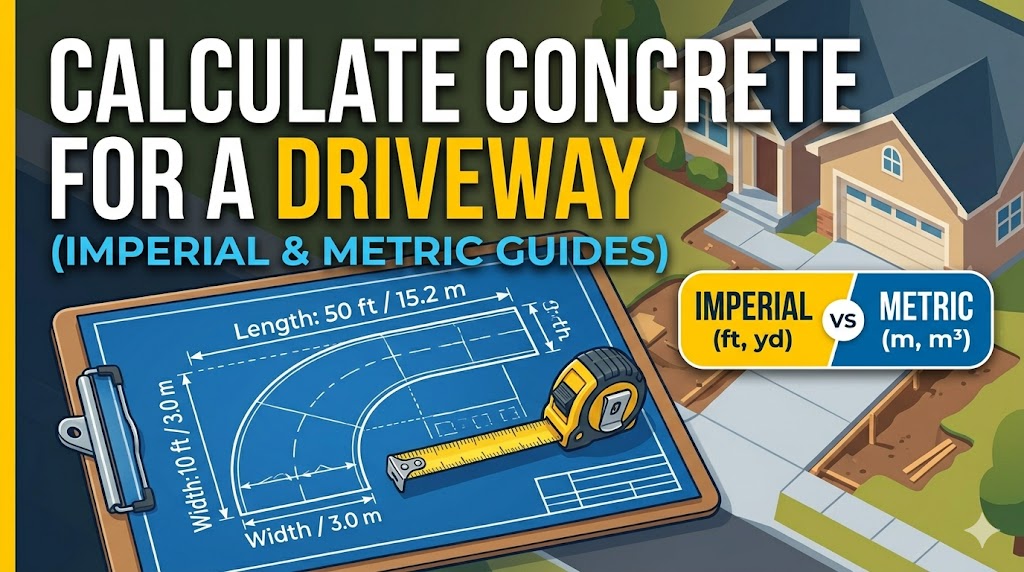
A standard two-car residential concrete driveway — 16 ft wide by 38 ft long at 5 inches thick — requires approximately 9.4 cubic yards (7.2 m³) of concrete. That figure shifts based on width, length, thickness, and whether you include the apron. Getting the calculation wrong in either direction means either a short pour mid-job or overpaying for concrete and disposal of unused material.
The driveway concrete formula — imperial and metric
The core calculation is: Volume = Length × Width × Thickness (all in the same unit).
Imperial: Convert all dimensions to feet. Thickness in inches ÷ 12 = thickness in feet. Then: Length (ft) × Width (ft) × Thickness (ft) = Volume in cubic feet ÷ 27 = cubic yards.
Metric: Convert all dimensions to metres. Thickness in mm ÷ 1000 = thickness in metres. Then: Length (m) × Width (m) × Thickness (m) = cubic metres.
Example — imperial: A driveway 18 ft wide × 40 ft long × 5 in thick = 18 × 40 × (5/12) = 300 cu ft ÷ 27 = 11.1 yd³. Add 10% waste: order 12.2 yd³, round to 12.5 yd³.
Example — metric: Same driveway = 5.5 m × 12.2 m × 0.125 m = 8.4 m³. Add 10% waste: order 9.2 m³, round up to 9.5 m³.
Why add 10% at all? Uneven subgrade, spillage, and over-excavation routinely eat into your margin — the Concrete Waste Factor Calculator lets you adjust that percentage based on how irregular your site actually is, rather than applying a flat 10% blindly.
The Concrete Driveway Calculator handles both unit systems and outputs cubic yards, cubic metres, and bag counts simultaneously — useful when comparing quotes from suppliers using different units.
Standard driveway dimensions and resulting concrete volumes
The table below covers the most common residential and light commercial driveway configurations. All volumes include a 10% waste factor.
| Configuration | Dimensions (ft / m) | Thickness | Volume (incl. 10% waste) |
| Single car (1 lane) | 10×20 ft / 3×6.1 m | 4 in / 100 mm | 2.7 yd³ / 2.0 m³ |
| Single car (1 lane) | 10×30 ft / 3×9.1 m | 4 in / 100 mm | 4.1 yd³ / 3.0 m³ |
| Double car (2 lane) | 16×20 ft / 4.9×6.1 m | 5 in / 125 mm | 5.4 yd³ / 4.1 m³ |
| Double car (2 lane) | 20×40 ft / 6.1×12.2 m | 5 in / 125 mm | 13.6 yd³ / 10.2 m³ |
| RV/boat pad addition | 12×30 ft / 3.6×9.1 m | 6 in / 150 mm | 7.3 yd³ / 5.4 m³ |
| Curved/irregular (est.) | 18×38 ft / 5.5×11.6 m | 5 in / 125 mm | 11.6 yd³ / 8.8 m³ |
For curved or irregular-shaped driveways, sketch the plan and break it into rectangles. Calculate each section independently, then sum. If the shape curves significantly, reduce the measured length by 5% to account for the difference between arc length and chord length on shallow curves.
Driveway thickness: what the standards actually require
Residential passenger vehicles (cars, SUVs, light pickups)
The minimum thickness is 4 inches / 100 mm per ACI 330R (Guide for the Design and Construction of Concrete Parking Lots and Driveways). In practice, most concrete contractors pour at 5 inches / 125 mm on residential work to provide margin against subgrade settlement and local traffic. On a 16×20 ft double-car driveway, upgrading from 4 to 5 inches adds approximately 1.0 yd³ (0.75 m³) — roughly $130–$180 in material.
Heavy vehicles and RV parking
Pickup trucks over 8,500 lb GVWR, loaded trailers, and RVs require a minimum of 6 inches / 150 mm. Areas regularly used for RV storage should have 6 inch slabs with #4 (13 mm) rebar at 18 inch (450 mm) centres both ways. Undersized slabs under heavy vehicles develop transverse cracking within 3–5 years in most climates.
The driveway apron: don’t forget this concrete
The driveway apron — the transition section from the street to the private driveway — is often calculated separately or forgotten entirely. In most US jurisdictions, aprons are owned by the homeowner but must meet municipal specifications: typically 6 inches / 150 mm thickness with a specific cross-slope (1–2%) for drainage compliance.
A standard single-car apron is approximately 10 ft × 6 ft (3 m × 1.8 m) and adds about 1.2 yd³ (0.9 m³). A two-car apron is typically 18–20 ft × 6 ft (5.5–6.1 m × 1.8 m). At 6 inches / 150 mm thick, a two-car apron adds roughly 2.3 yd³ (1.7 m³) to your order — a quantity that’s easy to miss when calculating only the main driveway section. The Concrete Driveway Apron Calculator calculates the apron separately so it can be added to your total.
Concrete mix specification for driveways
US residential driveways should use a minimum 4,000 PSI / 27 MPa mix. In freeze-thaw climates (US Exposure Class F1/F2), air-entrained concrete with 5–7% air content is required to prevent surface scaling. Non-air-entrained 4,000 PSI concrete placed in a freeze-thaw environment will show surface delamination within 2–5 winters.
Canadian driveways are specified differently. Under CSA A23.1, a plain (non-structurally-reinforced) residential driveway falls under Exposure Class C-2 — concrete exposed to chlorides and freeze-thaw, the same class covering walkways, patios, and steps. C-2 calls for a minimum 32 MPa (≈4,600 PSI) mix at 5–8% air content, which is meaningfully stronger than the 4,000 PSI US baseline. Don’t substitute the US figure on a Canadian job. The PSI to MPa Converter makes it easy to check a supplier’s quoted strength against whichever spec applies to your location.
The water-cement ratio must be 0.45 or less for driveway applications in freeze-thaw conditions (ACI 318 requirements; CSA A23.1 sets the same 0.45 ceiling for C-2). Higher w/c ratios increase permeability, allowing deicers to penetrate and cause internal damage. The Water-Cement Ratio Calculator shows how w/c ratio affects compressive strength so you can verify your mix design meets the spec.
Common mistakes when calculating driveway concrete
1. Calculating only the driveway and forgetting the apron. The apron from street to property line often adds 10–20% to total volume. Always calculate both sections and sum them before ordering.
2. Using 4-inch thickness for the whole driveway when it includes an RV pad or boat storage area. Those sections need 6 inches / 150 mm. Calculate the two zones at different thicknesses and add the volumes — don’t average the thickness across the whole area.
3. Not accounting for the subbase compaction depth. If your subbase drops 2 inches (50 mm) more than planned after compaction in any section, that’s additional concrete volume. Survey the finished subbase with a straightedge before finalising your order, and use the Gravel & Crushed Stone Calculator to work out how much base material you need to compact in the first place.
4. Ordering ready-mix without checking the truck access route or minimum load. A standard ready-mix truck requires 10–12 ft (3–3.6 m) of clearance and weighs approximately 66,000 lb (30,000 kg) loaded. Soft ground, low-clearance overhangs, and tight turns can prevent direct delivery. Chute reach is typically 18 ft (5.5 m); beyond that, you’ll need a pump or wheelbarrow relay. Small driveways and single-car pads often fall under the supplier’s minimum order — check with the Concrete Truck Load Calculator how many yards your job needs relative to a full truck, and if you’re ordering less than a full load, the Short Load Fee Estimator shows what surcharge to expect so it doesn’t show up as a surprise on the invoice.
Related calculators you might need
After calculating your driveway volume, use the Concrete Cost Per Square Foot Calculator to convert your volume figure into a total material cost at local pricing. If rebar is required — and it should be for RV pads, areas over poor soil, and any pour over 5 yards — the Rebar/Reinforcing Steel Calculator calculates bar quantities and spacing. The Concrete Slab Thickness Selector is also worth checking before finalising thickness, particularly if you’re unsure whether 4 or 5 inches applies to your load scenario. And once your driveway is placed, the Concrete Sealer Coverage Calculator tells you how much sealer you’ll need at 28 days post-pour.
Frequently asked questions
How many cubic yards of concrete do I need for a 2-car driveway?
A typical two-car driveway — 20 ft wide by 40 ft long at 5 inches thick — requires approximately 13.6 cubic yards including 10% waste. A more compact version at 16 ft × 30 ft at 5 inches requires 8.1 cubic yards. The actual number depends on your dimensions, so measure the exact length and width before ordering. Use the Concrete Driveway Calculator with your specific measurements for an accurate figure.
How thick should a concrete driveway be?
4 inches / 100 mm is the minimum for passenger vehicles. 5 inches / 125 mm is the practical standard for residential work — it provides a margin for subgrade variation and handles the occasional delivery truck. 6 inches / 150 mm is required for driveways with regular heavy vehicle use (RVs, trailers, loaded trucks). In freeze-thaw climates, never go below 5 inches and always specify air-entrained concrete.
Does concrete driveway thickness affect cost much?
Yes, meaningfully. On a 20×40 ft (6.1×12.2 m) driveway, upgrading from 4 to 5 inches adds approximately 2.5 yd³ (1.9 m³) — roughly $350–$475 in materials and $150–$200 in labour. Upgrading from 4 to 6 inches adds about 4.9 yd³ (3.7 m³) — adding $685–$930 in materials. For most residential applications, the 5-inch thickness offers the best value balance between cost and longevity.
How do I calculate concrete for an L-shaped or curved driveway?
Divide the shape into rectangles. For an L-shape: calculate each leg separately and sum. For a curved driveway, use the chord length (straight-line distance) of each curved section, reduced by 3–5% to account for curvature. For sweeping curves with a radius under 20 ft (6 m), reduce by 8%. Alternatively, use the Concrete Volume Multi-Shape Calculator which accepts multiple sections and handles irregular geometries.
Is the concrete spec different for a driveway in Canada vs the US?
Yes. US practice typically specifies 4,000 PSI (27 MPa) as the residential driveway minimum. Canada’s CSA A23.1 classifies plain residential driveways under Exposure Class C-2, which requires a minimum 32 MPa (≈4,600 PSI) mix at 5–8% air content — noticeably stronger than the US baseline. If you’re ordering concrete in Canada, quote the MPa figure to your supplier, not the PSI one, and confirm C-2 is the class specified on the ticket.