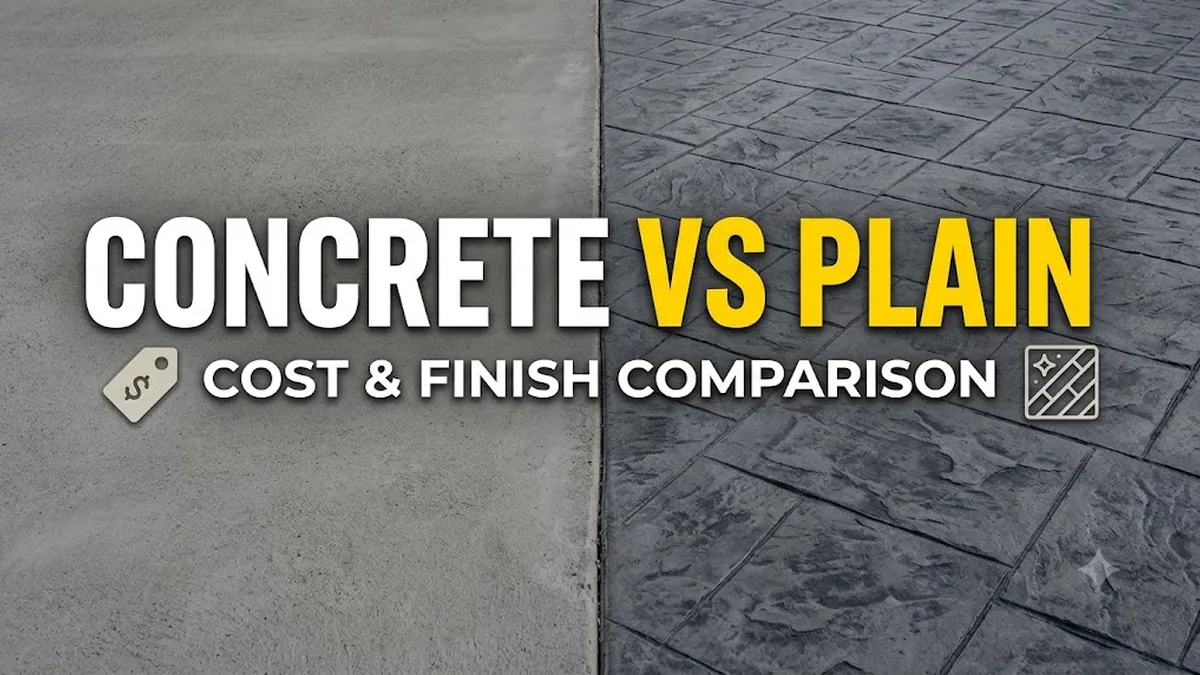
Stamped Concrete vs Plain: Cost and Finish Comparison
Stamped concrete looks like stone or brick for less than pavers, but it costs more than plain concrete to install and needs regular resealing. Here is the price gap, what you pay for and where each one makes sense.
By Rachel Sousa · B.S. Civil Engineering, Purdue 10+ years turning concrete standards into clear, usable guidance
Plain broom-finished concrete costs about $4–$9 per sq ft installed. Stamped concrete costs about $8–$12 for a single colour and basic pattern, $12–$18 with borders or two tones, and $18–$28 for complex hand-tooled work. On a 300 sq ft patio that is $1,200–$2,700 plain against $2,400–$8,400 stamped. The concrete itself is the same; the extra is colour, release agent, stamping tools, sealer and skilled labour. Stamped surfaces are usually sealed with a film-forming sealer that needs renewing as it wears.
$4–$9per sq ft for plain concrete, installed
$8–$28per sq ft for stamped, by pattern and colour
$5,298national average for a stamped concrete project
Stamping a steep driveway or ramp. Plain broom finish grips better.
Choosing stamped to save money over pavers, then skipping the sealer. The colour fades and the surface wears without it.
Using the cheapest installer for stamping. Stamping is a timing-critical skill; ask to see finished work that is a few years old.
Choose plain for driveways, utility areas, slopes and anywhere grip and low upkeep matter. Choose stamped for a patio or entrance where looks matter and you accept periodic resealing. A common compromise is a plain field with a stamped or coloured border.
The bottom line
Plain concrete costs about $4–$9 per sq ft; stamped costs $8–$12 for a basic pattern and up to $28 for complex work, so a 300 sq ft patio runs $1,200–$2,700 plain against $2,400–$8,400 stamped. Stamped needs resealing and is harder to repair; plain is cheaper, grippier and easier to maintain. Price both with the Stamped Concrete Calculator and see full patio prices in how much a concrete patio costs.
How much more does stamped concrete cost than plain?
Basic single-colour stamped concrete is roughly $8–$12 per sq ft against $4–$9 for plain, so often around double; borders, multiple colours and hand-tooled detail push it to $18–$28. On a 300 sq ft patio the difference is from about $1,200 to over $5,000.
Is stamped concrete slippery?
It can be, especially with a glossy sealer when wet. A broom finish gives better grip. For stamped pool decks, steps and slopes, ask for a lightly textured pattern and an anti-slip additive in the sealer.
How often does stamped concrete need sealing?
As needed rather than on a fixed calendar: reseal when water stops beading and the colour looks faded, often every few years on a patio. Resealing every year just for gloss builds up layers that can cloud and are costly to strip.
Does stamped concrete crack more than plain concrete?
No. It is the same concrete and cracks for the same reasons. Cracks are more visible in a pattern, though, so joint placement matters more; good installers hide control joints in the grout lines of the pattern.
Is stamped concrete cheaper than pavers?
Usually, for the installed price. Pavers can be lifted and replaced one by one, while a damaged stamped section is hard to match. See our comparison of concrete and pavers.
Can existing plain concrete be stamped?
Not directly; stamping is done while the concrete is still plastic. A sound existing slab can be given a stamped overlay, a thin cement-based topping that is then stamped.
✅ Sources & author
Sources and author
Installed prices come from two national US cost guides; sealing practice is from the Decorative Concrete Council of the American Society of Concrete Contractors.
Technical Writer & Content Lead · B.S. Civil Engineering, Purdue
Rachel holds a B.S. in Civil Engineering from Purdue University and spent 10+ years turning construction and engineering standards into clear documentation, including as documentation lead at a national ready-mix supplier. She writes every guide and calculator page on AllConcreteCalculator.com and owns the site’s editorial standards.