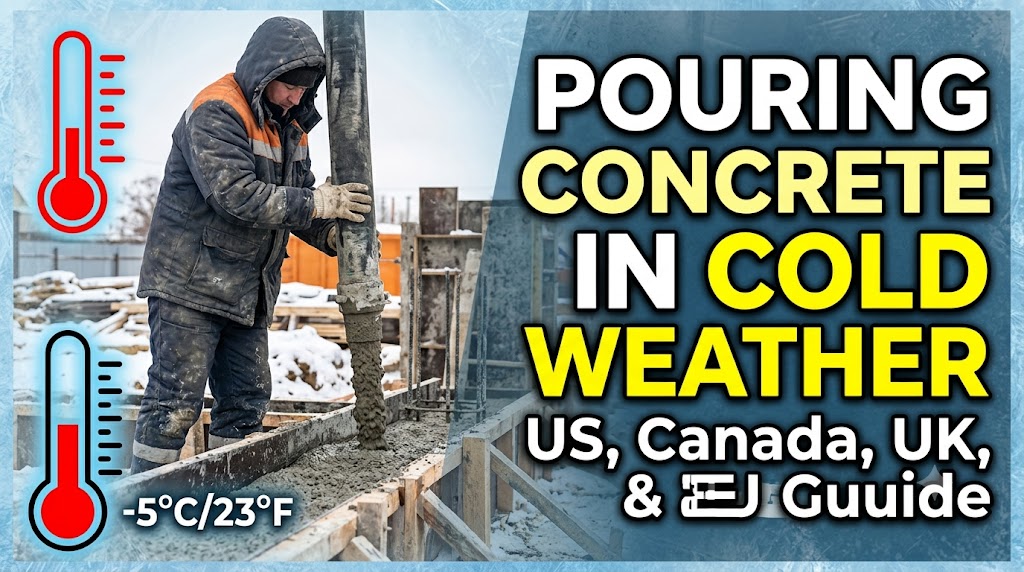
Cold weather concreting begins at 40°F / 4°C air temperature — not 32°F / 0°C. At 40°F, ground temperatures and subgrade conditions are already impacting the mix, and the 3-day forecast matters as much as conditions at placement. ACI 306R, CSA A23.1 (Canada), and BS 8500 (UK) all treat 5°C / 41°F as the threshold below which elevated protection measures apply.
Cold weather concrete temperature requirements by standard
The minimum concrete temperature at point of placement — not batch plant — varies by slab thickness. Thinner sections lose heat faster and require higher initial temperatures. Use the Concrete Curing Time Estimator to model temperature-adjusted strength gain curves for your specific conditions before committing to a pour date.
| Section thickness | Min concrete temp (moderate cold) | Min concrete temp (extreme cold) | Standard reference | Minimum protection period |
| <12 in / 300 mm | 55°F / 13°C | 65°F / 18°C | ACI 306R Table 5.1 | 7 days |
| 12–36 in / 300–900 mm | 50°F / 10°C | 60°F / 16°C | ACI 306R Table 5.1 | 7 days |
| >36 in / 900 mm (mass) | 45°F / 7°C | 55°F / 13°C | ACI 306R Table 5.1 | 7 days |
| Any (UK, BS 8500) | 50°F / 10°C | 50°F / 10°C | BS 8500 / CIRA C660 | 7 days min |
| Any (Canada, CSA) | 50°F / 10°C | 50°F / 10°C | CSA A23.1 Cl. 7.5 | 7 days, longer for SCM mixes |
“Moderate cold” in ACI terms means air temperatures between 25°F and 40°F / -4°C and 4°C; “extreme cold” means below 25°F / -4°C. These are air temperatures, not wind-chill values — wind-chill affects exposed humans but does not directly affect concrete temperature below the surface. Wind speed does accelerate surface moisture evaporation and heat loss from exposed fresh concrete.
Regional conditions: US, Canada, UK, and EU
United States and Canada
The Midwest and Prairie provinces present the most challenging winter concreting environment in North America — Chicago averages 18°F / -8°C in January; Winnipeg averages 0°F / -18°C. ACI 306R is the primary standard; the International Building Code (IBC) references it directly. Canadian practice follows CSA A23.1, which is closely aligned with ACI 306R but adds requirements for freeze-thaw durability: air entrainment is mandatory in all exposed concrete in freeze-thaw exposure zones F1 and F2. ASTM C260-compliant air-entraining admixtures at 4–8% air content by volume are the standard requirement.
The Frost Depth / Footing Depth Calculator provides state- and province-level frost line depths based on ASCE 7 and NBC climate data — essential for any footing or foundation work in winter conditions. Frost depths range from 6 inches / 150 mm in coastal Georgia to 72 inches / 1,830 mm in northern Minnesota and Manitoba.
United Kingdom
The UK’s maritime climate means sustained deep freezes are rare in southern England but common in Scotland and the north — January averages range from 39°F / 4°C in London to 34°F / 1°C in Aberdeen. BS 8500-1:2015 and the Concrete Society Technical Report 34 govern cold-weather practice. CIRIA C660 (Early-age Thermal Crack Control) is the standard reference for managing thermal gradients in mass pours. The key UK-specific risk is repeated freeze-thaw cycling rather than sustained extreme cold — temperatures hovering near 32°F / 0°C for weeks with daily cycling are more damaging to early-age concrete than a single sharp frost.
EU (Germany, Scandinavia, Poland, Alpine regions)
EN 13670 (Execution of Concrete Structures), used alongside the Eurocode 2 (EN 1992) structural design framework, governs cold-weather concrete across the EU including Scandinavia — Norway and Sweden both moved their structural concrete design basis onto Eurocode 2 over a decade ago, so older national codes like NS 3473 and BBK are legacy references rather than current practice. Germany’s DIN 1045 and the ÖVBB guidelines in Austria specify that no concrete shall be placed when the temperature at point of delivery is below 5°C / 41°F without specific protective measures detailed in a Method Statement. Scandinavian practice routinely specifies heating of enclosures and formwork in winter, with insulated timber form systems achieving R-values of 3–5 to maintain concrete temperature above 10°C for 7 days.
Heating, insulation, and protection methods by temperature range
| Air temp at pour | Required measures | Form stripping (guideline) | Notes |
| 40–50°F / 4–10°C | Warm batch water; insulated blankets on exposed surfaces | 48–72 hours | Standard cold-weather precautions |
| 28–40°F / -2–4°C | Warm batch water + heated subgrade; insulated enclosure if thin slab | 72–96 hours | Air entrainment required for exposed flatwork |
| 18–28°F / -8 to -2°C | Heated enclosure; heated mix water; pre-heat aggregates | 5–7 days minimum | Do not use CaCl2 with rebar at these temps |
| Below 18°F / -8°C | Heated enclosure mandatory; consider delaying | 10+ days | Core temp monitoring required; ACI 306R Appendix B |
Heating batch water is the most cost-effective temperature control — water has high specific heat (1.0 BTU/lb/°F vs 0.22 for aggregate) but accounts for only 6–8% of mix mass. Heating aggregate is more effective by mass but logistically complex. Never heat water above 180°F / 82°C before adding cement — superheated water in contact with cement causes flash set.
Common mistakes in cold weather concreting
1. Failing to heat the subgrade. Frozen subgrade acts as a heat sink — it will draw heat out of fresh concrete faster than any insulating blanket can compensate from above. ACI 306R requires that all ice, snow, and frost be removed from the subgrade, and that subgrade temperature at the surface be above 32°F / 0°C at time of placement. Use propane ground thaw heaters for a minimum of 24 hours prior to pour on frozen ground.
2. Misjudging “warm enough” on sunny winter days. A bright, calm winter day at 45°F / 7°C feels adequate. But after sunset, temperatures can drop to 20°F / -7°C within hours. Concrete placed at 2 PM may be exposed to freezing temperatures before it reaches 500 psi / 3.5 MPa — the ACI threshold below which freeze damage is permanent. Always plan for the overnight low, not the afternoon high.
3. Using calcium chloride accelerator with steel reinforcement. Calcium chloride (CaCl2) is an effective accelerator in plain concrete but causes accelerated corrosion in steel-reinforced structures. Above 1% by cement weight, it is prohibited in reinforced concrete by ACI 318 in all conditions. Use non-chloride accelerators (ASTM C494 Type C or E) in reinforced work — the Concrete Admixture Dosage Calculator gives correct dosage ranges for non-chloride alternatives.
4. Stripping forms before minimum in-place strength is verified. The schedule pressure to reuse formwork is real, but concrete at 35°F / 2°C may take 3–4 times longer to reach stripping strength than at 70°F / 21°C. A Schmidt rebound hammer or a pocket penetrometer provides a non-destructive field check. For critical structural elements, break field-cured cylinders stored adjacent to the pour at ambient conditions — they give the most accurate in-place strength estimate.
Related calculators you might need
Cold-weather pours often require more volume than estimated due to protective waste (overpour into heated enclosures, spillage from handling). The Concrete Waste Factor Calculator quantifies realistic overage and helps avoid costly short loads. For footings below the frost line, the Concrete Footing Calculator paired with the Frost Depth / Footing Depth Calculator gives the full volume and depth picture. If you’re heating the enclosure and running diesel or propane heaters for several days, factor that into the Full Concrete Project Estimator — heating costs on a 5-day winter pour can exceed $500–$2,000 depending on enclosure size.
Frequently asked questions
What is the minimum temperature to pour concrete?
The minimum safe air temperature at time of placement is 40°F / 4°C, with concrete mix temperature maintained at 50–65°F / 10–18°C depending on section thickness. Below 40°F / 4°C air temperature, active heating is required. Below 27°F / -3°C, concrete placed without full enclosure heating and ground thaw will almost certainly suffer irreversible freeze damage if protection fails.
Can I pour concrete when it’s going to freeze tonight?
Only if you can guarantee concrete reaches 500 psi / 3.5 MPa before freezing occurs — typically requiring 24+ hours at 50°F / 10°C or higher. If tonight’s low is at or below 32°F / 0°C and you cannot guarantee that temperature maintenance, do not pour. The $200–$400 saved by pouring today versus waiting is not worth the cost of a slab that must be demolished and replaced.
How do you keep concrete warm in winter?
Three tools, used in combination based on severity: insulated curing blankets (R-2 to R-4) on all exposed surfaces immediately after screeding; heated enclosures (plywood or poly sheet tenting with propane or electric heat) for temperatures below 25°F / -4°C; and concrete heating blankets (electric resistance heating pads) for critical structural pours. Monitor concrete temperature at depth with embedded thermocouples or thermal probes, not surface IR guns.
Does cold weather affect concrete strength permanently?
Yes, if freezing occurs before 500 psi / 3.5 MPa in-place strength is achieved. The ice formation physically disrupts the calcium silicate hydrate matrix being formed by hydration. Once disrupted, subsequent warming and curing cannot restore the concrete to design strength. If freezing occurs after 500 psi is confirmed, the concrete may recover most of its strength with continued curing, though the surface will show some scaling.
Is air entrainment required for cold weather concrete?
Air entrainment is required for all exposed concrete subject to freeze-thaw cycles regardless of whether it was placed in cold weather. ACI 318 Table 26.4.2.1 specifies 4.5–7.5% total air content for 1-inch / 25 mm maximum aggregate size in severe exposure (F2). This applies to driveways, patios, sidewalks, and pool decks in freeze-thaw zones — not to interior slabs or foundations below frost line. Check the Concrete Air Entrainment Calculator for exposure class and target air content.