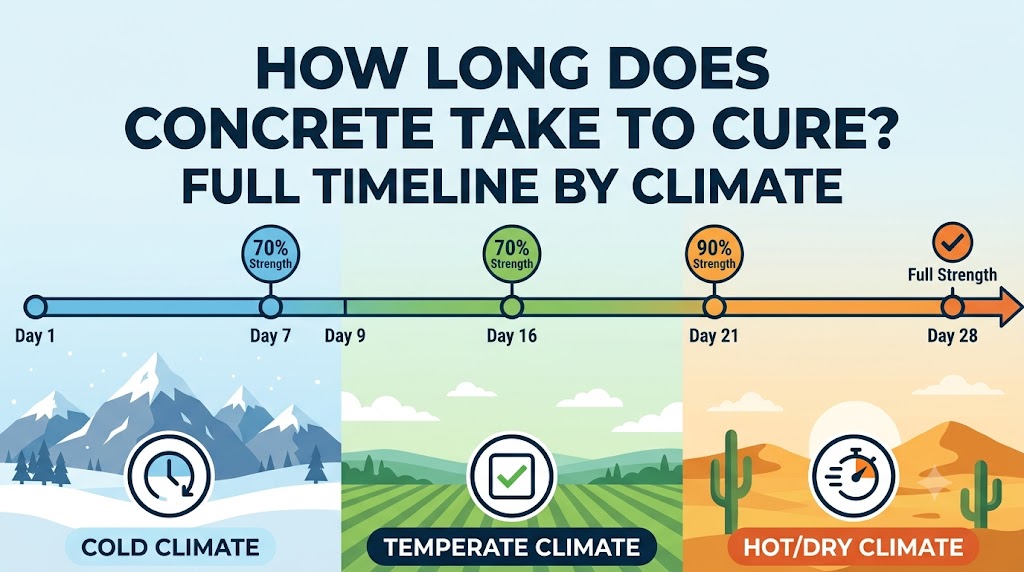
Concrete reaches design strength (typically 3,000–4,000 psi / 20–28 MPa) at 28 days under standard conditions — but you can walk on it after 24–48 hours and drive on it after 7 days. Those milestones assume moderate temperatures (60–80°F / 15–27°C) and adequate moisture. Change either variable and the entire timeline shifts.
Concrete curing timeline: what happens at each stage
Curing is not drying. It is a hydration reaction between water and cement particles (calcium silicate hydrate formation) that generates strength over time. Cutting off moisture too early stops the reaction; the concrete never reaches its rated strength, regardless of how long you wait after the fact.
Use the Concrete Curing Time Estimator to get a temperature-adjusted timeline for your specific pour conditions. The standard milestones below apply to Type I/II Portland cement mixed at a 0.45–0.50 water-cement ratio and cured at 70°F / 21°C:
| Time | Approx. Strength | Foot traffic | Vehicle traffic | Notes |
| 24–48 hours | ~1,000 psi / 7 MPa | Yes (carefully) | No | Avoid impact; no point loads |
| 3 days | ~1,800 psi / 12 MPa | Yes | No | Light equipment possible |
| 7 days | ~2,500 psi / 17 MPa | Yes | Passenger cars OK | ~65% of 28-day strength |
| 14 days | ~3,000 psi / 21 MPa | Yes | Yes | ~85–90% of 28-day strength |
| 28 days | Full design strength | Yes | Yes, incl. trucks | ACI standard benchmark |
| 90 days+ | >28-day strength | Yes | Yes | Strength continues rising slowly for years |
These percentages follow the typical strength-gain curve for standard OPC mixes used across concrete technology references. Supplementary cementitious materials (SCM) alter the curve: fly ash slows early-age gain; GGBS (slag) can push final strength higher but takes longer to get there.
How temperature affects concrete curing time
Temperature is the single biggest variable outside mix design. The Arrhenius relationship governs cement hydration — roughly, every 18°F / 10°C drop in temperature halves the reaction rate. Every 18°F / 10°C rise roughly doubles it (up to a threshold where flash setting becomes a risk).
| Curing temp | Days to 3,000 psi | Days to 28-day equiv. | Risk |
| 95°F / 35°C | ~3–4 days | ~18–20 days | Plastic shrinkage, rapid moisture loss |
| 70°F / 21°C | ~7 days | 28 days | Baseline — no special measures needed |
| 50°F / 10°C | ~14 days | ~50 days | Slow gain; keep forms longer |
| 40°F / 4°C | ~21 days | ~70+ days | Minimum viable curing temp (ACI 306) |
| Below 32°F / 0°C | Curing stops | Indefinite | Water freezes; permanent damage if early |
At below 50°F / 10°C, ACI 306R (Cold Weather Concreting) requires that concrete be maintained at a minimum of 50°F / 10°C for at least the first 7 days of curing. At above 90°F / 32°C, ACI 305R (Hot Weather Concreting) protocols apply — shading, chilled mix water, retarders, and accelerated curing compound application all become necessary tools.
Humidity and wind: the overlooked curing killers
High ambient temperature alone is manageable. High temperature + low humidity + wind is where plastic shrinkage cracking becomes near-certain without intervention. ACI 305R estimates evaporation rate using the Menzel formula, which works from the vapor pressure difference between the concrete surface and the surrounding air — driven by concrete surface temperature, air temperature, relative humidity, and wind speed — rather than a simple plug-in equation, which is why it’s normally read off a nomograph or calculated with dedicated software rather than by hand. What matters in practice is the output: when the estimated evaporation rate exceeds 0.2 lb/ft²/hr (1.0 kg/m²/hr), precautionary measures are mandatory. Below that threshold, standard wet curing works. The Concrete Curing Time Estimator factors this in automatically rather than requiring a manual nomograph read.
High-altitude curing
Above 5,000 ft / 1,500 m, lower atmospheric pressure accelerates surface moisture evaporation independent of temperature. Evaporation rates at altitude can run 20–30% higher than sea-level equivalents at the same air temperature. Budget for additional curing compound or extend wet curing duration by at least 2 days.
Common mistakes that compromise concrete curing
1. Stripping forms too early in cold weather. Contractors routinely pull forms after 24 hours regardless of temperature. At 45°F / 7°C, concrete may still be below 500 psi / 3.5 MPa at 24 hours — far too weak to handle form removal stresses. ACI 347 form stripping guidelines specify minimum in-place strength, not minimum time. Use a maturity meter or at minimum a pocket penetrometer to verify before stripping.
2. Applying a curing compound over bleed water. Bleed water is still rising from the mix for 1–4 hours after placement. Applying a membrane-forming curing compound before bleed water has evaporated traps it beneath the surface, causing delamination and dusting. Wait until the surface sheen disappears and the imprint of your thumb barely registers — then apply the compound.
3. Using a garden hose to wet-cure flatwork. Intermittent wetting creates wet-dry cycles that cause differential shrinkage. Plastic shrinkage cracks can develop in the top 1/4 inch / 6 mm of the slab between watering cycles. Correct approach: saturate the surface once, apply wet burlap, cover with polyethylene sheet, and keep it sealed for the full curing period — minimum 7 days for residential, 14 days for structural.
4. Sawcutting control joints too late. The standard window is 4–12 hours after finishing (sooner in hot, dry, windy conditions). Waiting until the next morning on a hot-weather pour means random cracking has already initiated. Joints must be cut to a depth of T/4 to T/3 (where T = slab thickness) to be effective — a 4-inch / 100 mm slab needs a 1-inch / 25 mm deep cut minimum.
Related calculators you might need
Before the pour, confirm your volume is right using the Concrete Slab Calculator, which handles rectangular and irregular flatwork in both imperial and metric. If you’re mixing on-site, the Water-Cement Ratio Calculator helps you dial in the w/c ratio that directly determines how your curing timeline plays out — a w/c above 0.60 extends the curing window and reduces final strength. For hot pours where admixtures are involved, the Concrete Admixture Dosage Calculator handles retarder and accelerator dosing. If you’re planning to seal the surface after cure, the Concrete Sealer Coverage Calculator prevents over- or under-ordering.
Frequently asked questions
How long before I can drive on new concrete?
Passenger cars: 7 days minimum at standard temperatures. Heavy trucks and equipment: 28 days. Driving on concrete before 7 days risks surface crushing and permanent rutting, particularly if the mix was placed in hot weather with a higher w/c ratio. In cold weather (below 50°F / 10°C during curing), add at least 3–5 days to both thresholds.
Does concrete cure faster in hot weather?
It gains strength faster early on, but total curing quality is often worse. High temperatures accelerate hydration but also drive off moisture faster than the reaction can use it. The result is higher early strength but lower 28-day strength — a 10°F / 5.5°C increase in curing temperature can reduce 28-day compressive strength by 3–5%. Wet curing and curing compounds become non-negotiable above 85°F / 29°C.
What happens if concrete freezes during curing?
If concrete freezes before it reaches 500 psi / 3.5 MPa compressive strength (typically within the first 24 hours at standard mix designs), the ice expansion physically disrupts the hydrating cement matrix. That damage is permanent — the concrete will never reach design strength, regardless of subsequent warming and continued curing. ACI 306R requires protection to maintain a minimum 50°F / 10°C for the first 7 days.
How do I know when concrete has fully cured?
The Concrete Curing Time Estimator gives a calculated timeline based on your pour temperature. For structural verification, a Schmidt rebound hammer gives a non-destructive surface hardness reading. For precise in-place strength, break field-cured cylinder cores at 7, 14, and 28 days. For residential DIY work, the 28-day mark is the practical standard.
Can I speed up concrete curing?
Yes — within limits. Steam curing at 140–175°F / 60–80°C (used precast) achieves 28-day strength in 18–24 hours. On-site, external heating blankets can compress the timeline by 30–40% in cold weather. Chemical accelerators (calcium chloride, up to 2% by cement weight for non-reinforced work; non-chloride accelerators for rebar applications) can push 3-day strength to near 7-day levels. None of these eliminate the 28-day requirement for structural load applications.
Is 28 days really when concrete stops curing?
No. ACI uses 28 days as the standard test benchmark because strength gain is roughly 90–95% complete by then. Concrete continues hydrating — and gaining strength — for years, provided moisture is present. 90-day strength often exceeds 28-day strength by 10–20% in mixes with fly ash or slag. The 28-day number is an engineering benchmark, not a biological endpoint.