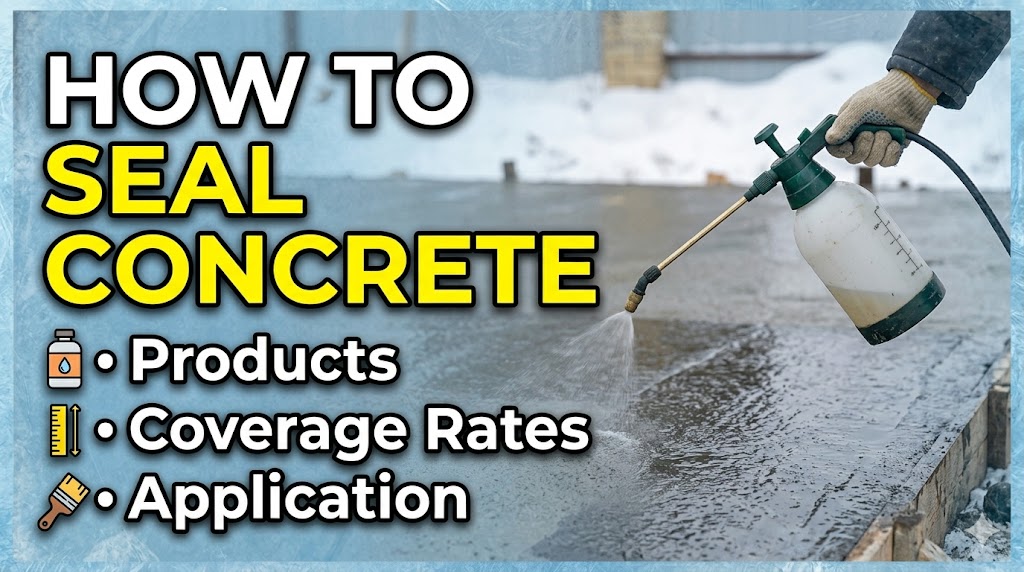
Most concrete surfaces need sealing within 28 days of curing — and then every 1–10 years depending on product type, traffic, and exposure. Skip this step and you get water infiltration, freeze-thaw spalling, staining, and surface degradation that shortens slab life by a decade or more.
Before ordering sealer, calculate your coverage needs precisely. The Concrete Sealer Coverage Calculator takes your surface area and selected product type and returns exact gallons (or litres) required, including a standard 10% waste factor for edges and re-coat overlap.
Which concrete sealer do you actually need?
The sealer category determines everything: penetration depth, surface sheen, durability, and whether you need to strip and reapply or can simply recoat. The four main types are not interchangeable.
| Sealer Type | Mechanism | Best For | Reapply Interval |
| Acrylic (solvent-based) | Surface film | Driveways, patios, decorative concrete | 1–3 years |
| Acrylic (water-based) | Surface film | Indoor slabs, low-traffic areas | 1–2 years |
| Penetrating silane/siloxane | Subsurface absorption | Exposed aggregate, pavers, bridge decks | 3–7 years |
| Polyurethane | Thick surface film | Garage floors, commercial floors | 3–5 years |
| Epoxy | Chemical bond surface coat | Warehouses, workshops, high-load floors | 5–10 years |
Solvent-based acrylics penetrate slightly better and enhance colour more aggressively than water-based equivalents — useful on stamped or exposed aggregate surfaces. But they off-gas VOCs, require solvent cleanup, and are restricted in some US states (California, specifically). Water-based acrylics are lower-odour and clean up with water, but offer less UV resistance on outdoor surfaces.
Penetrating sealers (silane, siloxane, or blended silane-siloxane) do not form a film — they chemically react with calcium silicate in the concrete and become part of the matrix. The surface looks unchanged after application. These are the right choice anywhere you need water repellency without altering appearance: exposed aggregate driveways, stamped concrete in HOA-controlled communities, or architectural concrete where sheen would look wrong.
Coverage rates and how much sealer to buy
Coverage varies by product and surface porosity. Manufacturers publish theoretical coverage rates, but actual coverage on rough or porous concrete typically runs 15–30% lower than the label figure, with the exact drop depending on product type — see the table below.
| Product Type | Theoretical Coverage | Practical Coverage (rough/porous) | Coats Required |
| Solvent acrylic | 200–300 sq ft/gal (4.9–7.4 m²/L) | 150–200 sq ft/gal (3.7–4.9 m²/L) | 2 |
| Water-based acrylic | 250–400 sq ft/gal (6.1–9.8 m²/L) | 200–300 sq ft/gal (4.9–7.4 m²/L) | 2 |
| Silane/siloxane penetrating | 100–200 sq ft/gal (2.5–4.9 m²/L) | 80–150 sq ft/gal (2.0–3.7 m²/L) | 1–2 |
| Polyurethane | 300–400 sq ft/gal (7.4–9.8 m²/L) | 250–350 sq ft/gal (6.1–8.6 m²/L) | 2 |
| Epoxy | 200–250 sq ft/gal (4.9–6.1 m²/L) | 150–200 sq ft/gal (3.7–4.9 m²/L) | 2 |
Worked example: a 500 sq ft (46.5 m²) driveway sealed with a solvent-based acrylic at a practical rate of 175 sq ft/gal needs 500 ÷ 175 = 2.86 gallons per coat, or 5.71 gallons for two coats. Add 10% for waste and you are ordering 6.3 gallons — round up to 7.
Step-by-step application: what the manufacturer instructions skip
Surface preparation
New concrete must cure for a minimum of 28 days before sealing — 3 days is inadequate regardless of what some product labels suggest. The slab needs to reach full hydration so sealer does not trap bleed water or inhibit strength gain. On existing concrete, remove all oil stains with a degreaser, acid-etch efflorescence with a 10% muriatic acid solution (diluted 1:10 with water), and pressure wash at 3,000 psi (207 bar) minimum. Allow 24–48 hours of drying time after washing — moisture in the slab will cause acrylic sealers to turn white (blushing).
Application method by product type
Solvent-based acrylics: apply with a 3/8 inch (9.5 mm) nap roller or pump sprayer. Rollers give better penetration on rough surfaces. Work in 10 ft (3 m) sections and maintain a wet edge to avoid lap marks. For stamped concrete, a pump sprayer followed by a short-nap roller works back-coded sealer into the pattern grooves.
Penetrating sealers: low-pressure pump sprayer only — rollers spread the product too thinly for absorption. Apply liberally until the surface is wet but not puddling. Wipe back any excess with a dry brush within 15–20 minutes to avoid surface crystallisation.
Polyurethane and epoxy coatings: these require two-part mixing (for epoxy) or careful humidity control (for polyurethane, which reacts with atmospheric moisture). Apply at temperatures between 50°F and 90°F (10°C and 32°C). Do not apply polyurethane if humidity exceeds 85% — the coating will bubble.
Common mistakes that waste product and wreck the finish
Applying to wet concrete. Blushing — the white, cloudy film that appears under acrylic sealers — is almost always caused by residual moisture in the slab. Wait 48 hours after any rain or washing. Test with plastic sheeting: tape a 18 x 18 inch (450 x 450 mm) sheet to the concrete for 16 hours. If condensation forms underneath, it is too wet to seal.
Over-applying in one heavy coat. One thick coat traps solvent and creates a sticky, peeling finish. Two thin coats at the correct coverage rate bond better and last longer. Allow the first coat to tack off (30–60 minutes for acrylics) before applying the second.
Sealing over contaminated concrete. Engine oil and food grease polymerise into the concrete surface. Sealer applied over them creates a film that peels in sheets within months. Use a commercial degreaser at full concentration, scrub with a stiff-bristle brush, and rinse. A simple water rinse does nothing to oil — you need the degreaser.
Using the wrong sealer for the exposure. Acrylic sealers on garage floors exposed to road salts and fuel spills fail within 18 months. Polyurethane or epoxy coatings are the minimum for vehicle traffic. Penetrating sealers are not decorative products — applying one expecting a sheen produces no visible result.
Related calculators you might need
If you are sealing a freshly poured slab, start with the Concrete Slab Calculator to confirm your pour volume before moving to sealer quantities. For stamped concrete specifically, the Stamped Concrete Calculator factors in pattern complexity and base slab area together. If you are pricing the full job, the Full Concrete Project Estimator covers materials, labour, and finishing costs in one pass. For resurfacing older concrete before sealing, the Concrete Resurfacing Calculator estimates overlay material quantities by area and depth.
Frequently asked questions
How long after pouring concrete can I seal it? Wait a minimum of 28 days. Concrete reaches approximately 70% of its design strength at 7 days and continues hydrating for months. Sealing too early traps bleed water and inhibits hydration, which reduces surface strength and causes the sealer to delaminate.
How many coats of concrete sealer do I need? Film-forming sealers (acrylic, polyurethane, epoxy) require two coats. The first coat partially absorbs into the surface; the second builds the protective film. Penetrating sealers are typically one coat on smooth concrete, two coats on porous or rough surfaces. More than two coats of acrylic traps solvent and creates a peeling film.
What is the coverage rate for concrete sealer? Expect 150–300 sq ft per gallon (3.7–7.4 m²/L) depending on product and surface porosity. Smooth, dense concrete covers at the high end; rough, open-textured surfaces absorb more and cover less. Use the Concrete Sealer Coverage Calculator to get a project-specific quantity with waste factor included.
Can I seal concrete myself or do I need a contractor? Acrylic sealers are routinely applied by homeowners. The process — surface prep, roller or sprayer application, two coats — requires no specialist equipment. Epoxy coatings on garage floors are also DIY-feasible but demand more precise mixing and faster application. Two-part polyurethane and commercial-grade coatings benefit from contractor application due to pot life limitations and humidity sensitivity.
Why is my concrete sealer turning white and cloudy? This is blushing, caused by moisture trapped under the sealer film during application. The fix depends on severity: light blushing on acrylics sometimes resolves as the moisture escapes through a thin film. Heavy blushing requires stripping the sealer with a xylene solvent or chemical stripper, allowing the slab to dry completely (48–72 hours minimum), and reapplying.
How long does concrete sealer last? Acrylic sealers last 1–3 years on driveways with vehicle traffic. Penetrating silane/siloxane sealers last 3–7 years. Polyurethane coatings last 3–5 years. Epoxy floor coatings last 5–10 years but are susceptible to UV yellowing if not topcoated with polyurethane.