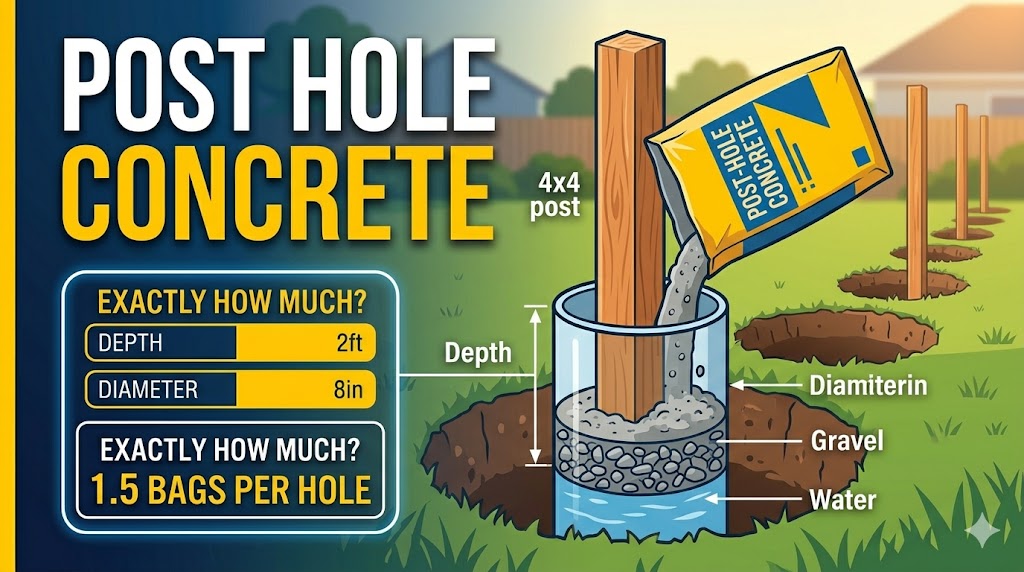
A standard 4-inch / 100 mm diameter post in a 10-inch / 254 mm wide hole requires roughly 0.46 cubic feet / 0.013 m³ of concrete per foot of depth — but the actual volume depends on your hole diameter, hole depth, and post size. Get those three numbers right, and waste drops to near zero.
How to Calculate Post Hole Concrete Volume
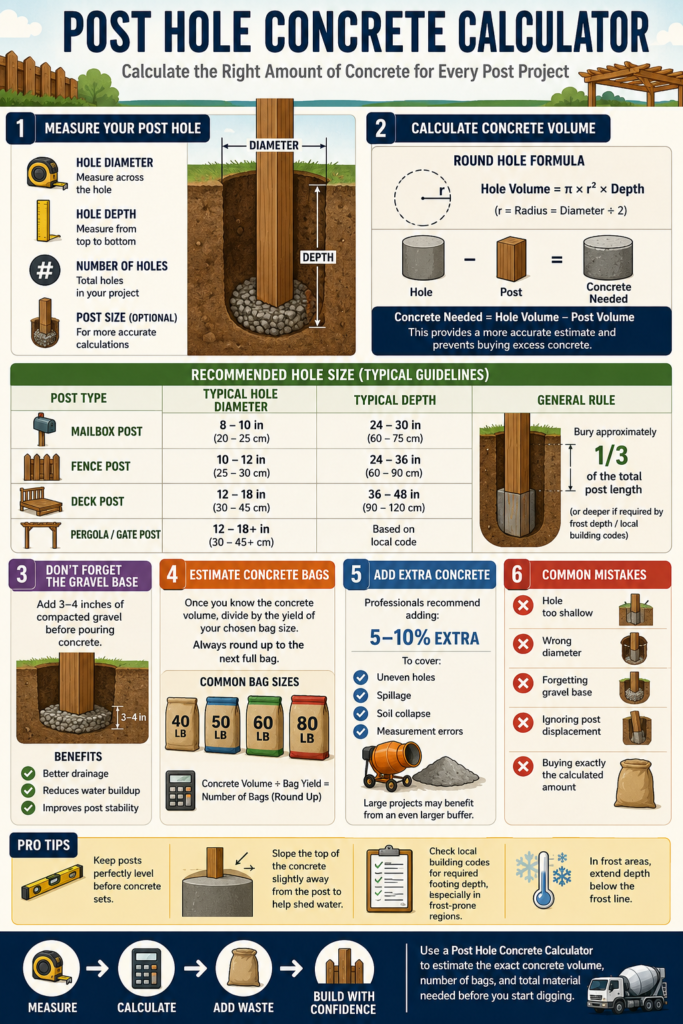
The formula treats the hole as a cylinder and subtracts the volume of the post itself:
Volume = π × r² × depth − post cross-section × depth
Where r is the radius of the hole. In practice, the post volume is small enough that most contractors skip the subtraction for wood posts — it matters more for large-diameter steel or concrete posts.
Worked example: a 10-inch / 254 mm diameter hole, 36 inches / 914 mm deep, for a 4×4 (3.5-inch / 89 mm actual) wood post.
- Hole radius = 5 inches / 127 mm = 0.417 ft / 0.127 m
- Hole volume = π × (0.417)² × 3 ft = 1.636 ft³ / 0.0463 m³
- Post cross-section = 3.5 × 3.5 = 12.25 in² = 0.0851 ft²
- Post volume = 0.0851 × 3 = 0.255 ft³ / 0.0072 m³
- Net concrete volume = 1.636 − 0.255 = 1.38 ft³ / 0.039 m³
A 60 lb bag yields approximately 0.45 ft³. With a 10% waste allowance, this hole needs 1.38 × 1.10 = 1.52 ft³, or 3.4 bags — round up to four 60 lb bags. For a fence project with 20 identical holes, that’s roughly 68 bags total calculated in bulk off total volume, rather than rounding up per hole, which wastes more material.
Skip the manual calculation — the post hole concrete calculator handles this for any hole size, depth, and post dimension, and outputs total bags across multiple holes at once.
Post Hole Concrete Volume by Common Hole and Depth Combinations
The table below shows net concrete volume (after subtracting a standard 4×4 post) for the most common post hole configurations, with bag counts including a 10% waste allowance.
| Hole diameter | Depth | Net volume (ft³) | 60 lb bags needed |
| 8 in / 203 mm | 24 in / 610 mm | 0.53 | 2 |
| 8 in / 203 mm | 36 in / 914 mm | 0.79 | 2 |
| 10 in / 254 mm | 36 in / 914 mm | 1.38 | 4 |
| 10 in / 254 mm | 48 in / 1219 mm | 1.84 | 5 |
| 12 in / 305 mm | 42 in / 1067 mm | 2.45 | 6 |
| 12 in / 305 mm | 48 in / 1219 mm | 2.80 | 7 |
| 16 in / 406 mm | 48 in / 1219 mm | 5.25 | 13 |
A 60 lb bag yields approximately 0.45 ft³ / 0.013 m³. An 80 lb bag yields roughly 0.60 ft³ / 0.017 m³. If you’re buying 80 lb bags instead, divide net volume (× 1.10 for waste) by 0.60 rather than 0.45. Ordering across many holes with different diameters? The waste factor calculator lets you set a custom percentage instead of the flat 10% used here.
How deep do post holes need to be?
Depth is determined by two factors: frost depth and the structural load the post carries.
In cold climates, the bottom of the footing must sit below the local frost depth or frost heave will push the post up over successive freeze-thaw cycles. Frost depth ranges from 0 in parts of Florida and southern California to over 60 inches / 1524 mm in Minnesota and northern Canada. The frost depth and footing depth calculator gives region-specific depths by US zip code and Canadian province.
The rule of thumb used by most fence and deck contractors is to set posts at least one-third of their above-ground height into the ground. A 6-foot / 1.83 m fence post needs a minimum 2-foot / 610 mm embedment, but in freeze-prone zones that often extends to 3–4 feet / 914–1219 mm.
For structural applications — deck posts carrying live loads, carport columns, pergola supports — engineered footings sized by a structural engineer replace rule-of-thumb depths. In those cases, the concrete column and pier calculator is the more appropriate tool.
Common mistakes when filling post holes with concrete
Adding too much water to the mix. Contractors and DIYers frequently add extra water to make bagged mix easier to pour into the hole. Every additional pint of water above the recommended ratio raises the water-cement ratio and drops final compressive strength. A mix that pours like soup may hit only 2,000 psi / 14 MPa instead of the 4,000 psi / 28 MPa printed on the bag. Add water conservatively — the mix should be stiff enough to hold a mound shape before it settles into the hole.
Skipping the gravel drainage layer. Placing concrete directly on undisturbed soil in clay-heavy ground traps moisture against the post base. The correct approach is 4–6 inches / 100–152 mm of compacted gravel at the bottom of the hole before pouring — use the gravel and crushed stone calculator to size that layer for your hole count. This allows water to drain away from the post and reduces post rot in wood applications.
Undersizing hole diameter for the post. A hole only slightly wider than the post leaves no room to plumb the post accurately before the concrete sets, and the thin concrete shell around the post lacks the bearing area to resist lateral loads. The minimum hole diameter is roughly 3× the post width for wood posts — so a 4×4 / 89 mm post needs at least a 10–12 inch / 254–305 mm hole depending on which standard auger bit you’re working with (10 inches for light fence work, 12 inches for structural applications). If you’re forming the hole with a sonotube rather than digging free-form, the concrete tube / sonotube calculator keeps the diameter consistent top to bottom and calculates volume directly from the tube size.
Pouring in cold weather without precautions. Fresh concrete that freezes before reaching initial set will not gain strength and will be permanently weakened. Below 40°F / 4°C, use warm mix water and cover the exposed hole opening with insulating blankets for at least 24–48 hours. Below 20°F / -7°C, postpone the pour or use a heated enclosure.
Related calculators you might need
For more foundation and footing tools beyond post holes, browse the full foundations and footings calculator hub. Once you know how many cubic feet of concrete each hole requires, the concrete bags calculator converts total volume into exact bag counts across 40 lb, 60 lb, and 80 lb sizes — useful when buying in bulk from a home centre. For larger post and column footings poured from a ready-mix truck, the concrete truck load calculator helps you determine whether you need a full load or will be paying a short-load surcharge. If your project also includes a deck or slab over the posts, the concrete footing calculator handles pad-style and continuous footings. For total project budgeting, the full concrete project estimator rolls materials, labour, and delivery into a single cost figure.
Frequently asked questions
How many bags of concrete do I need for a fence post?
For a standard 8-inch / 203 mm diameter hole at 30 inches / 762 mm deep, plan on two 60 lb bags. For a 10-inch / 254 mm hole at 36 inches / 914 mm deep, plan on four 60 lb bags. These figures include a 10% waste allowance. For multiple posts, it’s more efficient to total the volume first and divide by bag yield once, rather than rounding up per hole. The post hole concrete calculator gives exact figures for any combination of hole size and depth.
What is the right concrete mix for post holes?
A minimum 3,000 psi / 21 MPa mix is standard for fence posts; 4,000 psi / 28 MPa is preferred for deck and structural posts. Most bagged fast-setting mixes (Quikrete Fast Setting, SAKRETE, and equivalents) reach 4,000 psi at 28 days. Do not use general-purpose sand mix — it lacks the coarse aggregate needed for load-bearing footings.
Can I pour dry concrete into a post hole without mixing first?
Yes, for fast-setting mixes specifically labelled for dry-pour use. You pour dry mix into the hole, then add water on top; the mix absorbs moisture from the surrounding soil and the added water. This technique works in moist soil conditions. In dry, sandy soil the mix may not hydrate fully — in that case, mix in a bucket first. Standard bagged concrete should always be pre-mixed before pouring.
How long before I can hang a gate on a concrete-set post?
Fast-setting concrete reaches sufficient strength to accept light loads (fence rails, gate hardware) in 4 hours at 70°F / 21°C. Standard concrete needs 24–48 hours before loading. Full design strength takes 28 days regardless of mix type. The concrete curing time estimator adjusts cure timelines by temperature, so you can plan accurately in cold or hot conditions.
How deep should a post hole be for a 6-foot fence?
The structural minimum is one-third of above-ground height — 2 feet / 610 mm for a 6-foot / 1.83 m fence. In frost-prone climates, the code minimum is often 3–4 feet / 914–1219 mm to clear the frost line. Check your local building code; most jurisdictions require permits and inspections for fence installations on boundary lines.
Does the shape of the hole bottom affect how much concrete I need?
Yes. A flat-bottomed hole requires less concrete than a rounded or irregular bottom. Hand-dug holes in rocky ground often have irregular profiles that can add 15–20% more volume than the calculated cylinder. Flare the bottom of structural footings — a bell shape 1.5× the hole diameter — to increase bearing area in soft soil, but account for that added volume when ordering bags.