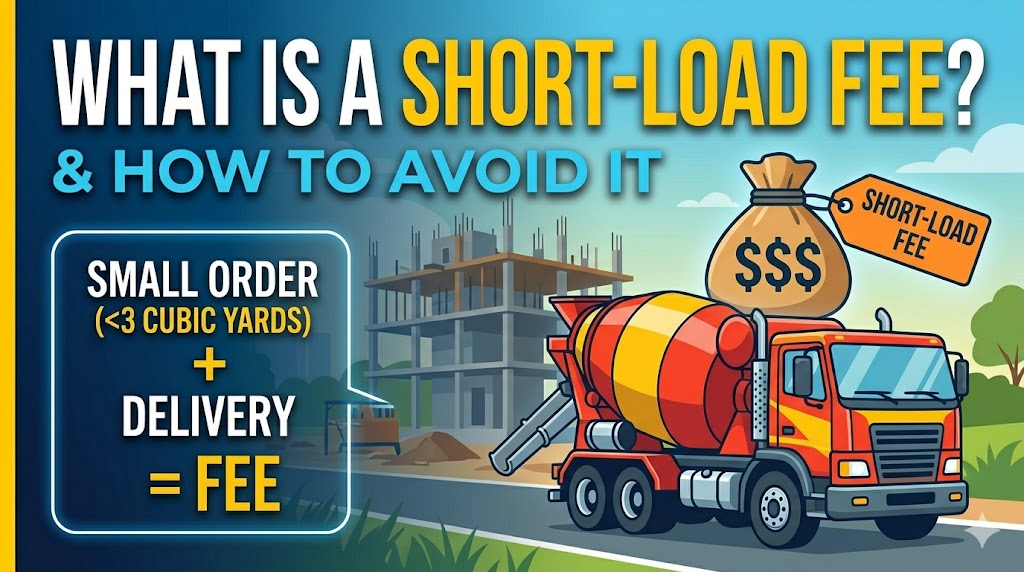
A short-load fee is a surcharge applied by ready-mix concrete suppliers when your order falls below their minimum delivery volume — typically 8–10 cubic yards / 6.1–7.6 m³. The fee ranges from $50 to $250 per cubic yard under the minimum, which can add $400–$1,200 to a small pour that was already borderline on budget.
How short-load fees are calculated
Ready-mix plants price their trucks on a full-load model. A standard transit mixer carries 8–10 cubic yards / 6.1–7.6 m³. When a customer orders less, the plant still dispatches the same truck, burns the same fuel, and ties up the driver for the same amount of time. The short-load fee compensates for the unused capacity.
The fee structure varies by supplier but typically follows one of two models:
- Flat-rate model: a fixed dollar amount charged per cubic yard below the minimum. If the minimum is 8 yards and you order 5 yards, you pay for 3 yards of shortfall at the surcharge rate.
- Graduated model: a smaller per-yard penalty near the minimum and a steeper one on smaller orders, designed to push customers toward the threshold.
Use the short load fee estimator to see your exact surcharge exposure before you call the plant, based on your order volume and supplier minimum.
A realistic example: you need 6.5 cubic yards / 4.97 m³ for a driveway apron and walkway extension. Your local plant charges $75 per yard under an 8-yard minimum — that’s a $112.50 short-load fee on top of base concrete costs.
Short-load fee comparison by typical order size
| Order volume (yd³) | Minimum threshold (yd³) | Shortfall (yd³) | Fee at $75/yd |
| 3.0 | 8.0 | 5.0 | $375 |
| 5.0 | 8.0 | 3.0 | $225 |
| 6.5 | 8.0 | 1.5 | $112.50 |
| 7.5 | 8.0 | 0.5 | $37.50 |
| 8.0+ | 8.0 | 0 | $0 |
Fee rates vary significantly by region and supplier. Urban markets with multiple plants tend to be more competitive; rural or remote sites often face higher minimums and steeper surcharges. Check the concrete price per yard by state page to see how your local market compares before you negotiate.
How to avoid paying a short-load fee
The most direct approach is to reach the minimum volume. Look at adjacent projects coming up in the next few weeks — a neighbour’s driveway apron, a garden retaining wall, or a shed pad that’s been deferred. Combining orders into a single truck pour eliminates the fee entirely and often lowers per-yard delivery costs too.
If there’s no adjacent pour to combine with, work out whether it’s cheaper to order up to the minimum and use the extra concrete, or pay the surcharge and order exactly what you need. Extra concrete can go toward walkway extensions, step repairs, or a small ancillary pad — plan the use before the truck arrives, since concrete doesn’t wait around.
Volumetric or metered trucks are a legitimate alternative for small pours. These trucks mix on-site and charge by the cubic yard actually dispensed — no minimum, no short-load fee. The per-yard cost runs 15–25% higher than plant-mixed concrete, but on a 3–4 yard order that premium is often less than the short-load surcharge from a conventional plant.
For truly small pours — under 1 cubic yard / 0.76 m³ — bagged concrete mixed on-site is almost always cheaper. Use the ready-mix vs bagged concrete cost calculator to find the crossover point for your specific volume and local pricing.
Timing matters too. Some plants waive or reduce short-load charges for off-peak deliveries — early morning, mid-week — when trucks would otherwise run light. Always ask the dispatcher directly; it costs nothing to ask.
Common mistakes that lead to unexpected short-load charges
- Not asking the supplier’s minimum before ordering. Short-load minimums aren’t always published. A customer assumes 5 yards because that’s what a neighbour said; the actual minimum is 8. Confirm the minimum volume and exact surcharge rate on the first call, before giving any project details.
- Calculating volume without a waste factor. Contractors often order the theoretical volume and find the pour runs short due to subbase variation, form blowouts, or measurement error. A second delivery to cover the gap triggers a separate short-load fee. Build in a 5–10% waste factor up front with the concrete waste factor calculator so the first order is enough.
- Treating the short-load fee as fixed. Many customers accept the quoted fee without pushing back. Plants have discretion, especially for repeat customers, commercial accounts, or an early-morning slot. A short conversation with the plant manager can eliminate or halve the fee on small orders.
- Defaulting to ready-mix when bagged or volumetric is the right tool. For isolated pours under 2 cubic yards / 1.53 m³ with no adjacent work, a standard ready-mix truck is the wrong call from the start — short-load fees, minimum charges, and drum residuals make it economically irrational. Compare total cost across supply methods before booking a truck.
Related calculators you might need
Before calling a supplier, know your exact volume. The concrete truck load calculator shows how many cubic yards your pour requires and whether it fills a standard truck. For the cost decision, the concrete delivery cost calculator builds up total delivered cost including base price, fuel surcharge, and short-load fees by region. If the numbers tip toward bagged concrete, the cubic yards to bags converter translates your volume into bag quantities across multiple bag sizes. If you’re quoting the job for a client, the concrete bid proposal generator turns your numbers into a client-ready estimate. For a full project cost summary, the full concrete project estimator rolls materials, delivery, and labour into a single line-item breakdown.
Frequently asked questions
What is a short load fee for concrete?
A short-load fee is a surcharge charged by ready-mix concrete plants when an order falls below their minimum delivery quantity. Minimums are typically 8–10 cubic yards; fees range from $50–$250 per yard under the threshold depending on the supplier and region. The fee exists because the plant incurs the full cost of dispatching a truck regardless of how much concrete it carries.
How do I avoid a short load concrete fee?
The three main strategies are: combine the pour with adjacent work to reach the minimum volume; use a volumetric (metered) truck that charges only for what’s dispensed; or choose bagged concrete for pours under 2 cubic yards / 1.53 m³. For borderline volumes, ask the supplier about off-peak delivery slots — plants sometimes waive fees to avoid running trucks empty.
Is it cheaper to use bags or ready-mix for a small pour?
For pours under 1 cubic yard / 0.76 m³, bagged concrete mixed on-site is almost always cheaper once short-load fees are factored in. Between 1 and 3 yards, it depends on local bag prices and the specific supplier’s fee structure. Use the ready-mix vs bagged concrete cost calculator to compare totals for your specific pour size and location.
Are volumetric trucks always cheaper than paying a short-load fee?
Not always — it depends on order size. Volumetric trucks charge 15–25% more per yard than plant-mixed concrete, but they have no minimum. On a 3–4 yard order, that premium is usually smaller than the short-load surcharge you’d pay from a conventional plant. On orders close to the minimum already, a standard truck plus the fee can still work out cheaper. Run both numbers before booking.
Do all concrete suppliers charge short-load fees?
Most ready-mix plants charge some form of short-load or minimum-order fee, but the threshold and rate vary widely. Some large operations in competitive urban markets have reduced minimums to 5 or 6 yards. Volumetric concrete suppliers typically don’t charge short-load fees — they charge per actual yard dispensed, making them cost-effective for small pours.
Can I order extra concrete to avoid the fee and use the leftovers?
Yes, and it’s often the right financial decision. Compare the per-yard cost of the extra concrete against the short-load surcharge. If your supplier charges $150/yd for concrete and the short-load fee is $75/yd for a 1-yard shortfall, ordering an extra yard costs $150 but gives you a usable cubic yard of material. Plan a use for it in advance — driveway patch, step footing, shed pad — so nothing goes to waste.