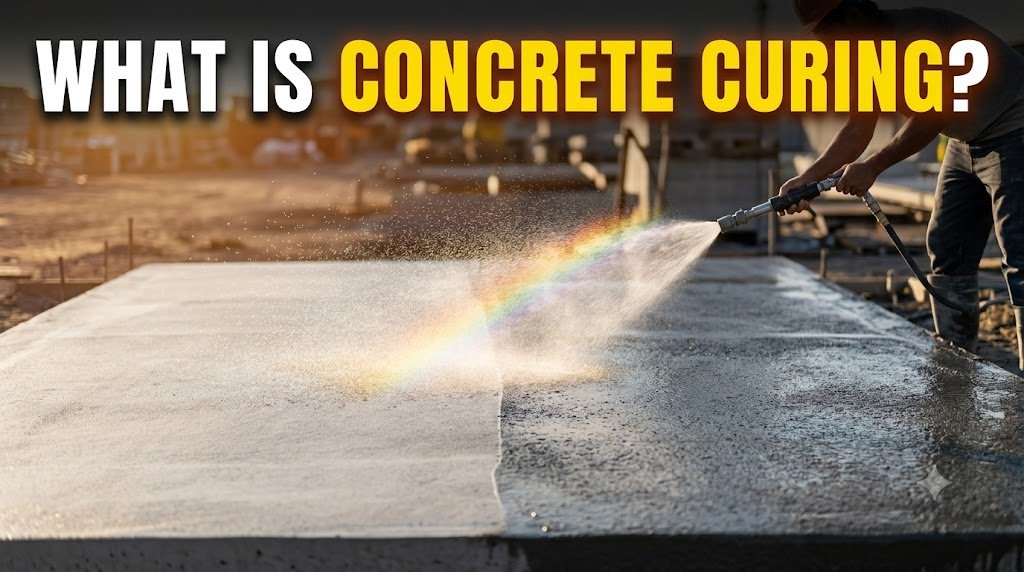
Concrete curing is the process of keeping freshly placed concrete moist and within a controlled temperature range so cement hydration can continue and the mix can reach its design strength. Under normal conditions, concrete reaches roughly 70% of its 28-day design strength in about 7 days and effectively full strength at 28 days — but that timeline stretches in cold weather and only holds if the slab is kept damp the entire time. Curing is not the same as drying: concrete that loses moisture too quickly stops hydrating before the cement has fully reacted, leaving it weaker, more porous, and prone to surface cracking. Skipping or shortening the curing period is one of the most common causes of slab failure.
Industry guidance (ACI 308, the standard guide to curing concrete) recommends a minimum of 7 days of continuous moist curing for most standard mixes, and longer for slower-setting or supplementary-cementitious blends. That 7-day figure is where the common rule of thumb comes from — but as this article covers, it’s a floor, not a fixed rule, because site temperature moves the whole curve.
How Long Does Concrete Take To Cure?
Cement hydration follows a fairly predictable strength-gain curve when temperature and moisture are held within normal ranges (10–25°C / 50–77°F, kept damp or sealed). At 3 days, a standard mix is around 40% of its 28-day strength. At 7 days it’s near 70%. At 14 days it’s around 90%, and by 28 days — the age used for standard compressive strength testing under ASTM C39 — it’s effectively at design strength, though hydration technically continues for years at a much slower rate.
| Age | Approx. % of 28-day strength | What it’s usually ready for (normal conditions) |
|---|---|---|
| 1 day | ~15% | Set but fragile; keep covered, no loads |
| 3 days | ~40% | Still curing; leave forms in place |
| 7 days | ~70% | Forms off; light foot traffic and cars |
| 14 days | ~90% | Most service loads acceptable |
| 28 days | ~100% (design strength) | Full load, heavy vehicles, sealing |
Temperature changes that curve significantly. Hydration slows sharply below 10°C (50°F) and essentially stops at freezing (0°C / 32°F), which is why cold-weather pours need insulating blankets or heated enclosures. Above 25°C (77°F), hydration accelerates, but the concrete also loses surface moisture faster, raising the risk of plastic shrinkage cracking before curing measures are even in place.
Because ambient temperature has this much influence on the schedule, a flat “7 days, then 28 days” rule doesn’t hold for every site. The concrete curing time estimator adjusts the strength-gain timeline for your actual site temperature, giving a more accurate date for form removal, foot traffic, or load-bearing use than the generic rule of thumb.
What Happens Chemically During Curing?
Cement hydration is a chemical reaction, not evaporation. Portland cement contains tricalcium silicate (C3S) and dicalcium silicate (C2S), which react with water to form calcium silicate hydrate (C-S-H) gel — the compound that actually binds aggregate together and gives concrete its strength — plus calcium hydroxide as a byproduct. The reaction is exothermic: a residential slab typically runs a few degrees warmer at its core than the surrounding air for the first 24–48 hours. The thicker the element, though, the more that heat builds up — mass pours like large footings or piers can reach tens of degrees hotter at the core, which introduces its own risk of thermal cracking as the hot interior and cooler surface expand at different rates.
This reaction needs water present in the capillary pores of the paste to keep going. If the surface dries out before hydration is far enough along, the reaction stops locally even though the interior is still damp — the result is a weak, dusting surface layer and a higher risk of shrinkage cracking, because the dry surface shrinks while the wet interior doesn’t. Three curing methods address this: ponding or continuous wetting (keeps the surface saturated directly), wet burlap or cotton mats (reduces evaporation while topping up moisture), and sprayed-on curing compounds (form a membrane that traps the mix’s own water inside). Plastic sheeting works the same way as a compound but needs to be sealed at the edges, or it just traps humid air instead of holding moisture against the slab. Sheeting can also leave mottled discoloration where it touches the surface unevenly, so it’s a poor choice where appearance matters.
Common Mistakes
Stripping forms too early is one of the most common errors on residential jobs. Forms hold moisture against the edges of a pour; removing them at 24 hours on a cool day exposes those edges to rapid drying and produces spalling and cracking along the perimeter within the first week. Wait until the concrete has reached at least 70% of design strength, generally 5–7 days in normal conditions, longer in cold weather.
Pouring in hot, dry, or windy weather without a curing plan already in place causes plastic shrinkage cracking — fine, random cracks that appear within the first few hours, before the concrete has even set. Contractors who wait until after finishing to think about curing are usually too late; the fix is scheduling curing compound application or wet covering within 30–60 minutes of finishing on hot or windy days. Evaporation retarders sprayed on between finishing passes buy time when conditions are severe.
Adding extra water to the mix on-site, thinking a wetter mix cures better, does the opposite. It raises the water-cement ratio, which increases porosity, reduces final strength, and increases both shrinkage and bleed water, which delays finishing and weakens the surface layer.
Treating curing and drying as the same thing leads to sealing a slab too soon. A sealer or coating applied before the slab has cured properly traps residual moisture underneath, which can cause blistering, delamination, or efflorescence months later. Most sealers shouldn’t go down until at least 28 days after the pour.
Related Calculators You Might Need
Curing time is directly affected by the mix itself, so it’s worth checking your water-cement ratio before you’re on-site — the water-cement ratio calculator helps confirm the mix isn’t unnecessarily wet, which shortens strength gain and increases cracking risk. If you need to convert a lab or field compressive strength reading between units, the concrete compressive strength converter handles PSI and MPa conversions so you can compare test results against the design strength you specified. For anyone still finalizing the mix itself, the concrete mix ratio calculator works out cement, sand, and aggregate proportions before the pour, which is the point where curing outcomes are actually decided. And if this is for a new slab, run the numbers first with the concrete slab calculator to confirm volume before ordering.
Frequently Asked Questions
How long does concrete need to cure before you can walk on it?
Concrete is generally safe for foot traffic after 24–48 hours, once it has set and reached roughly 25–30% of its design strength. That’s enough to resist light loads without leaving marks or disturbing the surface, but it’s not enough for anything heavier. Avoid dragging furniture, ladders, or equipment across it during this window, since point loads can still dent a surface that hasn’t fully hardened.
How long before you can drive on a new concrete driveway?
Wait a minimum of 7 days before light vehicle traffic, and ideally the full 28 days before parking heavier vehicles like trucks or RVs. At 7 days the slab is only around 70% of its design strength, which is enough for cars but risks surface damage under concentrated loads like jack stands or trailer tongues. Cold weather extends this timeline further, so check actual site temperatures before committing to a date.
How long before you can build or frame on a concrete foundation?
In normal conditions, framing loads are typically fine after about 7 days, once the concrete is near 70% of design strength — but this depends on the load and the design, and many crews wait longer to be safe. Heavy structural loads, backfill against foundation walls, or anything specified by an engineer should follow the project drawings rather than a rule of thumb. When in doubt, treat 7 days as the earliest reasonable point, not a target, and defer to the structural engineer on the job.
Can you over-cure concrete?
No — you cannot cure concrete too long, and keeping it moist beyond the minimum only helps. Extended moist curing continues to reduce porosity and improve durability, so leaving wet mats or ponding on longer than 7 days is never a problem. The only real “too long” is a scheduling one: sitting on a finished slab you need to seal or coat, since sealers generally shouldn’t go down until around 28 days regardless.
Does concrete cure underwater?
Yes — cement hydration doesn’t need air, only water, so concrete continues gaining strength when fully submerged, which is why ponding is a valid curing method. Underwater concrete for marine structures uses special mix designs, often with anti-washout admixtures, to prevent the cement paste from washing away before it sets, but standard concrete cured by ponding on land behaves the same way.
What happens if concrete dries out too fast?
Rapid surface drying stops hydration in the top few millimeters while the interior is still reacting, which causes plastic shrinkage cracking, a weak dusting surface, and reduced final strength at the surface layer specifically, even if the core strength is fine. This is most common on hot, windy, low-humidity days, and is prevented by covering or applying curing compound within an hour of finishing.
Do I need to cure concrete in cold weather?
Yes, and it matters more, not less. Hydration slows dramatically below 10°C (50°F) and essentially stops at freezing, so cold-weather pours need insulating blankets, heated enclosures, or accelerating admixtures to keep the reaction going. Fresh concrete also has to be protected from freezing outright in the first 24 hours — if the mix water freezes before it sets, the resulting ice damages the structure permanently. Use the concrete curing time estimator to see how a specific site temperature shifts your strength-gain timeline before deciding when forms can come off or loads can be applied.