Author: Concrete Calculator Writing Team

  • What Is a Short-Load Fee and How to Avoid It

    What Is a Short-Load Fee and How to Avoid It

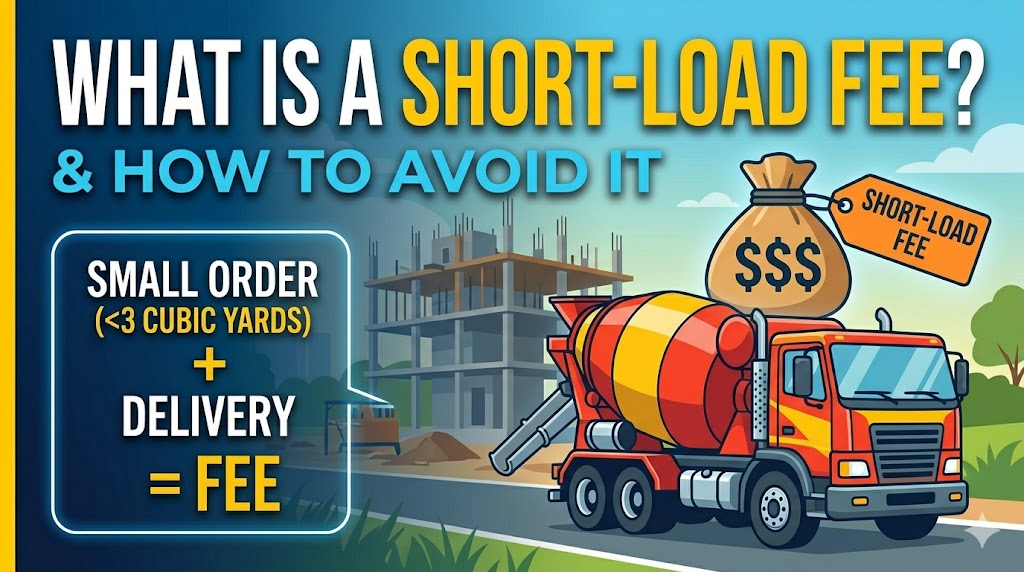
    A short-load fee is a surcharge applied by ready-mix concrete suppliers when your order falls below their minimum delivery volume — typically 8–10 cubic yards / 6.1–7.6 m³. The fee ranges from $50 to $250 per cubic yard under the minimum, which can add $400–$1,200 to a small pour that was already borderline on budget.

    How short-load fees are calculated

    Ready-mix plants price their trucks on a full-load model. A standard transit mixer carries 8–10 cubic yards / 6.1–7.6 m³. When a customer orders less, the plant still dispatches the same truck, burns the same fuel, and ties up the driver for the same amount of time. The short-load fee compensates for the unused capacity.

    The fee structure varies by supplier but typically follows one of two models:

    The flat-rate model charges a fixed dollar amount per cubic yard below the minimum. If the minimum is 8 yards and you order 5 yards, you pay for 3 yards of shortfall at the surcharge rate.

    The graduated model applies a smaller per-yard penalty on orders close to the minimum and a larger one on smaller orders — designed to nudge customers toward the threshold.

    The short load fee estimator calculates your exact surcharge exposure before you call the plant, based on your order volume and supplier minimums. That number alone often changes how a project is designed.

    A realistic example: you need 6.5 cubic yards / 4.97 m³ for a driveway apron and walkway extension. Your local plant charges $75 per yard under an 8-yard minimum — that is a $112.50 short-load fee on top of base concrete costs.

    Short-load fee comparison by typical order size

    Order volume (yd³)Minimum threshold (yd³)Shortfall (yd³)Fee at $75/yd
    3.08.05.0$375
    5.08.03.0$225
    6.58.01.5$112.50
    7.58.00.5$37.50
    8.0+8.00$0

    Fee rates vary significantly by region and supplier. Urban markets with multiple plants tend to be more competitive; rural or remote sites often face higher minimums and steeper surcharges.

    How to avoid paying a short-load fee

    The most direct approach is to reach the minimum volume. Look at adjacent projects that are coming up within the next few weeks — a neighbour’s driveway apron, a garden retaining wall, or a shed pad that was being deferred. Combining orders into a single truck pour eliminates the fee entirely and often reduces per-yard delivery costs as well.

    If there are no adjacent pours to combine, calculate whether it is cheaper to order up to the minimum and accept the extra concrete, or to pay the surcharge and order exactly what you need. Extra concrete can be used for walkway extensions, step repairs, or ancillary pads — concrete does not keep, but a prepared subbase for a future project costs almost nothing.

    Volumetric or metered trucks are a legitimate alternative for small pours. These trucks mix on-site and charge by the cubic yard actually dispensed — no minimum, no short-load fee. The per-yard cost is typically 15–25% higher than plant-mixed concrete, but on a 3–4 yard order that premium is often less than the short-load surcharge from a conventional plant.

    For truly small pours — under 1 cubic yard / 0.76 m³ — bagged concrete mixed on-site is almost always cheaper. The ready-mix vs bagged concrete cost calculator shows the crossover point for your specific volume and local pricing.

    Timing also affects fees. Some plants waive or reduce short-load charges for off-peak deliveries — early morning, mid-week — when trucks would otherwise run light. It is always worth asking the dispatcher directly.

    Common mistakes that lead to unexpected short-load charges

    Not asking the supplier’s minimum before ordering. Short-load minimums are not always published. A customer assumes the minimum is 5 yards because that is what a neighbour said; the actual minimum is 8 yards. Always confirm the minimum volume and the exact surcharge rate during the first call, before providing any project details.

    Calculating volume without a waste factor. Contractors often calculate the theoretical concrete volume, order that amount, and then find the pour runs short due to subbase variation, form blowouts, or measurement error. Adding the missing 0.5 yard as a second delivery triggers a separate short-load fee. Build in a 5–10% waste factor up front using the concrete waste factor calculator, so the first order is sufficient.

    Treating the short-load fee as fixed. Many customers accept the quoted fee without negotiating. Plants have discretion on these charges — especially for repeat customers, commercial accounts, or projects where the customer is willing to take an early-morning slot. A five-minute conversation with the plant manager can eliminate or halve the fee on small orders.

    Using a ready-mix truck when bagged or volumetric concrete is the right tool. For isolated pours under 2 cubic yards / 1.53 m³ with no adjacent work, a standard ready-mix truck is the wrong choice from the start. Short-load fees, minimum charges, and drum residuals make it economically irrational. Map the total cost of each supply method before defaulting to ready-mix.

    Related calculators you might need

    Before calling a supplier, know your exact volume. The concrete truck load calculator shows how many cubic yards your pour requires and whether it fills a standard truck. For the cost decision, the concrete delivery cost calculator builds up total delivered cost including base price, fuel surcharge, and short-load fees by region. If the numbers tip toward bagged concrete, the cubic yards to bags converter translates your volume into bag quantities across multiple bag sizes. For a full project cost summary, the full concrete project estimator rolls materials, delivery, and labour into a single line-item breakdown.

    Frequently asked questions

    What is a short load fee for concrete?

    A short-load fee is a surcharge charged by ready-mix concrete plants when an order falls below their minimum delivery quantity. Minimums are typically 8–10 cubic yards; fees range from $50–$250 per yard under the threshold depending on the supplier and region. The fee exists because the plant incurs the full cost of dispatching a truck regardless of how much concrete it carries.

    How do I avoid a short load concrete fee?

    The three main strategies are: combine the pour with adjacent work to reach the minimum volume; use a volumetric (metered) truck that charges only for what is dispensed; or choose bagged concrete for pours under 2 cubic yards / 1.53 m³. For borderline volumes, ask the supplier about off-peak delivery slots — plants sometimes waive fees to avoid running trucks empty.

    Is it cheaper to use bags or ready-mix for a small pour?

    For pours under 1 cubic yard / 0.76 m³, bagged concrete mixed on-site is almost always cheaper once short-load fees are factored in. Between 1 and 3 yards, it depends on local bag prices and the specific supplier’s fee structure. Use the ready-mix vs bagged concrete cost calculator to compare totals for your specific pour size and location.

    Do all concrete suppliers charge short-load fees?

    Most ready-mix plants charge some form of short-load or minimum-order fee, but the threshold and rate vary widely. Some large operations in competitive urban markets have reduced minimums to 5 or 6 yards. Volumetric concrete suppliers typically do not charge short-load fees — they charge per actual yard dispensed, making them cost-effective for small pours.

    Can I order extra concrete to avoid the fee and use the leftovers?

    Yes, and it is often the right financial decision. Calculate whether the per-yard cost of the extra concrete is less than the short-load surcharge. If your supplier charges $150/yd for concrete and the short-load fee is $75/yd for a 1-yard shortfall, ordering an extra yard costs $150 but gives you a usable cubic yard of material. Plan a use for it in advance — driveway patch, step footing, shed pad — so nothing goes to waste.

  • How to Calculate Concrete for a Slab: The Complete Step-by-Step Guide (2026)

    How to Calculate Concrete for a Slab: The Complete Step-by-Step Guide (2026)


    Whether you’re pouring a backyard patio, a garage floor, or a shed foundation, one question always comes first: how much concrete do I actually need? Ordering too little means a frustrating mid-pour emergency. Ordering too much wastes money. This guide walks you through every step of calculating concrete for a slab — accurately, confidently, and without guesswork.

    💡 Save time: Use our Free Concrete Slab Calculator to get your number instantly, then use this guide to understand exactly what that number means.


    What You’ll Learn in This Guide

    • The exact formula for calculating concrete volume
    • How to convert measurements to cubic yards
    • How thick your slab actually needs to be
    • How to account for waste (and why it matters)
    • Bags vs. ready-mix: which to choose
    • Common mistakes to avoid
    • How to use our free calculators to speed up the process

    Step 1: Understand the Basic Formula

    Calculating concrete volume comes down to one simple formula:

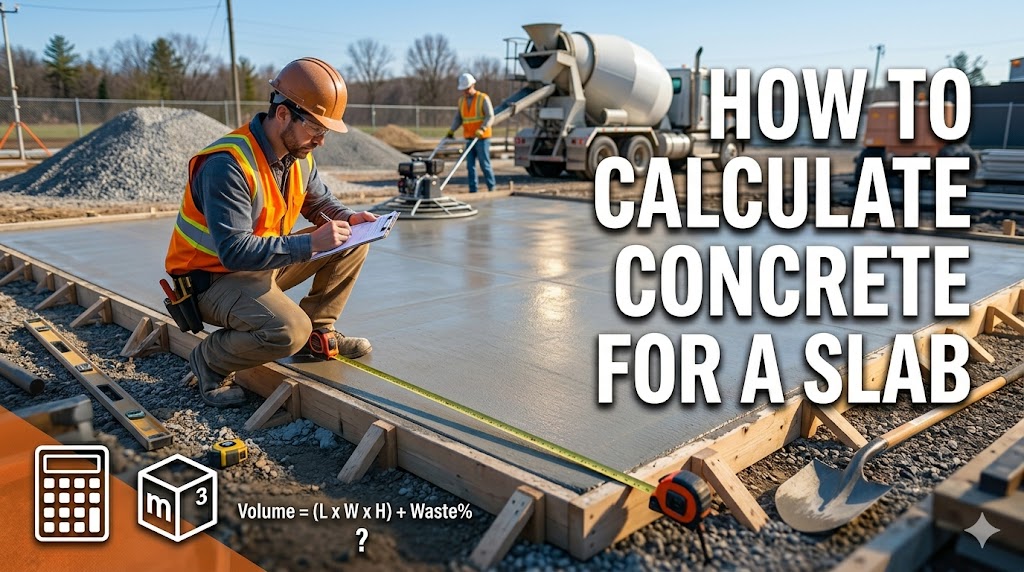
    Volume = Length × Width × Thickness
    

    The tricky part is unit consistency. Concrete is ordered and sold by the cubic yard in the United States, but most people measure their slab in feet and inches. So you need to convert everything to feet first, then divide by 27 (because 1 cubic yard = 27 cubic feet).

    The full formula:

    Cubic Yards = (Length ft × Width ft × Thickness ft) ÷ 27
    

    Example: 10×12 Patio at 4 Inches Thick

    • Length: 10 ft
    • Width: 12 ft
    • Thickness: 4 inches = 4 ÷ 12 = 0.333 ft
    10 × 12 × 0.333 = 40 cubic feet
    40 ÷ 27 = 1.48 cubic yards
    

    That’s your raw volume. But you’re not done yet — you still need to add for waste (more on that in Step 4).

    🔢 Skip the math: Plug your dimensions directly into our Concrete Calculator and get cubic yards, cubic feet, and bag count in seconds.


    Step 2: Decide on the Right Slab Thickness

    Thickness is the single biggest variable in your concrete calculation — and getting it wrong is expensive. A slab that’s 1 inch too thin might need replacing in 5 years. A slab that’s 2 inches too thick costs you significantly more concrete than needed.

    Here are the standard thickness guidelines:

    Project TypeRecommended Thickness
    Pedestrian walkway / sidewalk3–4 inches
    Residential patio4 inches
    Garage floor (passenger vehicles)4–5 inches
    Driveway (passenger vehicles)4 inches
    Driveway (trucks / heavy vehicles)5–6 inches
    Workshop / shed floor4 inches
    RV pad or heavy equipment6 inches

    📐 Not sure what thickness your project needs? Our Slab Thickness Guide recommends the right depth based on your load type and soil conditions.

    Pro Tip: If you’re in an area with freeze-thaw cycles, increase thickness by at least half an inch and always use air-entrained concrete. Frost heave is one of the leading causes of slab cracking in colder climates.


    Step 3: Measure Your Area Accurately

    Sounds obvious, but measurement errors are the #1 cause of ordering mistakes. Here’s how to do it right:

    Rectangular Slabs

    Measure length and width at multiple points, especially if your space isn’t perfectly square. Use the largest measurement for each dimension to make sure you don’t come up short.

    L-Shaped or Irregular Slabs

    Break the shape into two or more rectangles. Calculate the volume of each section separately, then add them together.

    Example: L-shaped patio

    • Section A: 12 ft × 8 ft × 0.333 ft = 32 cubic feet
    • Section B: 6 ft × 10 ft × 0.333 ft = 20 cubic feet
    • Total: 52 cubic feet ÷ 27 = 1.93 cubic yards

    Round or Circular Slabs

    Use the circular volume formula:

    Volume = π × radius² × thickness
    

    For a 12-foot diameter fire pit pad at 4 inches thick:

    • Radius = 6 ft
    • Volume = 3.14159 × 36 × 0.333 = 37.7 cubic feet ÷ 27 = 1.4 cubic yards

    🔵 Round slab? Our Round Slab Calculator handles circular calculations automatically — just enter your diameter and thickness.


    Step 4: Always Add a Waste Factor

    This is the step most beginners skip — and it’s the reason so many DIY pours run out of concrete before the job is done.

    Why do you need extra concrete?

    • Subgrade is never perfectly level (low spots consume more concrete)
    • Spillage during pouring and finishing
    • Slight variations in your forms
    • Over-excavation beyond your planned dimensions

    Standard waste factors:

    • 5% — Experienced contractors with precision-built forms
    • 10% — Typical residential DIY project (recommended starting point)
    • 15% — Irregular shapes, uneven terrain, or first-time DIYers
    • 20% — Complex projects with curves, slopes, or steps

    Applying the Waste Factor

    Final Order = Calculated Volume × (1 + Waste Factor)
    

    For our 10×12 patio (1.48 cubic yards) with 10% waste:

    1.48 × 1.10 = 1.63 cubic yards → order 1.7 cubic yards
    

    Running short mid-pour is a serious problem. When fresh concrete sits while you wait for more, the earlier pour begins to set. The joint where old meets new concrete is called a cold joint — it’s structurally weak and prone to cracking. Always have enough.

    ⚠️ Important: Most ready-mix suppliers have a minimum order (usually 1 cubic yard) and charge a short-load fee for smaller quantities. An emergency re-order mid-pour can cost $150–$300 in fees alone — far more than the cost of a little extra concrete.


    Step 5: Bags or Ready-Mix Concrete?

    Once you know your volume, you need to decide how to buy your concrete. This is a bigger decision than most people realize.

    Bagged Concrete (DIY Mix)

    Best for: Small projects under 1 cubic yard (27 cubic feet)

    Common bag sizes and yields:

    • 40 lb bag → approximately 0.30 cubic feet
    • 60 lb bag → approximately 0.45 cubic feet
    • 80 lb bag → approximately 0.60 cubic feet

    For a small 4×4 stepping pad at 4 inches thick:

    4 × 4 × 0.333 = 5.33 cubic feet
    5.33 ÷ 0.60 = 8.9 → need 9 bags of 80 lb concrete
    

    Pros: Available at any hardware store, no minimum order, mix as you go Cons: Labor-intensive, time-consuming, inconsistent mixing, expensive per cubic yard

    🛍️ How many bags do you need? Use our Concrete Bag Calculator to convert any cubic footage into bag counts by size.

    Ready-Mix Concrete (Truck Delivery)

    Best for: Anything over 1 cubic yard

    Ready-mix concrete arrives in a mixer truck already batched to your specified PSI. It’s faster, more consistent, and usually cheaper per cubic yard for larger pours.

    Average ready-mix cost (2026): $150–$200 per cubic yard depending on your region and PSI specification.

    Pros: Consistent mix, fast pour, no manual labor for mixing Cons: Minimum order quantities, delivery fees, time pressure (concrete must be placed within 90 minutes)

    💰 Want to compare costs? Our Concrete Cost Calculator breaks down bags vs. ready-mix pricing for your specific project volume.


    Step 6: Choose the Right PSI (Concrete Strength)

    Not all concrete is the same strength. PSI (pounds per square inch) indicates compressive strength — the higher the number, the stronger the concrete.

    PSIBest Use Case
    2500 PSIFootings, non-structural fills
    3000 PSIResidential driveways, patios, slabs (most common)
    3500 PSIDriveways with heavy vehicles
    4000 PSICommercial floors, structural elements
    5000+ PSIHigh-load structural applications

    For the vast majority of residential concrete slabs — patios, garage floors, sidewalks — 3000 PSI is the standard. It balances cost and durability perfectly.

    Higher PSI mixes typically cost $10–$20 more per cubic yard from a ready-mix supplier but can be worth it for long-term durability, especially in high-traffic areas.


    Step 7: Don’t Forget Reinforcement

    Concrete is strong in compression but weak in tension — meaning it resists being crushed but can crack when pulled or flexed. Reinforcement adds tensile strength to prevent cracking.

    Wire Mesh (Welded Wire Fabric)

    • Used in residential slabs, patios, and garage floors
    • Placed in the middle of the slab (use chairs to elevate it)
    • Prevents cracks from spreading after they form
    • Cost: ~$0.10–$0.15 per square foot

    Rebar (Steel Reinforcing Bar)

    • Used in driveways, footings, structural slabs
    • #3 rebar (3/8 inch) on 18-inch grid is standard for residential driveways
    • Provides structural strength, not just crack control
    • Cost: ~$0.50–$1.00 per linear foot

    Fiber Reinforcement

    • Mixed directly into the concrete
    • Controls surface shrinkage cracking
    • Does NOT replace rebar for structural strength
    • Best used in combination with mesh or rebar

    📏 Calculate your rebar needs: Use our Rebar Calculator to determine how many linear feet and what spacing you need for your slab dimensions.


    Step 8: Prepare Your Site Properly

    Even a perfectly calculated concrete order will fail if your site preparation is poor. This is the step that separates lasting slabs from ones that crack within a year.

    The proper base sequence:

    1. Excavate to the correct depth (slab thickness + 4 inches for gravel base)
    2. Add 4 inches of compacted gravel (crushed stone #57 is ideal)
    3. Compact with a plate compactor until the surface is firm — you should leave no footprints when walking on it
    4. Install forms (2×4 or 2×6 lumber depending on slab thickness)
    5. Lightly dampen the base just before pouring — this prevents the dry subgrade from sucking water out of the concrete too fast
    6. Place vapor barrier (inside slabs only) to prevent moisture migration

    A 4-inch compacted gravel base does three things: provides drainage, prevents ground movement from cracking the slab, and gives you a stable, level surface to pour against.


    Putting It All Together: Complete Example

    Let’s calculate everything for a 12×20 ft garage floor at 4 inches thick:

    Step 1 — Raw Volume:

    12 × 20 × 0.333 = 79.92 cubic feet ÷ 27 = 2.96 cubic yards
    

    Step 2 — Add 10% waste:

    2.96 × 1.10 = 3.26 cubic yards → order 3.5 cubic yards
    

    Step 3 — PSI: 3000 PSI (standard residential garage)

    Step 4 — Reinforcement: Wire mesh or #3 rebar on 18-inch grid

    Step 5 — Ready-mix vs. bags: At 3.5 cubic yards, definitely use ready-mix. Bagging this would require ~158 bags of 80 lb concrete — exhausting and time-consuming.

    Step 6 — Base: 4 inches of compacted gravel = 12 × 20 × 0.333 ft = 2.96 cubic yards of gravel

    🏗️ Get the full breakdown in one click: Our Concrete Slab Calculator outputs cubic yards, bag count, waste-adjusted totals, and cost estimates all at once.


    Common Mistakes to Avoid

    1. Measuring in inches but forgetting to convert Always convert thickness to feet before calculating. 4 inches = 0.333 ft, not 4.

    2. Skipping the waste factor Even a 5% overage is better than nothing. Running short mid-pour costs far more than the extra concrete.

    3. Pouring on unprepared ground No gravel base = slab will settle unevenly and crack within 1–2 years.

    4. Under-ordering for round or irregular shapes These shapes are harder to estimate mentally. Always use a calculator and add extra waste.

    5. Ordering PSI that’s too low 2500 PSI is technically sufficient for footings, but don’t use it for driveways or garage floors where you need durability.

    6. Not checking weather Concrete should not be poured when temperatures are below 40°F or above 90°F without special precautions. Cold slows curing; heat accelerates it, causing surface cracking.


    Quick Reference: Concrete Calculators for Every Project

    Your slab is just one of many concrete projects you might tackle. Here are the tools available to you on All Concrete Calculator:


    Final Thoughts

    Calculating concrete correctly before you pour is one of the most important steps in any concrete project — and it’s not complicated once you know the formula. Measure your slab, apply the right thickness for your use case, add a waste factor, and decide between bags and ready-mix based on your volume.

    The math is simple. The preparation matters more than most people realize. And having the right tools makes both effortless.

    Ready to calculate your project? Head to our Free Concrete Calculator — it takes under 60 seconds and gives you everything you need to order with confidence.


    Found this guide helpful? Browse more articles in our Concrete Learning Hub for tips on mixing, curing, finishing, and more.