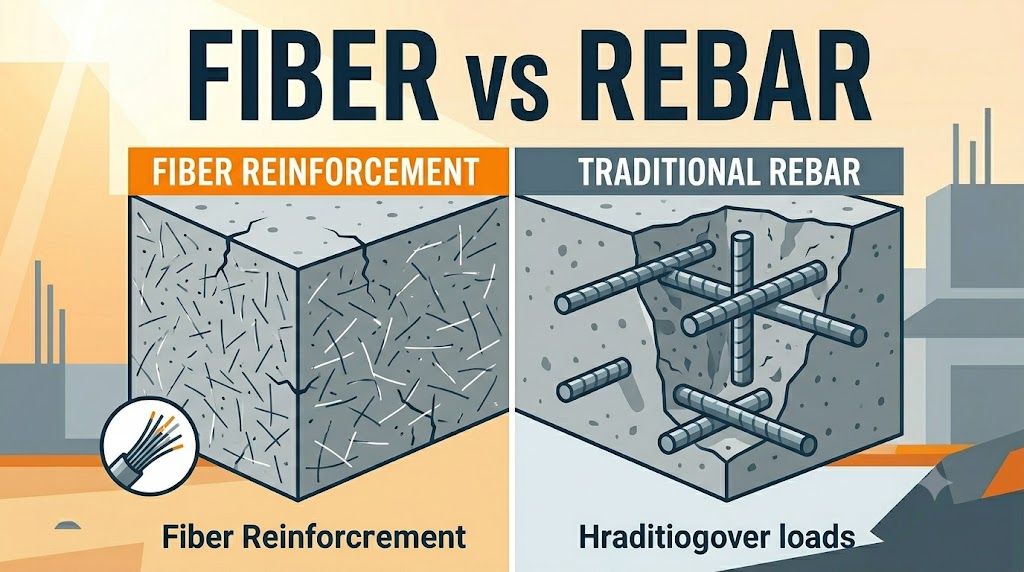
Fiber reinforcement does not replace rebar for structural applications. That is the most important thing to understand before comparing the two. Fibers control shrinkage cracking and improve toughness; rebar carries tensile load. Choosing between them — or combining them — depends entirely on what the concrete is being asked to do.
How fiber reinforcement and rebar actually work
Concrete is strong in compression and weak in tension. Rebar solves the tension problem by embedding steel bars that carry tensile forces the concrete cannot handle alone. This is structural reinforcement: it prevents failure under load and keeps a cracked section from separating. Without it, a loaded slab or beam can crack through and collapse.
Fiber reinforcement works differently. Synthetic fibers — typically polypropylene at 12–19 mm for micro-fibers, or nylon and polyester for macro-fibers — are distributed randomly throughout the mix. They do not form a continuous load path the way a rebar mat does. What they do is bridge micro-cracks as they form, limiting crack width and slowing propagation. Steel fibers (typically 30–60 mm, hooked-end) can carry meaningful post-crack load in industrial flooring, but they still cannot replicate the directional tensile capacity of a placed rebar layout in structural members.
The concrete fiber reinforcement calculator lets you calculate dosage by volume and project size for both synthetic and steel fiber types.
Side-by-side comparison: cost, labour, lifespan, and use cases
This table covers the real decision variables — not theoretical ones.
| Factor | Synthetic Micro-Fiber | Steel / Macro-Fiber | Rebar (mild steel) |
| Material cost (per m³ / yd³) | $3–$8 / $2.50–$6.50 | $18–$45 / $15–$38 | $20–$80+ depending on layout |
| Labour impact | Mixed in with batch — zero extra placement labour | Same as synthetic — no placement work | Requires cutting, bending, tying, and placement; adds 1–4 hrs per 10 m² / 110 ft² |
| Crack control | Controls plastic and early drying shrinkage cracks | Controls shrinkage and improves post-crack toughness | Controls structural cracks under load; minimal effect on early shrinkage |
| Structural capacity | None | Partial — only in certain slab-on-grade designs with engineering approval | Full — designed tensile capacity per ACI 318 / AS 3600 / BS EN 1992 |
| Typical lifespan | Same as the concrete — 30–50+ years | Same as the concrete if corrosion-resistant type used | 50–100 years with adequate cover; shorter if corrosion occurs |
| Best use cases | Footpaths, driveways, patios, pool decks, residential slabs | Industrial floors, warehouse slabs, precast elements | Footings, beams, columns, retaining walls, any structural element |
When fiber alone is sufficient — and when it is not
Micro-synthetic fibers are sufficient for any non-structural flatwork where the primary risk is plastic shrinkage cracking: residential driveways, sidewalks, patios, shed pads, and pool decks. At a typical dosage of 0.6–0.9 kg/m³ (1.0–1.5 lb/yd³), they distribute into millions of filaments per cubic metre and intercept micro-cracks before they become visible. The concrete still cracks — all concrete cracks — but the cracks stay narrow and do not open up.
Where fiber reinforcement is not sufficient:
Any element that carries load in bending — beams, suspended slabs, lintels — needs rebar. The tensile stress at the bottom of a loaded beam cannot be resisted by randomly distributed short fibers. Any retaining wall resisting lateral earth pressure needs rebar, typically at both faces. Any footing transferring column or wall loads to soil needs rebar. Fibers in these applications are a secondary addition at best, not a substitute.
Steel fibers in industrial slab-on-grade applications are a different conversation. Dosages of 25–40 kg/m³ (42–67 lb/yd³) can replace conventional rebar mats in ground-supported floors where the primary loading is distributed (forklifts, racking loads) and joint-free slab construction is the goal. This requires a structural engineer, a fibre supplier’s design tool, and compliance with TR34 (UK/international) or ACI 360 (US).
Common mistakes
Treating micro-fibers as a one-for-one rebar substitute in structural work. This is the most dangerous misunderstanding in the comparison. A contractor who swaps out a rebar mat for a fiber dose in a footing or retaining wall has not simplified the job — they have created a structural deficiency. Micro-fibers carry zero tensile load in a cracked section under sustained stress. The correct approach: use fibers for shrinkage control and rebar for structural performance, often together.
Using rebar to solve a plastic shrinkage cracking problem. If a slab cracks within the first 24 hours — before the concrete has hardened — rebar provides no benefit. Plastic shrinkage cracking is caused by the surface drying faster than water bleeds up from below. The fix is fiber reinforcement (prevents crack initiation), windbreaks, evaporation retarder, and curing covers — not additional steel.
Inadequate rebar cover. The standard minimum cover for rebar in a slab-on-grade is 38 mm / 1.5 inches from the bottom. Contractors who place chairs incorrectly — or none at all — end up with rebar sitting at mid-depth or lower, where it contributes almost nothing to flexural capacity. Rebar at mid-slab resists neither top-fibre tension nor bottom-fibre tension effectively.
Assuming all fibers are equivalent. A 12 mm polypropylene micro-fiber added at 0.6 kg/m³ is a crack-control additive. A 50 mm hooked-end steel fiber at 35 kg/m³ is a structural material. Using the former in an industrial floor application and expecting structural-grade crack resistance is a dosage and product mismatch. Check the fiber type, length, aspect ratio, and the supplier’s dosage curves.
Related calculators you might need
If you are designing the reinforcement layout for a slab, the rebar / reinforcing steel calculator converts your bar size and spacing into total weight and linear metres — useful when comparing the steel cost against a fiber dosage. For laying out the grid itself, the rebar spacing calculator handles bar centres for a given slab thickness and load. For the concrete itself, the concrete mix ratio calculator helps you confirm that the base mix design is compatible with fiber addition (water-cement ratio and workability both affect fiber distribution). If the project involves a structural slab and you need to verify load capacity, the concrete load capacity calculator gives you a working baseline before involving a structural engineer.
Frequently asked questions
Can I add fiber to a mix that already has rebar?
Yes — combining both is standard practice in industrial slabs, driveways, and concrete structures in aggressive environments. Synthetic micro-fibers control early shrinkage cracking independently of the rebar layout. Steel fibers in structural-grade dosages can sometimes allow rebar reduction, but only with engineering sign-off. For most residential and commercial flatwork, adding 0.6–0.9 kg/m³ of polypropylene fiber to a rebar-reinforced slab is straightforward and has no negative effect on the rebar.
Is fiber reinforcement cheaper than rebar?
For the material alone, micro-synthetic fibers typically add $3–$8 per m³ ($2.50–$6.50 per yd³), which is cheaper than most rebar layouts. The real cost difference is labour: rebar requires cutting, tying, and placing, which adds meaningful time on site. For a 100 m² / 1,075 ft² driveway, rebar placement can add 6–8 hours of skilled labour. Fiber is added at the batch plant and requires nothing on site. However, if structural reinforcement is required, rebar is not optional — no labour saving justifies the omission.
What does fiber reinforcement actually do to concrete strength?
Micro-synthetic fibers at standard dosages (0.6–0.9 kg/m³) have no meaningful effect on compressive strength — typically less than 1–2 MPa difference. They improve toughness (energy absorption after cracking) and reduce plastic shrinkage crack width by 80–90% in controlled tests. Steel fibers at high dosages (30–40 kg/m³) increase post-crack flexural strength and toughness substantially, which is why they are used in industrial floor design. Neither fiber type increases the 28-day compressive strength the way an improved mix design or lower water-cement ratio would.
Does fiber reinforcement stop concrete from cracking entirely?
No. Every concrete element will crack at some point — thermal movement, drying shrinkage, and load-induced stress all exceed concrete’s tensile strength under normal service conditions. What fibers do is limit crack width and spacing. A slab with synthetic fibers at adequate dosage will still crack, but the cracks will be narrower (typically under 0.2 mm at early age) and more numerous rather than fewer wide cracks. That is the desired outcome: distributed fine cracks are structurally and aesthetically less damaging than isolated wide ones.
How do I calculate the right fiber dose for my project?
Standard residential dosage for polypropylene micro-fiber is 0.6 kg/m³ (1.0 lb/yd³) for general flatwork, and up to 0.9 kg/m³ (1.5 lb/yd³) for slabs with higher shrinkage risk (large surface area, hot weather, low humidity). Use the concrete fiber reinforcement calculator to convert your slab volume into total fiber weight by dosage rate. For steel fiber in industrial applications, use the supplier’s design guide — dosage ranges from 20 to 40 kg/m³ depending on the design method and loading scenario.
Can I use fiber reinforcement in footings?
Micro-synthetic fibers in footings control plastic shrinkage cracking during cure, which is useful in hot conditions. They do not, however, provide the tensile reinforcement that footings require. A strip footing, pad footing, or pile cap must have rebar sized and placed to an engineer’s specification. Adding fibers to a footing mix is acceptable as a secondary measure but does not reduce or eliminate the rebar requirement under any major building code.