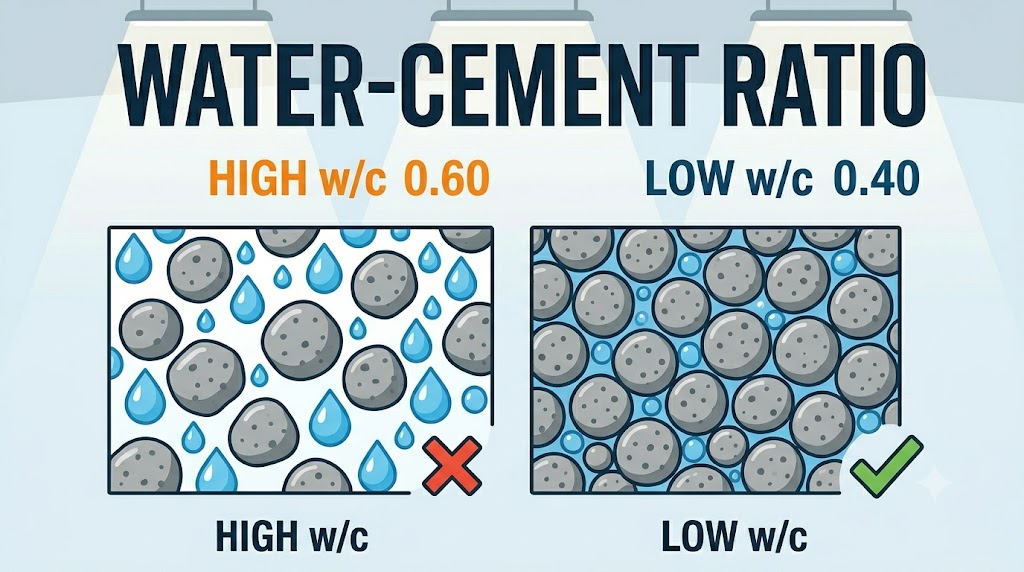
The water-cement (w/c) ratio is the weight of water in a concrete mix divided by the weight of cement. A mix with 160 kg of water and 320 kg of cement has a w/c ratio of 0.50. That one number controls strength and durability more than any other single variable: going by the ACI 211.1 mix design tables, moving from 0.40 to 0.60 costs roughly 40% of the 28-day compressive strength, and the extra water leaves the concrete more porous for the rest of its life.
Key points at a glance
- Formula: w/c = weight of water ÷ weight of cement, both in the same unit.
- Lower w/c means stronger, less permeable concrete, as long as the mix can still be fully compacted.
- 0.45–0.50 is the usual target for reinforced residential and light commercial work; codes cap it at 0.40–0.45 where deicers, seawater or sulfates are present.
- Every 10 L of water added per m³ (about 2 US gal per yd³) raises w/c by around 0.03 and costs roughly 2–3 MPa / 300–450 psi.
- Fix workability with admixtures, not water. A water reducer raises slump without touching the ratio.
On this page: How to calculate it · Water per bag of cement · W/C and strength · Code limits by exposure · The workability problem · W/C vs w/cm · Common mistakes · FAQ
How to calculate the water-cement ratio
w/c = weight of water ÷ weight of cement
The ratio is always by weight, never by volume. Water makes the conversion easy: 1 litre weighs 1 kg, and 1 US gallon weighs 8.34 lb.
- Metric example: 175 L of water and 350 kg of cement per m³ gives 175 ÷ 350 = 0.50.
- US example: 33.6 gal of water (280 lb) and 560 lb of cement per yd³ gives 280 ÷ 560 = 0.50.
One detail trips people up. The water that counts is the free water: what you add at the mixer plus any surface moisture already on the sand and stone. Water soaked up inside the aggregate particles does not count. Damp sand can carry a surprising amount, which is covered under common mistakes below.
The Water-Cement Ratio Calculator does the arithmetic in kg, lb, litres or gallons, gives an estimated 28-day strength, and checks the result against the ACI 318 exposure class you choose.
How much water per bag of cement?
If you are site-mixing from cement, sand and stone, the ratio converts directly into water per bag:
| W/C ratio | Water per 50 kg bag | Water per 94 lb sack |
|---|---|---|
| 0.40 | 20.0 L | 4.5 US gal |
| 0.45 | 22.5 L | 5.1 US gal |
| 0.50 | 25.0 L | 5.6 US gal |
| 0.55 | 27.5 L | 6.2 US gal |
| 0.60 | 30.0 L | 6.8 US gal |
Total free water per bag of cement, including moisture already in the sand. With damp sand, add less.
This table is for plain cement. Pre-blended bagged concrete mix already contains sand and stone, so follow the water quantity printed on the bag. Our guide to bags vs ready-mix concrete explains the difference.
How the water-cement ratio determines strength
The link between water and strength was set out by Duff Abrams in 1918 and is still called Abrams’ Law: for given materials, age and curing, the strength of fully compacted concrete depends on the water-cement ratio. In formula form:
f’c = A ÷ B(w/c)
A and B are constants fitted to test results for a particular cement and aggregate, which is why the law gives the shape of the curve and trial mixes give the actual numbers.
The physical reason is simple. Cement needs only a limited amount of water to hydrate. Everything beyond that is there to make the mix workable, and when it eventually dries out it leaves a network of fine capillary pores behind. More water means more pores, and pores carry no load and let water, chlorides and sulfates in. The same excess water also rises to the surface as bleed water, leaving the top layer weakest of all.
| 28-day strength | W/C without air | W/C with entrained air |
|---|---|---|
| 7,000 psi / 48 MPa | 0.33 | not listed |
| 6,000 psi / 41 MPa | 0.41 | 0.32 |
| 5,000 psi / 34 MPa | 0.48 | 0.40 |
| 4,000 psi / 28 MPa | 0.57 | 0.48 |
| 3,000 psi / 21 MPa | 0.68 | 0.59 |
| 2,000 psi / 14 MPa | 0.82 | 0.74 |
Approximate relationship between w/c ratio and 28-day cylinder strength for non-air-entrained and air-entrained concrete, from the ACI 211.1 mix proportioning tables.
Reading across that table (reproduced here from ACI 211.1):
- Cutting w/c from 0.60 to 0.45 raises strength by about 45%, from roughly 26 MPa to 37 MPa (3,700 to 5,400 psi).
- Cutting it from 0.60 to 0.40 raises strength by about 65%, to roughly 42 MPa / 6,100 psi.
- Each 0.05 step is worth about 3–5 MPa / 450–700 psi, with the bigger gains at the low end of the range.
- Entrained air costs strength: an air-entrained mix needs a w/c about 0.08–0.09 lower to reach the same figure.
Treat these as planning values. Cement type, aggregate, admixtures and above all curing shift the real result, so structural mixes are confirmed by trial batches and cylinder or cube tests. For the proportions that go with each ratio, see concrete mix ratios from M10 to M40.
W/C ratio limits by strength class and exposure
Design codes do not pick a w/c ratio for strength alone. They cap it according to what the concrete will be exposed to, because permeability, not strength, decides how long reinforcement stays protected. The three most widely used systems are below. They use different class names but land in the same place: around 0.50 for ordinary weather-exposed work and 0.40–0.45 once chlorides or severe sulfates are involved.
ACI 318 (United States and many other countries)
| Class and exposure | Max w/cm | Min strength (f’c) |
|---|---|---|
| F1: freezing and thawing, limited exposure to water | 0.55 | 3,500 psi / 24 MPa |
| F2: freezing and thawing, frequent exposure to water | 0.45 | 4,500 psi / 31 MPa |
| F3: freezing and thawing, frequent water plus deicing chemicals | 0.40 | 5,000 psi / 35 MPa |
| S1: moderate sulfate exposure, including seawater | 0.50 | 4,000 psi / 28 MPa |
| S2: severe sulfate exposure | 0.45 | 4,500 psi / 31 MPa |
| W2: in contact with water, low permeability required | 0.50 | 4,000 psi / 28 MPa |
| C2: moisture plus external chlorides (deicing salts, seawater, spray) | 0.40 | 5,000 psi / 35 MPa |
Selected limits from ACI 318-19 Table 19.3.2.1. Classes F0, S0, W0, W1, C0 and C1 carry no w/cm limit. The F classes also require air entrainment.
NRMCA’s guide to selecting exposure classes walks through how to assign these to a real project.
IS 456 (India)
| Exposure and minimum grade | Max free w/c | Min cement content |
|---|---|---|
| Mild (M20) | 0.55 | 300 kg/m³ |
| Moderate (M25) | 0.50 | 300 kg/m³ |
| Severe (M30) | 0.45 | 320 kg/m³ |
| Very severe (M35) | 0.45 | 340 kg/m³ |
| Extreme (M40) | 0.40 | 360 kg/m³ |
Reinforced concrete limits from IS 456:2000 Table 5. The code also caps cement content at 450 kg/m³.
EN 206 (Europe and the UK)
| Class and exposure | Max w/c | Min strength class and cement |
|---|---|---|
| XC1: dry or permanently wet, such as indoors | 0.65 | C20/25 260 kg/m³ |
| XC2: wet, rarely dry, such as foundations | 0.60 | C25/30 280 kg/m³ |
| XC3: moderate humidity, sheltered from rain | 0.55 | C30/37 280 kg/m³ |
| XC4: cyclic wet and dry, exposed to rain | 0.50 | C30/37 300 kg/m³ |
| XS1: airborne sea salt | 0.50 | C30/37 300 kg/m³ |
| XS2: permanently submerged in seawater | 0.45 | C35/45 320 kg/m³ |
| XS3: tidal, splash and spray zones | 0.45 | C35/45 340 kg/m³ |
| XD3: cyclic wet and dry with deicing salts | 0.45 | C35/45 320 kg/m³ |
| XF4: freeze-thaw with deicers, high saturation | 0.45 | C30/37 340 kg/m³ plus 4% air |
Selected recommended values from EN 206 Table F.1. National provisions such as BS 8500 in the UK set the binding figures and often differ.
A warning on comparing grades across codes. Indian M grades and the second number in a European class are cube strengths. ACI’s f’c is a cylinder strength, which runs about 20% lower for the same concrete. So M25 is not 3,625 psi in ACI terms: it corresponds to C20/25, roughly 20 MPa / 2,900 psi on a cylinder. The concrete grades guide lines the systems up side by side, and the PSI to MPa converter handles the unit conversion.
Why IS 456 and EN 206 also set a minimum cement content. A low ratio only works if there is enough cement paste to coat the aggregate and fill the gaps between particles. At w/c 0.40 with 360 kg/m³ of cement, the mix holds just 144 L of water per m³ (38 US gal). A normal-slump mix without admixtures wants roughly 180–200 L, so that concrete can only be placed with a superplasticiser.
Freeze-thaw exposure adds an air requirement. W/C ratio and air entrainment are specified together, not as substitutes. See air entrainment in concrete and the Concrete Air Entrainment Calculator for that side of the specification.
The workability problem: why contractors add too much water
Water is the cheapest and fastest way to make stiff concrete flow, which is why it gets added at the truck. The rule of thumb from the National Ready Mixed Concrete Association is that about 5 L per m³ (1 US gal per yd³) raises slump by 25 mm (1 in). Here is what that costs.
- Per 10 L/m³ added: w/c rises by 0.03–0.04 for cement contents of 250–330 kg/m³, and strength falls by roughly 2–3 MPa / 300–450 psi.
- Taking slump from 75 mm to 175 mm (3 in to 7 in) with water: about 20 L/m³. A mix with 320 kg of cement and 150 L of water goes from w/c 0.47 to 0.53, and its expected strength drops from about 36 MPa to 30 MPa (5,200 to 4,400 psi), a loss of around 14%.
- A driver adding 50 L (13 gal) to a 6 m³ load: about 8 L/m³, or +0.03 on the ratio. It sounds small, but a mix designed right at its code maximum is now over it.
Strength is not the only casualty. Extra water means more bleeding, more drying shrinkage and a weaker, dustier surface, which is where many of the cracks covered in our crack repair guide begin.
What the rules allow on site
Adding water at the job is not banned outright. Under ASTM C94, the ready-mix specification, water may be added on arrival to bring the slump up, on these conditions: the specified maximum w/c ratio and maximum slump are not exceeded, no more than a small portion of the load (about 0.2 m³ / ¼ yd³) has been discharged, the drum is turned a further 30 revolutions at mixing speed, and the amount is measured and recorded on the ticket. Water beyond that needs the purchaser’s authorisation, and the purchaser then owns the consequences.
The right fix: admixtures
Water-reducing admixtures give the slump without the water. A normal water reducer (ASTM C494 Type A) cuts water demand by at least 5%; a high-range water reducer, or superplasticiser, cuts it by 12% to 30% or more. Used the other way round, they turn a stiff 0.45 mix into a flowing one with the ratio unchanged. Order the slump you need from the plant, or have the admixture added there. What concrete admixtures actually do covers the types, and the Concrete Admixture Dosage Calculator works out the dose for your batch.
W/C, w/cm and w/b: which ratio does your spec mean?
Most modern mixes replace part of the cement with supplementary cementitious materials (SCMs) such as fly ash, slag (GGBS) or silica fume. The ratio then has two versions:
- w/c divides water by portland cement only.
- w/cm (water-cementitious materials) or w/b (water-binder) divides water by cement plus SCMs.
Take a mix with 300 kg of cement, 100 kg of fly ash and 160 kg of water. Its w/c is 160 ÷ 300 = 0.53, but its w/cm is 160 ÷ 400 = 0.40. ACI 318 writes all its limits as w/cm, counting the full SCM weight. EN 206 is stricter about it: under its k-value concept only part of the addition counts, 40% for fly ash, so the same mix is assessed at 160 ÷ (300 + 40) = 0.47. Check which ratio your specification means before ordering, because the same mix can pass under one and fail under another.
Common mistakes involving water-cement ratio
1. Adding water to the truck at the pour. Take a cubic metre with 320 kg of cement and 150 L of water, w/c 0.47. Add 40 L on site and the total is 190 L, w/c 0.59. By the ACI 211.1 table the expected strength falls from about 36 MPa to 26 MPa (5,200 to 3,800 psi), more than a quarter gone from concrete that was ordered, paid for and ticketed at the higher grade. It sets, looks fine and fails a core test months later.
2. Ignoring the water already in the sand. Mix designs assume aggregate that is saturated inside but dry on the surface. Stockpiled sand is rarely like that, and a few percent of free surface moisture is common after rain. If a cubic metre uses 750 kg of sand carrying 4% free moisture, that is 30 L of water nobody measured. On the mix above it lifts w/c from 0.47 to 0.56 before a hose is touched. Batch plants correct for this with moisture tests (ASTM C566, or EN 1097-5, which replaced BS 812-109). On site, the practical answer is to hold back some of the water and add it only as needed.
3. Chasing a low ratio by cutting water alone. A ratio of 0.40 with only 200 kg/m³ of cement means 80 L of water per m³, which is far too dry to compact. The honeycombing that follows does more damage than a slightly higher ratio would have. A low w/c has to come with enough cement paste and a water reducer, which is why specifications pair a maximum ratio with a minimum cement content or a minimum strength.
4. Measuring water by eye. “Until it looks right” is how one batch ends up at 0.45 and the next at 0.60. Use a marked bucket and the same number of buckets every time. When scaling a mix up or down, scale cement, water and aggregate together; the Concrete Batch Calculator keeps every batch in proportion.
5. Mixing up w/c and w/cm. As shown above, the two can differ by 0.10 or more on the same mix. State which one you mean on the order.
6. Getting the ratio right and then not curing. A good ratio only delivers its strength if the concrete stays moist long enough to hydrate. Low-w/c mixes are the least forgiving, because they have little bleed water to protect the surface. See what concrete curing is and, for summer pours, pouring concrete in hot weather.
For structural concrete
The limits on this page are general code values for planning and for checking a delivery ticket. The exposure class, maximum ratio and minimum strength for a real structure come from the project specification, and the mix itself should be designed and tested by the supplier or a qualified engineer. Do not reduce a specified strength or raise a specified ratio without written approval.
Related calculators you might need
- Water-Cement Ratio Calculator: w/c and w/cm from your water, cement and SCM weights, with an ACI 318 exposure check.
- Concrete Mix Ratio Calculator: cement, sand and stone proportions for the full mix.
- Cement Quantity Calculator: how much cement the job needs.
- Concrete Batch Calculator: scaling a mix to your mixer size.
- Concrete Admixture Dosage Calculator: plasticiser and superplasticiser doses.
- Concrete Compressive Strength Converter: test results between PSI, MPa and kgf/cm².
- Concrete Curing Time Estimator: how long to protect the pour before loading it.
Frequently asked questions
What is a good water-cement ratio for concrete?
For reinforced slabs, beams, columns, driveways and foundations, aim for 0.45–0.50. Interior concrete that stays dry can go to 0.55. Concrete exposed to deicing salts, seawater or severe sulfates is limited to 0.40–0.45 by ACI 318, IS 456 and EN 206 alike. Below about 0.40 you will need a superplasticiser to place it.
How does water-cement ratio affect concrete strength?
Strength rises as the ratio falls. By the ACI 211.1 tables, lowering w/c from 0.60 to 0.40 lifts 28-day strength by about 65%, from roughly 26 MPa to 42 MPa (3,700 to 6,100 psi) for non-air-entrained concrete. Each 0.05 reduction adds about 3–5 MPa / 450–700 psi. Actual results depend on the cement, aggregate and curing.
What happens if water-cement ratio is too low?
Strength keeps rising, which is why high-strength concrete is made at 0.25–0.35, but the mix gets harder to handle. Three things change. First, it becomes too stiff to compact without a superplasticiser, and poorly compacted concrete loses more strength to voids than it gained from the low ratio. Second, below roughly 0.42 there is not enough water inside a sealed mix to hydrate all the cement, so the concrete dries itself internally and shrinks, which raises the risk of early cracking. Third, there is almost no bleed water, so the surface dries fast and must be cured immediately. The leftover unhydrated cement is not wasted; it acts as a dense filler.
How much water do I need for a bag of cement?
Multiply the bag weight by the ratio. At w/c 0.50, a 50 kg bag takes 25 L of water and a 94 lb sack takes 47 lb, or 5.6 US gallons. At 0.45 it is 22.5 L or 5.1 gallons. That is total water, so use less when the sand is damp. This applies to plain cement mixed with sand and stone, not to pre-blended bagged concrete.
Is the water-cement ratio by weight or by volume?
By weight. Mix proportions such as 1:2:4 are often given by volume, but the water-cement ratio in every modern code is a weight ratio. Because a litre of water weighs a kilogram, litres of water divided by kilograms of cement gives the ratio directly.
Can I calculate the w/c ratio from a ready-mix docket?
Often, yes. Divide the total water in litres by the cement content in kg: 160 L of water and 350 kg of cement gives 160 ÷ 350 = 0.46. Two cautions. Some dockets show only the water added at the plant and leave out aggregate moisture, and any water added on site should be written on the ticket and included. If the mix contains fly ash or slag, the figure that matters for the specification is usually w/cm. For a structural record, ask the plant for the full batch record or mix design sheet.
Does w/c ratio affect concrete curing time?
It changes how carefully you must cure more than how long. Low-ratio mixes gain strength earlier but are more sensitive to early drying, so curing has to start as soon as finishing allows. For duration, ACI 318 calls for at least 7 days of moist curing above 10°C / 50°F (3 days for high-early-strength concrete), and IS 456 calls for 7 days with ordinary portland cement and at least 10 days with blended cements or mineral admixtures. More detail is in how long concrete takes to cure, and the Concrete Curing Time Estimator gives a figure for your conditions.
References and standards
- American Concrete Institute, ACI 318 Building Code Requirements for Structural Concrete: Table 19.3.2.1 (exposure classes and maximum w/cm). Table number follows the 2019 edition; check which edition your jurisdiction has adopted.
- ACI 211.1, Standard Practice for Selecting Proportions for Normal, Heavyweight, and Mass Concrete: w/c versus strength table, as reproduced by the Pennsylvania Aggregates and Concrete Association.
- National Ready Mixed Concrete Association, Guide to Selecting Exposure Classes, and Concrete in Practice CIP 26, Jobsite Addition of Water.
- Bureau of Indian Standards, IS 456:2000, Plain and Reinforced Concrete: Code of Practice, Table 5 and clauses 8.2.4.2 and 13.5.1.
- EN 206, Concrete: Specification, performance, production and conformity, Table F.1 and the k-value concept for additions.
- ASTM C94 (ready-mixed concrete), ASTM C494 (chemical admixtures) and ASTM C566 (aggregate moisture content).
- Duff A. Abrams, Design of Concrete Mixtures, Bulletin 1, Structural Materials Research Laboratory, Lewis Institute, Chicago, 1918.
How we check our figures is set out in our editorial policy.