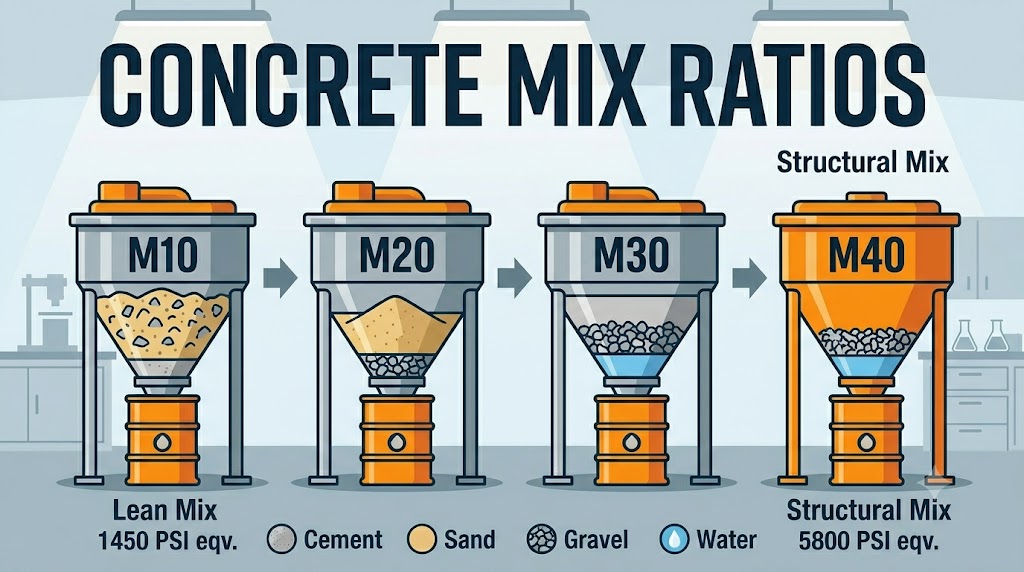
Concrete mix grades in the M-series run from M10 (roughly 1450 PSI / 10 MPa) to M40 (5800 PSI / 40 MPa) and beyond. Each grade specifies a characteristic compressive strength at 28 days and a corresponding cement:sand:aggregate ratio. Choose the wrong grade and your structure either fails under load or wastes money on over-engineered concrete.
- The M-number is MPa, measured on a cube at 28 days — M20 means 20 MPa characteristic strength.
- M10–M20 use fixed nominal ratios; M25 and above require a lab-designed mix, not a fixed volumetric ratio.
- C-grades (UK/Australia) are cylinder strengths, not cube strengths — C25 and M25 are not the same number in practice.
- The characteristic strength is a 95th-percentile floor, not the average you should mix to — target mean strength is always higher.
How mix ratios work — and what the M-number actually means
The M in M10, M20, M30 stands for mix. The number is the characteristic compressive strength in MPa (megapascals) measured on a 150 mm cube sample at 28 days. M20 = 20 MPa, which is the minimum grade permitted by most codes for reinforced concrete structural members. Picking a grade should start from the actual load the element carries, not the other way around — the Concrete Load Capacity Calculator is a useful sanity check before you commit to a grade for a beam, column, or slab.
The nominal mix ratio is expressed as cement : fine aggregate (sand) : coarse aggregate by volume. For M20 the nominal mix is 1:1.5:3, meaning 1 part cement, 1.5 parts sand, 3 parts aggregate. As grade increases, the cement content rises relative to aggregate, which increases strength and cost simultaneously.
Use the Concrete Mix Ratio Calculator to convert any M-grade into actual batch weights per cubic metre or cubic yard — accounting for the specific gravities of your materials.
M10 to M40 mix ratios, PSI equivalents, and typical applications
| Grade | Ratio (C:S:A) | MPa | PSI (approx.) | Typical use |
| M10 | 1 : 3 : 6 | 10 | 1,450 | Lean concrete, blinding, mass fill |
| M15 | 1 : 2 : 4 | 15 | 2,175 | Plain footings, non-structural slabs |
| M20 | 1 : 1.5 : 3 | 20 | 2,900 | Residential RCC slabs, beams, columns |
| M25 | 1 : 1 : 2 | 25 | 3,625 | Heavy slabs, commercial foundations |
| M30 | Design mix | 30 | 4,350 | Bridges, water-retaining structures |
| M35 | Design mix | 35 | 5,075 | Prestressed members, marine structures |
| M40 | Design mix | 40 | 5,800 | High-rise columns, pre-cast elements |
Grades M10 to M20 use nominal mixes — fixed volumetric ratios that provide adequate strength for most residential work. M25 and above technically require design mixes, where the w/c ratio, aggregate grading, and admixture dosage are calculated from trial batches to hit a target mean strength that accounts for statistical variability. Where the table shows reinforced members (beams, columns), remember the grade only covers the concrete — the Rebar / Reinforcing Steel Calculator covers the separate reinforcement schedule those members also need.
PSI vs MPa: converting between systems
1 MPa = 145.04 PSI. To convert MPa to PSI, multiply by 145. To go the other way, divide PSI by 145. In US construction, 3,000 PSI (≈ 20.7 MPa) is the standard residential concrete specification — directly equivalent to M20. 4,000 PSI (≈ 27.6 MPa) maps closely to M25–M30. The Concrete PSI to MPa Converter handles both directions instantly, and if you’re comparing an actual core or cylinder test report against a spec, the Concrete Compressive Strength Converter covers PSI, MPa, and N/mm² together.
UK and Australian standards use C-grades (C20, C25, C30 etc.) which express the characteristic cylinder strength in MPa — the cylinder test gives results roughly 80% of the cube test, so a C25 cylinder result corresponds to a cube strength of about 31 MPa (25 ÷ 0.8), closer to M30–M31 than to a direct M25 match. Do not treat C-grades and M-grades as interchangeable without checking which test method the specification references.
Common mistakes when specifying or batching mix ratios
Using nominal ratios above M25. M30 to M40 concrete cannot reliably achieve target strength through fixed volumetric ratios. The cement content needs to be determined from water-cement ratio calculations and material-specific trial mixes — the Water-Cement Ratio Calculator is the starting point for that. Using 1:0.75:1.5 as a ‘nominal M30’ is likely to undershoot or overshoot depending on aggregate moisture and grading.
Not adjusting for aggregate moisture. Aggregate stockpiles typically carry 2–6% free moisture. If you add design water without subtracting moisture already present in the aggregate, you raise the effective w/c ratio and reduce strength — often by one full M-grade. Weigh wet and dry samples to determine free moisture before batching.
Confusing M-grade with 28-day mean strength. The M-number is the characteristic strength, meaning 95% of test samples should meet it. The target mean strength used in mix design is typically M + 1.65σ, where σ is standard deviation. For M20 with a 4 MPa SD, target mean strength is 20 + 6.6 = 26.6 MPa. Mixing to exactly M20 will fail about 50% of tests.
Using dry-volume ratios for bagging calculations. The dry ingredients occupy roughly 30–35% more volume than the finished concrete due to compaction. 1 m³ of M20 concrete requires approximately 1.54 m³ of dry mix. Ignoring the bulking factor leads to under-ordering materials by a third — pair that dry-volume adjustment with your normal project contingency using the Concrete Waste Factor Calculator so the final order accounts for both.
Related calculators you might need
Once you have your mix grade, the next step is quantifying materials. The Cement Quantity Calculator outputs bags of cement per m³ for any M-grade. If you are batching on site rather than ordering ready-mix, the Concrete Batch Calculator converts your mix design into exact weights per batch. For the water side of the equation, the Water-Cement Ratio Calculator lets you determine the precise w/c ratio for your target strength. If you are adding plasticisers or retarders to extend workability at higher grades, the Concrete Admixture Dosage Calculator converts manufacturer-recommended percentages into actual dosing volumes per m³. And once grade is settled, the Concrete Cost Calculator prices the job out at that grade.
Frequently asked questions
What is the difference between M20 and 3000 PSI concrete?
M20 has a characteristic compressive strength of 20 MPa, which equals 2,900 PSI. US residential specs typically call for 3,000 PSI (20.7 MPa). The difference is less than 4% and falls within normal test variability — for practical purposes they are the same grade. If a US specification calls for 3,000 PSI and you are sourcing locally specified M20 mix, verify with your engineer that the characteristic strength approach aligns with the project’s acceptance criteria.
What mix ratio should I use for a driveway?
A residential driveway requires a minimum of M25 / 3,500 PSI — M20 is marginal for vehicle loads and will surface-scale faster under freeze-thaw. The ratio for M25 is approximately 1:1:2 (cement:sand:aggregate) as a nominal mix. Air entrainment is essential in freeze-thaw climates — use the Concrete Air Entrainment Calculator to get the right air content dosage for your exposure. Pair the grade with an appropriate slab thickness using the Concrete Slab Thickness Selector, then use the Concrete Mix Ratio Calculator to get precise batch weights for your site.
Can I use M10 for a concrete slab?
M10 (10 MPa / 1,450 PSI) is suitable only for blinding layers and non-structural mass fill. It should not be used for any slab that carries foot traffic, furniture, vehicles, or structural loads. For a basic residential floor slab, the minimum is M20; for garage slabs or any slab carrying vehicles, M25 is the appropriate starting point. The Concrete Slab Thickness Selector pairs the grade with the right depth for the intended load.
What does ‘design mix’ mean for M30 and above?
A design mix is produced through laboratory trial batches that account for the specific gravity, absorption, and grading of your local aggregates, the cement brand’s actual strength contribution, and the required workability. Rather than a fixed ratio, a design mix specifies a maximum water-cement ratio, a minimum cement content per m³, and a target slump. Ready-mix plants supply design mixes as standard; on-site batching at M30+ requires mix design documentation from a materials lab.
How much does mix grade affect cost?
Each grade increase from M20 to M25 typically adds 8–12% to material cost due to higher cement content. M30 costs roughly 20–25% more per m³ than M20. Labour and delivery costs are unaffected by grade. The largest cost driver above M30 is usually the requirement for admixtures — superplasticisers to maintain workability at low w/c ratios add £5–£15 / $8–$20 per m³ depending on dosage rate. The Concrete Cost Per Square Foot Calculator lets you compare the installed cost across grades for a specific slab or driveway size.
Is M25 the same as C25?
No. M25 specifies a 25 MPa characteristic strength on a 150 mm cube. C25 specifies a 25 MPa characteristic strength on a 150 mm cylinder. Cylinder strengths run approximately 80% of cube strengths, so C25 ≈ M31 in equivalent cube strength terms. UK structural drawings specify C-grades; Indian and many Asian standards use M-grades. Always confirm which test geometry the project specification references before sourcing concrete.
Mix grade selection above reflects common code conventions for general planning. The correct grade for a specific structural element — and whether a nominal or design mix is acceptable — should be confirmed against your project’s structural drawings or with a qualified engineer before ordering.