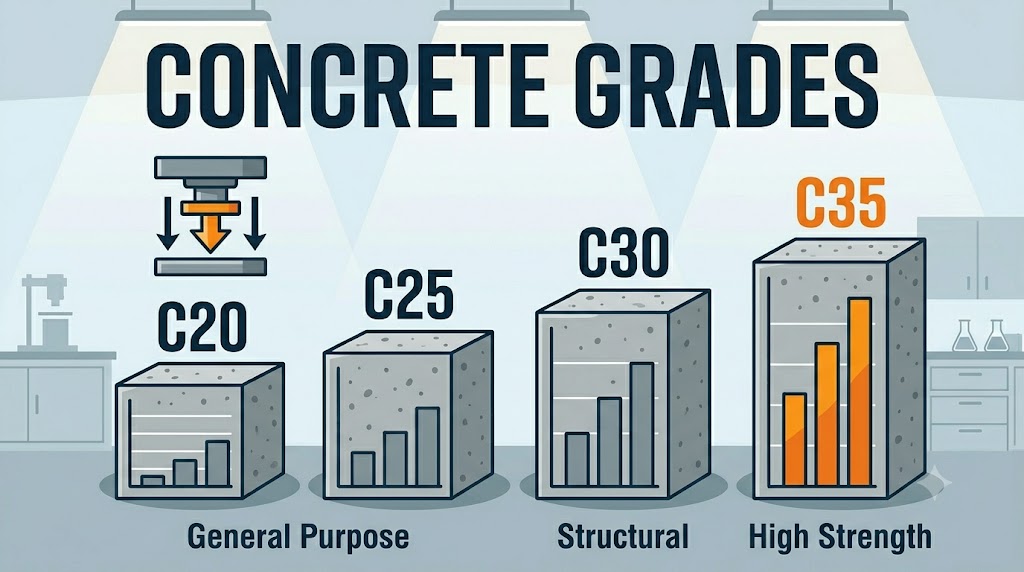
C-grades — C20, C25, C30, C35, and upward — are characteristic compressive strength classes defined by Eurocode 2 (EN 206) and used across the UK, Europe, and Commonwealth countries. The number is the cylinder strength in MPa, measured at 28 days on a 150 mm × 300 mm cylinder test specimen. C30 means 95% of cylinders tested will exceed 30 MPa (4,350 PSI). Every structural concrete element on a Eurocode-designed project has a minimum C-grade specification; using the wrong one is a code violation.
What C-grade notation actually specifies
EN 206 expresses grades as C(cylinder)/cube — so C30/37 means a characteristic cylinder strength of 30 MPa and a characteristic cube strength of 37 MPa. Cylinder results run approximately 80% of cube results for the same mix, which is why the two numbers differ. UK practice historically used cube testing (BS 5328), and many contractors still think in cube terms; the cube strength is the higher of the two numbers in the designation.
The concrete compressive strength converter converts between cylinder MPa, cube MPa, and PSI — essential when comparing a UK spec (cube) against a Eurocode spec (cylinder) or a US readymix plant’s PSI rating.
The C-grade defines a statistical floor, not an average. The target mean strength used by the ready-mix plant to design the actual mix is higher than the specified grade, to account for production variability. For C30 with a production standard deviation of 5 MPa, the target mean strength is 30 + (1.645 × 5) = 38.2 MPa. This is why delivered concrete routinely test higher than the C-grade — that is intentional and correct.
C20 to C50: grades, equivalent PSI, and structural applications
| Grade (EN 206) | Cylinder (MPa) | Cube (MPa) | PSI (approx.) | Structural application |
| C16/20 | 16 | 20 | 2,320 | Blinding, mass fill, non-structural slabs |
| C20/25 | 20 | 25 | 2,900 | Foundations, ground slabs, lightly loaded elements |
| C25/30 | 25 | 30 | 3,625 | Residential RC slabs, beams, columns |
| C28/35 | 28 | 35 | 4,060 | Commercial floors, heavier foundations |
| C30/37 | 30 | 37 | 4,350 | Bridges, parking structures, retaining walls |
| C32/40 | 32 | 40 | 4,640 | Heavily loaded structures, water retaining |
| C35/45 | 35 | 45 | 5,075 | Prestressed elements, marine structures |
| C40/50 | 40 | 50 | 5,800 | High-rise columns, pre-cast beams |
| C45/55 | 45 | 55 | 6,525 | Offshore, bridge decks, industrial floors |
| C50/60 | 50 | 60 | 7,250 | High-performance structural members |
For residential work in the UK, the most common grade on a structural engineer’s drawing is C25/30 for ground-bearing slabs, pad foundations, and domestic RC frames. C30/37 appears in commercial basements, retaining walls, and any element with significant reinforcement. Below C20/25, concrete is considered non-structural and should only be used as blinding or mass fill.
How C-grades relate to exposure classes under EN 206
EN 206 ties minimum concrete grade to exposure class. The designation covers chemical and physical attack: XC (carbonation), XD (chloride from non-seawater), XS (chloride from seawater), XF (freeze-thaw), XA (chemical attack). For each class there is a minimum grade, a maximum w/c ratio, and a minimum cement content. Note that EN 206 is a framework standard — individual countries set the exact numeric limits through their National Annex (BS 8500 in the UK, DIN in Germany, and so on), so figures below are representative of common UK/BS 8500 practice rather than a single universal number; confirm against your specific national annex before finalising a spec.
| Exposure class | Description | Min grade (EN 206) | Max w/c |
| XC1 | Dry or permanently wet | C20/25 | 0.65 |
| XC2 | Wet, rarely dry | C25/30 | 0.60 |
| XC3/XC4 | Moderate/cyclic wet-dry | C30/37 | 0.55 |
| XD1 | Chloride, moderate humidity | C30/37 | 0.55 |
| XD2/XD3 | Chloride, wet or cyclic | C35/45 | 0.45 |
| XS1 | Marine, airborne salt | C30/37 | 0.50 |
| XS2/XS3 | Submerged / tidal | C35/45 | 0.45 |
| XF1–XF4 | Freeze-thaw (four sub-classes of increasing severity — this range spans all four, not one figure per class) | C25/30–C30/37 | 0.45–0.55 |
A basement retaining wall in a UK car park with deicing salts (XD3 exposure) requires a minimum of C35/45 with a maximum w/c of 0.45 and a minimum cement content of 360 kg/m³. Specifying C30/37 in that environment is non-compliant regardless of whether it is structurally adequate — durability and strength requirements must both be met, and the more demanding criterion governs.
Common mistakes when specifying or ordering C-grade concrete
Specifying the cylinder strength when the plant expects cube. In the UK, most ready-mix plants still quote and batch to cube strength. If you order ‘C30 concrete’ without specifying cylinder or cube, you may receive concrete designed to C30 cube (37 MPa cylinder) when your engineer specified C30 cylinder (37 MPa cube). Always use the full EN 206 designation — C30/37 — and confirm with your plant which test method they use for compliance.
Using C20/25 for exposed concrete in freeze-thaw climates. C20/25 has insufficient density and cement content to resist freeze-thaw cycling. In Scotland, Northern Ireland, or anywhere with more than 25 freeze-thaw cycles per year, the minimum for exposed slabs, paths, and driveways is C25/30 with air entrainment (3–6% entrained air). C20/25 without air entrainment will surface-scale within 3–5 winters.
Ordering standard C-grade concrete for sulphate-bearing ground. Sites with ground sulphate content above Class DS-2 (SO₃ > 0.5 g/L in groundwater) require sulphate-resisting Portland cement (SRPC) or a specified blend with GGBS. The C-grade alone does not address this — you can have C40 concrete that deteriorates in sulphate ground if the cement type is wrong. Always check the site investigation report for sulphate classification before specifying foundations.
Assuming higher C-grade always means better concrete for the application. C50/60 in a domestic house foundation is money wasted and potentially problematic — higher-grade concrete is stiffer (higher modulus), more prone to early thermal cracking in thick sections, and requires tighter placing and curing procedures that site crews are not set up to follow. Specify the minimum grade that satisfies both structural and durability requirements.
Related calculators you might need
Knowing the C-grade is the first step; calculating the volume of concrete you need is the next. For foundations, the concrete footing calculator outputs m³ for pad and strip footings at any dimension. For ground-bearing slabs, the concrete slab calculator handles rectangular and irregular areas. Once you have a volume, the concrete cost calculator can apply your local ready-mix price to get a delivered cost. If the project uses high-grade concrete (C35+) and you need to verify load-bearing capacity, the concrete load capacity calculator is the relevant structural check.
Frequently asked questions
What is C25 concrete used for?
C25/30 is the most common grade for residential reinforced concrete in the UK — used for house foundations, ground floor slabs, garden walls, retaining walls up to about 1.5 m / 5 ft, and lightly loaded beams and columns. It has a 28-day cylinder strength of 25 MPa (3,625 PSI) and cube strength of 30 MPa. It is the minimum grade most structural engineers specify for any load-bearing reinforced concrete member.
What is the difference between C30 and C35 concrete?
C30/37 has a characteristic cylinder strength of 30 MPa; C35/45 has 35 MPa — a 17% increase in strength. C35/45 also requires a lower maximum w/c (0.45 vs 0.50 for XC4) and higher cement content. In practice, C35 is specified for more aggressive exposure conditions — parking structures, bridge decks, retaining walls in chloride environments — rather than simply for load capacity. The ready-mix cost difference is typically £8–£18 / $12–$25 per m³ depending on supplier and region.
Is C20 concrete strong enough for a driveway?
For a domestic driveway carrying passenger cars, C25/30 is the correct minimum, not C20. C20/25 has lower abrasion resistance and is more susceptible to surface scaling under freeze-thaw and deicing salts. Most UK contractors pour domestic driveways in C25/30 or C28/35. If the driveway carries HGVs or regular delivery vehicles, C30/37 is appropriate and the slab thickness should increase to at least 150 mm / 6 in.
How do I convert C-grade to PSI for US specifications?
Multiply the cylinder MPa by 145 to get PSI. C25 = 25 × 145 = 3,625 PSI, which rounds to 3,500 PSI in US specification. C30 = 4,350 PSI ≈ 4,000 PSI. Use the concrete PSI to MPa converter for exact two-way conversion. Note that the UK cube-strength number in the C(cylinder)/cube designation should not be used for this conversion — always use the cylinder figure.
What concrete grade do I need for a retaining wall?
For a domestic retaining wall up to 1.0 m / 3.3 ft in retained height, C25/30 is the structural minimum. For walls between 1.0–2.0 m / 3.3–6.6 ft, C30/37 with full engineering design is standard. Walls above 2.0 m / 6.6 ft retain enough lateral load that exposure class (often XC4 or XD1 in most climates) becomes the governing criterion and pushes the grade to C30/37 or C35/45. Waterproofing admixtures do not substitute for specifying the correct grade and cover depth.