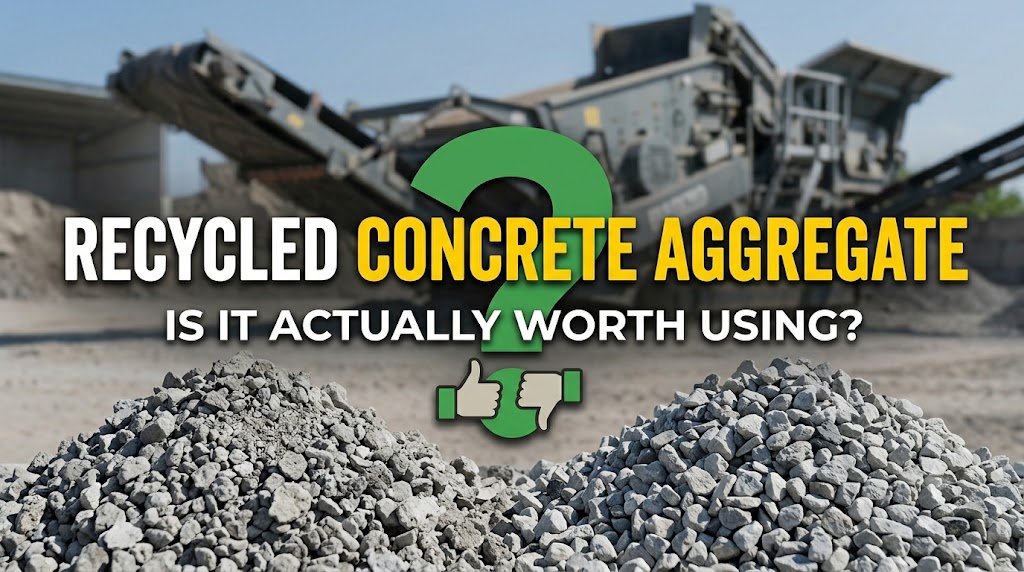
Recycled concrete aggregate (RCA) costs 20–40% less than virgin crushed stone in most North American and European markets, and it diverts demolition waste from landfill. But those savings come with real trade-offs in strength, absorption, and long-term durability that make it unsuitable for several common applications. Whether it is worth using depends entirely on what you are building.
- 30% replacement is the sweet spot — most codes accept it with no special design provisions, and the strength penalty is under 10%.
- 100% replacement is a different proposition — expect a 20–25% strength drop and meaningfully higher shrinkage.
- Higher absorption is the root cause of most RCA problems — pre-soak to SSD condition or the aggregate steals water from the mix mid-batch.
- RCA is excellent for sub-base and fill, and much more conditional for structural concrete.
What is recycled concrete aggregate and how is it produced?
RCA is crushed demolition concrete — broken slabs, foundations, pavements, and structural elements — processed through jaw crushers, screened for size, and stripped of embedded rebar. The output is a coarse aggregate that ranges from 4 mm to 40 mm (3/16 in to 1.5 in), with fines sometimes recovered separately as recycled concrete fines (RCF).
The key difference from virgin aggregate is the residual cement mortar attached to each particle. That old mortar is porous, weaker than the original aggregate, and it drives up water absorption — typically 3–10% for RCA versus 0.5–2% for natural crushed stone. Higher absorption means the water-cement ratio in new concrete is harder to control unless mix water is adjusted at the batch plant.
If you are calculating material quantities for a project using RCA, use the Recycled Concrete Aggregate Calculator to account for density and volume differences versus virgin aggregate.
Performance comparison: RCA versus virgin aggregate
The table below reflects published test data ranges from ACI 555R, RILEM TC 121, and Transport Research Laboratory reports. Actual results depend on parent concrete quality and processing standards at the recycling facility.
| Property | Virgin Crushed Stone | RCA (typical range) |
| Compressive strength reduction | Baseline | 0–25% lower, depending on replacement level |
| Water absorption | 0.5–2% | 3–10% |
| Bulk density | 1,550–1,650 kg/m³ | 1,150–1,450 kg/m³ |
| Drying shrinkage | Baseline | 20–50% higher |
| Freeze-thaw resistance | Baseline | Reduced without air entrainment |
| Typical cost saving | — | 20–40% per tonne |
Using 30% RCA replacement — the threshold most codes allow without special design provisions — the strength penalty is generally under 10%, which is acceptable for most non-structural applications. At 100% replacement, the compressive strength drop reaches 20–25% and drying shrinkage becomes a significant durability concern.
Where RCA performs well and where it does not
Suitable applications include sub-base and base course for roads and driveways, fill under slabs-on-grade, non-structural backfill, drainage layers, and concrete for low-load flatwork such as footpaths, shed pads, and residential driveways where a minimum strength of 20 MPa (2,900 psi) is sufficient. If you’re planning one of these, the Concrete Driveway Calculator and Concrete Shed / Equipment Pad Calculator size the flatwork itself, while the Fill Dirt Calculator covers backfill volume where RCA isn’t the right fit or isn’t available and you’re using standard fill instead.
Unsuitable applications include reinforced structural elements (columns, beams, load-bearing slabs), prestressed concrete, concrete exposed to aggressive freeze-thaw cycles without air entrainment correction, marine or sulfate-exposure environments, and any element requiring a water-cement ratio below 0.45 without careful pre-soaking of the RCA. Where freeze-thaw exposure applies, the Concrete Air Entrainment Calculator sizes the AEA dosage needed to offset RCA’s reduced freeze-thaw resistance.
The porosity issue is manageable: pre-soaking RCA to saturated-surface-dry (SSD) condition before batching is the standard mitigation. Skipping this step causes the aggregate to absorb mix water mid-batch, effectively increasing the water-cement ratio after the truck leaves the plant — a common cause of below-spec strength results in RCA mixes.
Common mistakes with recycled concrete aggregate
1. Using ungraded or contaminated RCA. Site-crushed concrete mixed with brick, tile, asphalt, or gypsum wallboard causes unpredictable expansion and strength loss. Always source RCA from a licensed facility with grading certificates. Uncontrolled site crushing is not equivalent to processed RCA.
2. Ignoring mix water adjustment. RCA absorption ranges from 3–10% versus 0.5–2% for virgin aggregate. Using the same mix design without adjusting total water results in a stiffer mix on-site and actual effective water-cement ratios lower than specified — or, if extra water is added at the truck, a weaker mix. The Water-Cement Ratio Calculator lets you recalculate effective w/c ratio when aggregate absorption changes.
3. Specifying 100% RCA replacement for structural work. Most building codes (ACI 318, Eurocode 2, BS 8500) either prohibit or require specific design modifications for 100% coarse RCA replacement in structural concrete. A 30% partial replacement is the safe default that requires no special code treatment in most jurisdictions.
4. Overlooking drying shrinkage. RCA concrete shrinks 20–50% more than equivalent virgin aggregate mixes. Ignoring this in slab design means joints may be spaced too widely, and cracking between control joints becomes likely. Reduce joint spacing by 15–20% compared to your normal spacing for RCA flatwork above 50% replacement.
Related calculators you might need
After confirming RCA suitability, the next step is calculating your concrete volumes. The Concrete Slab Calculator handles flatwork dimensions, while the Concrete Mix Ratio Calculator lets you adjust aggregate proportions for a blended RCA mix. If you are recycling your own demolition concrete and want to understand the cost offset, the Concrete Recycling Savings Calculator quantifies the landfill and material cost savings, and the Concrete Carbon Footprint Calculator quantifies the emissions offset if that’s part of your project’s case for using RCA. Projects using RCA in sub-base applications often need gravel volume estimates alongside — the Gravel / Crushed Stone Calculator covers that.
Frequently asked questions
Is recycled concrete aggregate as strong as regular gravel? For sub-base use, yes — compacted RCA performs comparably to virgin crushed stone as a base course and is accepted by most highway specifications. In concrete mixes, coarse RCA at 30% replacement produces negligible strength loss. At 100% replacement, expect 20–25% lower compressive strength depending on parent concrete quality.
Can I use crushed concrete as a base for a driveway? Yes, and this is one of the best applications for RCA. Crushed concrete compacts well, drains adequately, and meets most residential and light commercial sub-base specifications. Use a 100 mm (4 in) minimum depth for light vehicles and 150 mm (6 in) for heavier loads. Confirm the material is free from asphalt, brick, and contaminated fill. The Concrete Driveway Calculator handles the slab on top once the base is compacted.
What percentage of RCA is allowed in structural concrete? ACI 555R allows up to 30% coarse RCA replacement in structural concrete without additional design modifications. Eurocode guidance through national annexes typically allows 20–50% depending on the exposure class. Exceeding these thresholds requires engineer review and mix design testing.
Does RCA concrete need more cement? Often, yes. To compensate for strength reduction and higher shrinkage at high replacement rates, mix designs typically increase cement content by 5–15% when using 50% or more RCA. This partially offsets the cost advantage of recycled aggregate, which is why the economic case for RCA is strongest at 20–30% replacement rates.
How do I calculate how much RCA I need for a project? Use the Recycled Concrete Aggregate Calculator — it accounts for the lower bulk density of RCA (typically 1,150–1,450 kg/m³ versus 1,550–1,650 kg/m³ for crushed stone), so volume and tonnage outputs are accurate for ordering purposes.
Replacement percentages, strength penalties, and code allowances above are general planning figures — actual RCA performance depends heavily on the parent concrete and the processing facility. For structural or load-bearing applications, confirm the allowable replacement rate and any required mix adjustments with your project’s structural engineer before specifying RCA.