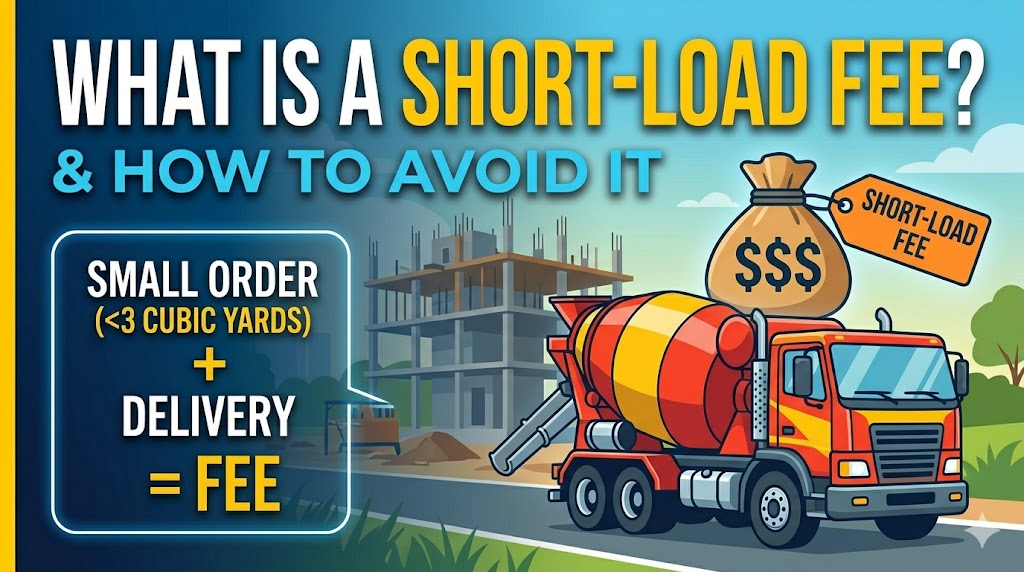
A short-load fee is a surcharge applied by ready-mix concrete suppliers when your order falls below their minimum delivery volume — typically 8–10 cubic yards / 6.1–7.6 m³. The fee ranges from $50 to $250 per cubic yard under the minimum, which can add $400–$1,200 to a small pour that was already borderline on budget.
How short-load fees are calculated
Ready-mix plants price their trucks on a full-load model. A standard transit mixer carries 8–10 cubic yards / 6.1–7.6 m³. When a customer orders less, the plant still dispatches the same truck, burns the same fuel, and ties up the driver for the same amount of time. The short-load fee compensates for the unused capacity.
The fee structure varies by supplier but typically follows one of two models:
The flat-rate model charges a fixed dollar amount per cubic yard below the minimum. If the minimum is 8 yards and you order 5 yards, you pay for 3 yards of shortfall at the surcharge rate.
The graduated model applies a smaller per-yard penalty on orders close to the minimum and a larger one on smaller orders — designed to nudge customers toward the threshold.
The short load fee estimator calculates your exact surcharge exposure before you call the plant, based on your order volume and supplier minimums. That number alone often changes how a project is designed.
A realistic example: you need 6.5 cubic yards / 4.97 m³ for a driveway apron and walkway extension. Your local plant charges $75 per yard under an 8-yard minimum — that is a $112.50 short-load fee on top of base concrete costs.
Short-load fee comparison by typical order size
| Order volume (yd³) | Minimum threshold (yd³) | Shortfall (yd³) | Fee at $75/yd |
| 3.0 | 8.0 | 5.0 | $375 |
| 5.0 | 8.0 | 3.0 | $225 |
| 6.5 | 8.0 | 1.5 | $112.50 |
| 7.5 | 8.0 | 0.5 | $37.50 |
| 8.0+ | 8.0 | 0 | $0 |
Fee rates vary significantly by region and supplier. Urban markets with multiple plants tend to be more competitive; rural or remote sites often face higher minimums and steeper surcharges.
How to avoid paying a short-load fee
The most direct approach is to reach the minimum volume. Look at adjacent projects that are coming up within the next few weeks — a neighbour’s driveway apron, a garden retaining wall, or a shed pad that was being deferred. Combining orders into a single truck pour eliminates the fee entirely and often reduces per-yard delivery costs as well.
If there are no adjacent pours to combine, calculate whether it is cheaper to order up to the minimum and accept the extra concrete, or to pay the surcharge and order exactly what you need. Extra concrete can be used for walkway extensions, step repairs, or ancillary pads — concrete does not keep, but a prepared subbase for a future project costs almost nothing.
Volumetric or metered trucks are a legitimate alternative for small pours. These trucks mix on-site and charge by the cubic yard actually dispensed — no minimum, no short-load fee. The per-yard cost is typically 15–25% higher than plant-mixed concrete, but on a 3–4 yard order that premium is often less than the short-load surcharge from a conventional plant.
For truly small pours — under 1 cubic yard / 0.76 m³ — bagged concrete mixed on-site is almost always cheaper. The ready-mix vs bagged concrete cost calculator shows the crossover point for your specific volume and local pricing.
Timing also affects fees. Some plants waive or reduce short-load charges for off-peak deliveries — early morning, mid-week — when trucks would otherwise run light. It is always worth asking the dispatcher directly.
Common mistakes that lead to unexpected short-load charges
Not asking the supplier’s minimum before ordering. Short-load minimums are not always published. A customer assumes the minimum is 5 yards because that is what a neighbour said; the actual minimum is 8 yards. Always confirm the minimum volume and the exact surcharge rate during the first call, before providing any project details.
Calculating volume without a waste factor. Contractors often calculate the theoretical concrete volume, order that amount, and then find the pour runs short due to subbase variation, form blowouts, or measurement error. Adding the missing 0.5 yard as a second delivery triggers a separate short-load fee. Build in a 5–10% waste factor up front using the concrete waste factor calculator, so the first order is sufficient.
Treating the short-load fee as fixed. Many customers accept the quoted fee without negotiating. Plants have discretion on these charges — especially for repeat customers, commercial accounts, or projects where the customer is willing to take an early-morning slot. A five-minute conversation with the plant manager can eliminate or halve the fee on small orders.
Using a ready-mix truck when bagged or volumetric concrete is the right tool. For isolated pours under 2 cubic yards / 1.53 m³ with no adjacent work, a standard ready-mix truck is the wrong choice from the start. Short-load fees, minimum charges, and drum residuals make it economically irrational. Map the total cost of each supply method before defaulting to ready-mix.
Related calculators you might need
Before calling a supplier, know your exact volume. The concrete truck load calculator shows how many cubic yards your pour requires and whether it fills a standard truck. For the cost decision, the concrete delivery cost calculator builds up total delivered cost including base price, fuel surcharge, and short-load fees by region. If the numbers tip toward bagged concrete, the cubic yards to bags converter translates your volume into bag quantities across multiple bag sizes. For a full project cost summary, the full concrete project estimator rolls materials, delivery, and labour into a single line-item breakdown.
Frequently asked questions
What is a short load fee for concrete?
A short-load fee is a surcharge charged by ready-mix concrete plants when an order falls below their minimum delivery quantity. Minimums are typically 8–10 cubic yards; fees range from $50–$250 per yard under the threshold depending on the supplier and region. The fee exists because the plant incurs the full cost of dispatching a truck regardless of how much concrete it carries.
How do I avoid a short load concrete fee?
The three main strategies are: combine the pour with adjacent work to reach the minimum volume; use a volumetric (metered) truck that charges only for what is dispensed; or choose bagged concrete for pours under 2 cubic yards / 1.53 m³. For borderline volumes, ask the supplier about off-peak delivery slots — plants sometimes waive fees to avoid running trucks empty.
Is it cheaper to use bags or ready-mix for a small pour?
For pours under 1 cubic yard / 0.76 m³, bagged concrete mixed on-site is almost always cheaper once short-load fees are factored in. Between 1 and 3 yards, it depends on local bag prices and the specific supplier’s fee structure. Use the ready-mix vs bagged concrete cost calculator to compare totals for your specific pour size and location.
Do all concrete suppliers charge short-load fees?
Most ready-mix plants charge some form of short-load or minimum-order fee, but the threshold and rate vary widely. Some large operations in competitive urban markets have reduced minimums to 5 or 6 yards. Volumetric concrete suppliers typically do not charge short-load fees — they charge per actual yard dispensed, making them cost-effective for small pours.
Can I order extra concrete to avoid the fee and use the leftovers?
Yes, and it is often the right financial decision. Calculate whether the per-yard cost of the extra concrete is less than the short-load surcharge. If your supplier charges $150/yd for concrete and the short-load fee is $75/yd for a 1-yard shortfall, ordering an extra yard costs $150 but gives you a usable cubic yard of material. Plan a use for it in advance — driveway patch, step footing, shed pad — so nothing goes to waste.

Concrete is the most widely used building material on Earth, yet some of the most important decisions behind it are still made with rough guesses, outdated spreadsheets, and conflicting advice from random websites.
We thought that was a problem worth fixing.
Every calculator and guide on this platform exists for one reason: to replace uncertainty with reliable numbers. Whether you’re estimating a slab, planning footings, calculating reinforcement, comparing mix designs, or budgeting a project, the goal is the same—help you make decisions with confidence before concrete is poured.
We don’t publish calculators for the sake of having calculators. Every formula is researched, tested, and built around real construction requirements. Every guide is written to answer practical questions that contractors, builders, engineers, and homeowners actually face on job sites—not questions invented for search engines.
Because concrete is unforgiving.
A small mistake in volume estimation can waste thousands of dollars. An undersized footing can create structural problems. Incorrect reinforcement calculations can compromise performance. Once concrete is placed, many mistakes become expensive—or impossible—to undo.
That’s why accuracy matters.
Our approach is simple: start with the engineering, verify the calculations, explain the reasoning, and present the results in a way that anyone can use. No inflated claims. No copied content. No generic formulas stripped of context.
Just practical tools, clear guidance, and calculations designed to solve real-world construction problems.
The internet has plenty of articles about concrete.
We’re building a resource that helps people work with it.