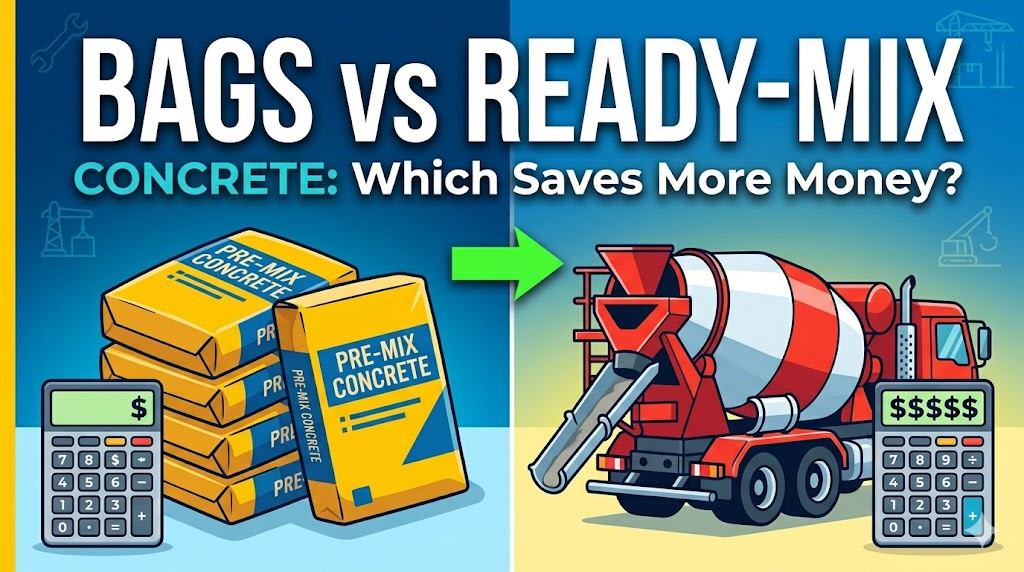
Ready-mix concrete is cheaper per cubic yard once you cross approximately 1 cubic yard (0.76 m³) of material — but that threshold shifts depending on local delivery fees, short-load surcharges, and your labour costs. Below that volume, bagged concrete is typically the lower total-cost option when all factors are included. Neither answer applies universally; the correct choice depends on your volume, your location, and whether you’re supplying your own labour.
The real cost comparison: materials, delivery, and labour
Ready-mix is quoted per cubic yard or per cubic metre from the plant. In the US, ready-mix prices in 2024 ranged from $125–$180 per cubic yard for standard 3,000 PSI / 20 MPa residential mix, with significant regional variation. Delivery adds $75–$150, and most plants charge a short-load fee of $40–$100 per cubic yard under the minimum (usually 5–8 yd³). A 2 yd³ pour from a plant with a 5 yd³ minimum can therefore attract $120–$300 in short-load surcharges alone.
Bagged concrete (3,000–4,000 PSI / 20–27 MPa general purpose mixes) runs $5–$7 per 60 lb bag (US retail) and yields 0.45 cu ft per bag. At that price, 1 cubic yard from bags costs approximately $350–$475 in materials — versus roughly $200–$250 delivered for the same volume in ready-mix (materials + delivery amortised, no short-load). Use the Ready-Mix vs Bagged Concrete Cost Calculator to run this comparison at your local prices.
Labour is the variable most DIYers undercount. Mixing 45 bags of concrete by hand (the quantity for 1 cubic yard) takes 2–3 hours with a rented electric mixer and 4–5 hours by hand. At a contractor labour rate of $45–$65/hr, that makes bagged concrete cost-equivalent to ready-mix at volumes well under 1 yd³.
Cost scenarios side by side
The table below shows total estimated project costs across four volume scenarios using 2024 US national averages. Ready-mix delivery cost assumed $100 flat; short-load fee assumed $60/yd³ for loads under 5 yd³; labour at $50/hr.
| Volume | Bags (materials only) | Bags (+ labour) | Ready-Mix (+ delivery) | Verdict |
| 0.25 yd³ (0.19 m³) | ~$95 | ~$170 | $175–$280 (short-load) | Bags |
| 0.5 yd³ (0.38 m³) | ~$185 | ~$285 | $215–$300 (short-load) | Bags or toss-up |
| 1 yd³ (0.76 m³) | ~$370 | ~$520 | $225–$340 (short-load) | Ready-mix |
| 5 yd³ (3.8 m³) | ~$1,850 | ~$2,850 | $900–$1,100 (no short-load) | Ready-mix |
These figures are directional. For an accurate number at your location, the Concrete Cost Calculator allows input of local material prices, delivery rates, and labour costs and returns total project cost in both scenarios.
When bags win — and when they don’t
Bags are the right choice when:
The pour is under 0.5 yd³ (0.38 m³) and you can supply the labour. Patch repairs, single post holes, small steps, and equipment pads under 10 sq ft (0.93 m²) all fall here. Bags also win when site access prevents a truck: steep or narrow driveways, backyards accessible only through a gate, and upper-floor deck footings where wheelbarrows can’t reach the pour.
Bags also give you control over timing. You can mix one bag at a time and work at your own pace — important in hot weather when ready-mix begins to set within 60–90 minutes of discharge. For coloured or decorative work, bagged mixes allow consistent pigment-to-concrete ratios across the job; the Concrete Pigment/Color Calculator helps maintain colour consistency batch-to-batch.
Ready-mix is the right choice when:
Volume exceeds 1 yd³ (0.76 m³), the pour needs to be placed and finished within a tight window, or the specification calls for a mix design that isn’t available in bagged form — such as air-entrained concrete for freeze-thaw climates, low water-cement ratio structural mixes, or fibrous concrete. Ready-mix also reduces physical labour significantly: a 5 yd³ pour from bags involves moving, cutting, and mixing 225 × 60 lb bags.
The short-load fee — the cost most people miss
Ready-mix plants set minimum loads of 5–8 cubic yards (3.8–6.1 m³). Orders below the minimum are subject to a short-load fee, typically structured as a per-yard penalty for each yard below the minimum. A plant with a 7 yd³ minimum and a $55/yd³ short-load fee will charge an extra $275 on a 2 yd³ order — pushing the effective material cost from $150/yd³ to $287.50/yd³.
The Short Load Fee Estimator calculates this exact penalty for your plant’s pricing structure. In many cases, combining a driveway approach with a walkway repair or adding a small pad to reach the minimum order threshold is cheaper than paying the surcharge.
Common mistakes when choosing between bags and ready-mix
1. Ignoring the short-load fee when pricing ready-mix. Most online ready-mix quotes are for full truckloads. Call the plant and ask for their minimum order and short-load rate before comparing. A $130/yd³ quoted price can become $230/yd³ effective cost on a small pour.
2. Underestimating how many bags 1 cubic yard actually is. 45 × 60 lb bags weigh 2,700 lb (1,225 kg). Mixing that by hand in summer heat is not a practical option for most people. Rent a towable mixer for any job over 20 bags.
3. Buying bagged concrete retail when a contractor can access trade pricing. Contractors frequently pay $3.50–$4.50 per 60 lb bag through builders’ merchants — 30–40% less than retail box store pricing. If you’re a contractor comparing bids, use trade pricing in your calculations.
4. Not accounting for bag waste and partial mixes. The last bag on a job is almost always a partial — wet concrete left in the mixer or mixing trough that hardens before it can be used. Budget 1–2 extra bags per 10 bags ordered for small pours.
Related calculators you might need
Before committing to either option, verify your volume estimate with the Concrete Slab Calculator or the relevant project-specific tool. Once you know your volume, the Concrete Bags Calculator converts it into bag counts for 40 lb, 60 lb, and 80 lb bags so you can check pricing at your local supplier. For the delivery side of the equation, the Concrete Delivery Cost Calculator estimates total ready-mix costs including plant price, delivery fee, and short-load surcharge. And if you want to see both options summarised against your full project scope, the Full Concrete Project Estimator rolls materials, delivery, and labour into one number.
Frequently asked questions
At what volume does ready-mix become cheaper than bags?
The crossover point is typically 0.75–1.25 cubic yards (0.57–0.95 m³) in most US markets when you include short-load fees and labour. In markets with high retail bag prices (UK, Australia), ready-mix becomes competitive even below 0.5 m³. Short-load fees push the crossover point higher — the heavier the penalty, the more bags make sense for mid-range volumes of 1–2 yd³.
How many 60 lb bags equal a yard of concrete?
Approximately 45 bags at the standard yield of 0.45 cu ft per bag. If you’re mixing by hand rather than with a mechanical mixer, budget 50 bags (about 11% extra) to account for uneven water addition and mixing losses. For 80 lb bags, the equivalent is approximately 34 bags per cubic yard.
Does bagged concrete have the same strength as ready-mix?
Standard general-purpose bagged concrete mixes (e.g. Quikrete 5000, Sakrete High Strength) are rated at 4,000–5,000 PSI / 27–34 MPa at 28 days, which meets or exceeds the 3,000 PSI / 20 MPa minimum for residential driveways and footings. Where bagged mixes fall short is in specialty applications: air entrainment for freeze-thaw resistance, low-shrinkage mixes, and high-early-strength formulations are difficult to achieve reliably from bags.
Is it worth renting a concrete mixer for a small job?
Yes, above 15 bags (roughly 0.33 yd³ / 0.25 m³). Mixer rental runs $50–$85/day from most tool hire companies. The labour time savings more than justify the cost, and mechanical mixing produces a more consistent water-cement ratio than hand mixing — which directly affects final strength. Don’t mix more than 2–3 bags at a time in a standard 3.5 cu ft drum mixer.
What does a short-load fee typically cost?
Short-load fees vary by plant, but typical structures in the US charge $40–$75 per cubic yard under the minimum order. A plant with a 6 yd³ minimum and a $60/yd³ short-load rate will add $240 to a 2 yd³ order. Some plants charge a flat short-load fee of $100–$200 regardless of how far below the minimum you are. Always confirm the exact fee structure before ordering.

Concrete is the most widely used building material on Earth, yet some of the most important decisions behind it are still made with rough guesses, outdated spreadsheets, and conflicting advice from random websites.
We thought that was a problem worth fixing.
Every calculator and guide on this platform exists for one reason: to replace uncertainty with reliable numbers. Whether you’re estimating a slab, planning footings, calculating reinforcement, comparing mix designs, or budgeting a project, the goal is the same—help you make decisions with confidence before concrete is poured.
We don’t publish calculators for the sake of having calculators. Every formula is researched, tested, and built around real construction requirements. Every guide is written to answer practical questions that contractors, builders, engineers, and homeowners actually face on job sites—not questions invented for search engines.
Because concrete is unforgiving.
A small mistake in volume estimation can waste thousands of dollars. An undersized footing can create structural problems. Incorrect reinforcement calculations can compromise performance. Once concrete is placed, many mistakes become expensive—or impossible—to undo.
That’s why accuracy matters.
Our approach is simple: start with the engineering, verify the calculations, explain the reasoning, and present the results in a way that anyone can use. No inflated claims. No copied content. No generic formulas stripped of context.
Just practical tools, clear guidance, and calculations designed to solve real-world construction problems.
The internet has plenty of articles about concrete.
We’re building a resource that helps people work with it.