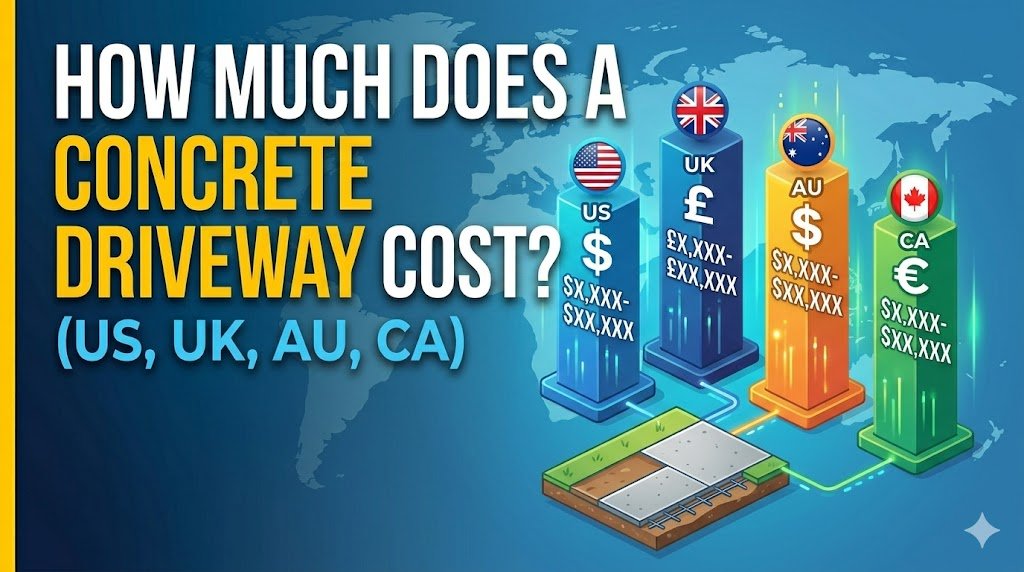
A standard concrete driveway costs $8–$18 per square foot (USD) installed in the US, £90–£160 per square metre in the UK, AUD $65–$130 per square metre in Australia, and CAD $10–$22 per square foot in Canada. Those are contractor-installed prices including labour, formwork, finishing, and a basic broom or brushed finish. Stamped, exposed aggregate, and coloured concrete all add cost. The variables that move the number most are site access, existing demolition, soil conditions, and local ready-mix pricing in your area.
To get an accurate volume and material estimate before you call a contractor, use the concrete driveway calculator — it handles rectangular, L-shaped, and circular configurations and outputs cubic yards/metres, bag counts, and a material cost range.
What Does a Concrete Driveway Actually Cost by Country?
The table below reflects 2025–2026 market data for a standard residential driveway, plain broom finish, 4 inches / 100 mm thick, single-car width (approximately 10 ft × 20 ft / 3 m × 6 m) to double-car width (20 ft × 20 ft / 6 m × 6 m). Prices include labour, ready-mix delivery, formwork, and basic finishing. They exclude demolition of existing surfaces.
| Country | Low End | High End | Notes |
| United States | $4,500 (single) | $10,800 (double) | Varies widely by state — Southern states cheaper, Northeast/West Coast significantly higher |
| United Kingdom | £2,700 (single) | £7,200 (double) | Based on 3m × 6m to 6m × 6m; London adds 20–30% premium |
| Australia | AUD $3,900 (single) | AUD $15,600 (double) | Sydney/Melbourne at upper end; regional QLD/SA cheaper |
| Canada | CAD $4,500 (single) | CAD $13,200 (double) | Prairie provinces cheaper; BC and Ontario at upper end |
What Factors Push the Price Up or Down?
Thickness is the most controllable cost lever. A 4-inch / 100 mm slab is standard for passenger vehicles. Heavy trucks, RVs, or equipment access require 6 inches / 150 mm, which increases concrete volume by 50% and adds roughly 30–40% to material cost alone.
Demolition of an existing asphalt or concrete surface typically adds $1.50–$4.00 per square foot (USD) or £15–£40/m² (UK) depending on thickness and disposal costs. If the existing surface is asphalt over a decent base, some contractors will pour directly over it — this is not recommended for longevity but does cut upfront cost.
Reinforcement makes a meaningful difference. A plain slab relies entirely on the concrete’s compressive strength and proper joint placement. Adding rebar on 18-inch / 450 mm centres or a layer of wire mesh adds $0.50–$1.20/sqft (USD) to labour and material but meaningfully extends slab life in freeze-thaw climates. In the UK and Australia, mesh reinforcement is common practice and often already included in quotes.
Site preparation — grading, compacting a gravel sub-base, and managing drainage — can add significant cost if the existing ground is poor. A sloped site or one with clay soil typically requires more base work than a level sandy site. Budget at least $1.00–$2.50/sqft (USD) or £10–£25/m² for this if it is not already included in a contractor’s quote.
Concrete Driveway Cost Breakdown: Materials vs Labour
On a typical US residential project, material costs (ready-mix, reinforcement, formwork lumber) account for roughly 40–55% of the total installed price. Labour makes up the rest. In the UK and Australia, labour costs proportionally more, reflecting higher hourly rates — labour can be 55–65% of total project cost.
| Cost Component | US (per sqft) | UK (per m²) | AU (per m²) |
| Ready-mix concrete | $2.50–$4.50 | £35–£60 | AUD $130–$200 |
| Labour (placing, finishing) | $3.00–$6.00 | £40–£75 | AUD $40–$80 |
| Formwork & prep | $1.00–$2.50 | £12–£25 | AUD $15–$30 |
| Reinforcement (rebar/mesh) | $0.50–$1.20 | £5–£15 | AUD $8–$20 |
| Sealing (optional) | $0.50–$1.50 | £6–£14 | AUD $8–$18 |
The ready-mix vs bagged concrete cost calculator is useful if you are deciding between ordering a ready-mix truck or mixing on-site for a smaller section. For most driveways larger than about 0.5 cubic yards / 0.4 m³, ready-mix is cheaper per yard once you factor in your time.
Concrete vs Asphalt vs Pavers: Is Concrete Worth It?
| Material | Installed Cost (US, sqft) | Lifespan | Maintenance |
| Concrete | $8–$18 | 30–50 years | Sealing every 3–5 years; joint filling |
| Asphalt | $3–$7 | 15–30 years | Seal-coating every 2–3 years; more frequent |
| Interlocking pavers | $12–$25 | 25–50 years | Occasional re-levelling; weed control |
| Gravel | $1–$3 | Ongoing | Annual top-up; edging maintenance |
Concrete costs more upfront than asphalt in every market but requires less ongoing maintenance and lasts significantly longer under normal residential use. In freeze-thaw climates (Canada, northern US, UK), concrete requires proper joint placement and a sealed surface to resist spalling — skipping these steps is the primary reason driveways fail early. In hot climates (Australia, southern US), concrete holds up better than asphalt, which can soften and rut under sustained heat.
Common Mistakes That Inflate Cost or Cause Failure
Skipping the sub-base. Pouring concrete directly on unprepared or soft ground is the single most common cause of cracked driveways. A compacted 4-inch / 100 mm gravel base costs money upfront but is non-negotiable for long-term performance. Contractors who skip this to cut cost are not saving you money — they are moving the cost to a future repair or replacement.
Ordering the wrong PSI mix. Residential driveways need a minimum 3,500 PSI / 24 MPa mix in moderate climates. In areas with sustained freeze-thaw cycles (most of Canada, northern US, UK), 4,000 PSI / 27.5 MPa with air entrainment is the correct spec. Using a 2,500 PSI / 17 MPa mix — common on some residential pours to cut cost — produces a surface that scales and spalls within a few winters.
Ignoring control joints. Concrete shrinks as it cures. Without saw-cut or tooled control joints placed every 8–10 feet / 2.4–3 m, the slab will crack where it wants to rather than where you manage it. A contractor who does not include joint placement in their scope is not describing a complete job.
Accepting a short-load delivery without accounting for the fee. Ready-mix trucks have a minimum charge, typically covering 7–10 cubic yards / 5.4–7.6 m³. A small driveway pour that only needs 3–4 cubic yards will attract a short-load surcharge of $50–$200+ depending on the supplier. Use the short load fee estimator to factor this into your budget before comparing quotes.
Related Calculators You Might Need
Once you have your driveway dimensions, the concrete driveway calculator gives you volume in cubic yards and metres plus a material cost estimate. If you are coordinating delivery, the concrete delivery cost calculator breaks down per-yard rates and surcharges by pour size. For projects in the US, the concrete price per yard by state tool gives current regional ready-mix pricing so you can sanity-check supplier quotes. If you are also adding a slab for a garage or shed alongside the driveway, use the full concrete project estimator to combine multiple pours into a single budget figure.
Frequently Asked Questions
How much does a concrete driveway cost per square foot?
In the US, installed concrete driveway cost runs $8–$18 per square foot for a standard 4-inch slab with a broom finish. Plain, single-car driveways in lower-cost states come in at the lower end. Double-wide driveways with decorative finishes in high-cost markets hit the upper end or beyond. Labour is typically 45–55% of that figure.
Is a concrete driveway cheaper than pavers?
Concrete is cheaper to install than interlocking pavers in almost every market — typically $8–$18/sqft vs $12–$25/sqft in the US. Pavers offer easier crack repair (replace individual units rather than patching or replacing a slab) and are often preferred for aesthetics, but the installed cost premium is real and significant for large surfaces.
How long does a concrete driveway last?
A properly installed concrete driveway with correct mix design (minimum 3,500 PSI), adequate sub-base, control joints, and periodic sealing lasts 30–50 years. Most premature failures — scaling, cracking, spalling — trace back to under-spec mix design, missing control joints, or inadequate base preparation rather than product failure.
What is the cheapest way to get a concrete driveway?
Get at least three quotes — prices for identical scopes often vary 20–35% between contractors. Time the pour during shoulder season (spring and early autumn in cold climates) when contractors are less busy. Consider a plain broom finish over decorative options; stamped or exposed aggregate adds $4–$8/sqft. Use the concrete cost calculator to arrive at a rough material figure so you can identify any quotes that seem inflated on material cost.
Do I need a permit for a concrete driveway?
In most US jurisdictions, a residential driveway does not require a building permit unless it connects to a public road or involves drainage work. The UK requires permitted development rules compliance — most standard driveways are permitted but permeable surfacing may be required under current PD rules. Australia and Canada vary by municipality; check with your local council or city before pouring.