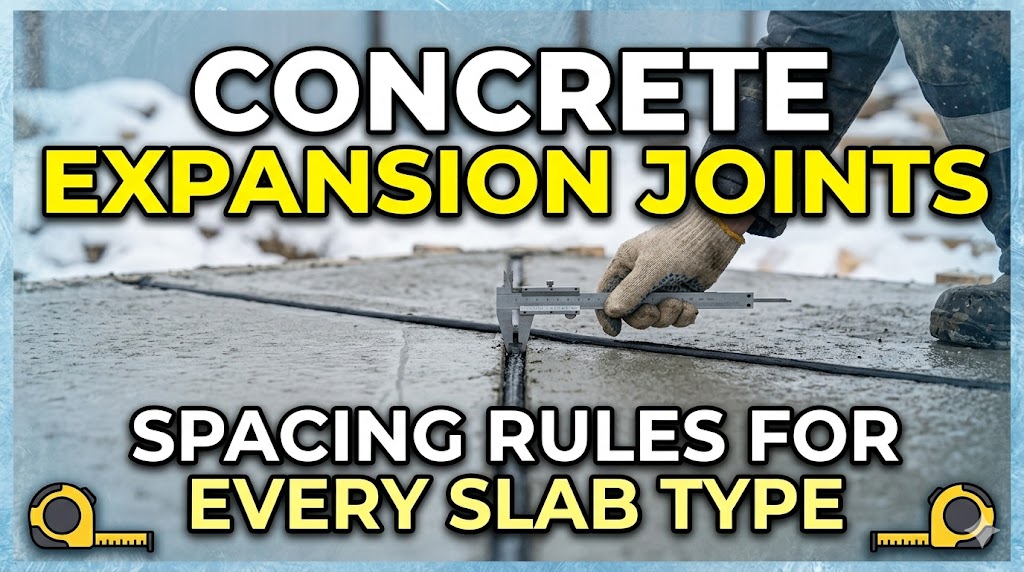
The standard rule for contraction joint spacing is 2–3 times the slab thickness in feet — a 4-inch / 100 mm slab gets joints every 8–12 feet / 2.4–3.6 m. Expansion joints are a separate matter: they are placed only at fixed structures (columns, walls, drains) and changes in slab direction, not on a regular grid. Confusing the two types — contraction vs expansion — is the most common error in residential and light commercial flatwork.
Contraction joints vs expansion joints: different functions, different rules
A contraction joint (also called a control joint) is a deliberate plane of weakness sawn or formed into the slab to control where shrinkage cracking occurs. The concrete will crack — joints simply determine where. A true expansion joint is a full-depth gap filled with compressible material that allows the slab to expand thermally without transferring load to adjacent structures.
Use the Concrete Expansion Joint Spacing Calculator to get spacing recommendations based on slab thickness, aggregate type, climate zone, and slab use. The calculator applies ACI 224R and ACI 330R recommendations and flags where structural isolation joints are required.
| Joint type | Purpose | Depth | Filler required? |
| Contraction / control | Directs shrinkage cracking | T/4 to T/3 (sawn or tooled) | No — crack closes on itself |
| Expansion / isolation | Absorbs thermal movement; isolates slab from structure | Full depth | Yes — compressible backer rod + sealant |
| Construction joint | Pour termination point | Full depth | Optional — depends on continuity requirement |
Contraction joint spacing by slab type and thickness
ACI 224R-01 (Control of Cracking in Concrete Structures) gives the primary guidance. The L/T ratio — panel length to slab thickness — should not exceed 1.5 for square panels. Elongated panels (L:W ratio greater than 1.5:1) crack diagonally in the corners regardless of joint spacing. Both constraints must be satisfied simultaneously.
| Slab type | Typical thickness | Max joint spacing (imperial) | Max joint spacing (metric) | Standard reference |
| Residential driveway | 4 in / 100 mm | 10–12 ft | 3.0–3.6 m | ACI 302.1R |
| Residential patio / walkway | 3.5–4 in / 90–100 mm | 8–10 ft | 2.4–3.0 m | ACI 302.1R |
| Garage floor (residential) | 4–5 in / 100–125 mm | 10–15 ft | 3.0–4.6 m | ACI 302.1R |
| Light industrial floor | 5–6 in / 125–150 mm | 15–20 ft | 4.6–6.1 m | ACI 302.1R-15 Cl. 9.3 |
| Warehouse / heavy industrial | 6–8 in / 150–200 mm | 20–25 ft (or joint-free design) | 6.1–7.6 m | TR34 / ACI 360R |
| Exterior pavement / highway | 8–12 in / 200–300 mm | 15 ft (JPCP) — 20 ft (JRCP) | 4.6–6.1 m | AASHTO / FHWA |
| Pool deck | 4 in / 100 mm | 8–10 ft | 2.4–3.0 m | ACI 302.1R + moisture cycling |
Pool deck spacing is tighter than the thickness formula alone suggests because of wet/dry thermal cycling from pool water contact — the slab expands when wet and warm, contracts when dry. ACI 302.1R recommends 8-ft / 2.4-m maximum panels for pool decks regardless of thickness. For heavily reinforced slabs designed as structurally reinforced (not plain concrete), the ACI 318 minimum reinforcement ratio may allow larger panels — consult the Rebar Spacing Calculator to verify steel coverage.
Where expansion joints are actually required
True expansion joints — full-depth, compressible filler — are required at specific locations, not on a spacing grid. The engineering logic: when concrete is restrained from expanding (by a column, foundation wall, or adjacent slab) it will buckle or spall. An isolation joint between the slab and the fixed structure allows independent movement.
| Location | Joint type | Width and material |
| Column bases and footings | Isolation (diamond or round pattern around column) | 3/4 in / 19 mm — closed-cell foam backer rod + polyurethane sealant |
| Slab abutting foundation wall | Isolation joint full perimeter | 1/2–3/4 in / 12–19 mm — premolded bituminous filler |
| Slab meeting existing slab | Expansion joint if different pour dates/ages | 1/2 in / 12 mm min — compressible foam + sealant |
| Driveway at garage apron / building edge | Isolation joint | 1/2 in / 12 mm — closed-cell backer + sealant |
| Change in slab thickness or direction | Construction or expansion joint | Full depth — depends on load transfer requirement |
| Sidewalk at light poles / trees | Isolation joint around structure | 1/2 in / 12 mm — foam filler |
For highway and arterial paving, FHWA HRT-14-083 (Pavement Design for Rural Roads) and AASHTO MEPDG govern expansion joint placement at bridges, rigid/flexible transitions, and intersections. State DOT specifications vary significantly — always check state standard specifications, as generic ACI guidance does not govern roadway work.
Climate adjustments to spacing
Temperature range drives expansion movement. Concrete’s coefficient of thermal expansion is approximately 5.5 × 10^-6/°F (9.9 × 10^-6/°C). A 100-ft / 30.5-m slab exposed to a 100°F / 56°C seasonal temperature range (common in US continental climates — Phoenix to Minneapolis annual delta) will expand and contract by approximately 0.66 inches / 17 mm over its full length. This is why FHWA limits JPCP slabs to 15-ft / 4.6-m lengths in high-temperature-range climates and allows up to 20 ft / 6.1 m in moderate climates.
In maritime climates (UK, Pacific Northwest, coastal Australia) where the annual temperature range is 40–60°F / 22–33°C, control joint spacing can be stretched 10–15% beyond inland equivalents without higher cracking risk, assuming standard OPC mixes and adequate subgrade preparation.
Common mistakes with concrete joint placement
1. Cutting control joints too late. The window is 4–12 hours after finishing — in hot or windy conditions, closer to 2–4 hours. Random cracking initiates at bleed water channels and aggregate interfaces as the slab dries; if joints are not cut before cracking starts, the joint is useless as a control measure. A wet saw cut is required in all cases — a scoring tool applied after the slab stiffens does not create an effective plane of weakness. Sawcut depth must be T/3 for wet saws in most conditions (T/4 is acceptable with early-entry saws in the first 1–4 hours).
2. Omitting isolation joints at column bases. Without an isolation joint, differential settlement between the column footing (deep, stable) and the slab (shallow, susceptible to subgrade movement) will crack the slab radiating outward from the column. Diamond or circular isolation patterns 6–12 inches / 150–300 mm larger than the column base are standard. Use premolded foam or pre-cut expansion joint filler placed before the pour, not caulk applied afterward.
3. Using the wrong filler material. Premolded asphalt filler (AASHTO M213) compresses when the slab expands but does not recover its full thickness on contraction — it is a permanent compression absorber. Backer rod + polyurethane sealant is the correct detail for joints that must remain watertight through cycling. Foam backer rod controls sealant depth (target 2:1 width-to-depth ratio for polyurethane) and prevents three-sided adhesion, which causes sealant failure.
4. Spacing joints for aesthetics rather than engineering. Square panel grids at 10-ft / 3.0-m centres look clean on a plan. Actual joint spacing is determined by slab thickness and aggregate size — not by what looks even. An L-shaped or irregular slab may require non-uniform joint spacing and re-entrant corner joints (45-degree saw cuts into corners) to prevent the diagonal cracking that consistently forms at concave corners without a relief cut.
Related calculators you might need
Accurate joint spacing starts with knowing the exact slab dimensions. The Concrete Slab Calculator gives volume in cubic yards or cubic metres and flags recommended panel dimensions for the slab size entered. For driveways specifically, the Concrete Driveway Calculator includes a joint spacing output based on driveway width. Reinforced slabs that use steel to enable wider joint spacing should be sized with the Rebar / Reinforcing Steel Calculator to confirm coverage and lap length. For pool decks where isolation joint placement around pool coping and equipment pads is critical, the Concrete Pool Deck Calculator handles irregular perimeter shapes.
Frequently asked questions
How far apart should concrete expansion joints be?
Expansion joints (full-depth isolation) are placed at fixed structures — columns, walls, drains — not on a regular grid. What most people call expansion joints are actually contraction joints, which go every 8–12 ft / 2.4–3.6 m for a 4-inch / 100 mm slab per ACI 302.1R. Thicker slabs allow wider spacing: a 6-inch / 150 mm slab can go to 15–20 ft / 4.6–6.1 m. Use the Concrete Expansion Joint Spacing Calculator for your specific slab type.
Do I need expansion joints in a residential driveway?
You need isolation joints where the driveway meets the garage slab, any structure, and adjacent sidewalk. The joints running across the driveway width every 8–12 feet are contraction joints, not expansion joints. If your driveway is longer than 60–80 feet / 18–24 m, full-depth expansion joints (1/2 inch / 12 mm premolded filler) at mid-length are good practice in continental climates with large seasonal temperature swings.
What material should I use to fill expansion joints?
For horizontal flatwork with drainage concerns: closed-cell polyethylene backer rod sized 1/8 inch / 3 mm larger than the joint width, then a pourable or self-leveling polyurethane sealant tooled to a 2:1 width-to-depth ratio. For vertical isolation joints at walls: premolded asphalt-impregnated fibreboard (AASHTO M213) works as a pour filler, then seal the top 1 inch / 25 mm with sealant. Avoid rigid fillers (wood, concrete) — they defeat the joint’s purpose.
How deep do concrete saw cuts need to be for control joints?
T/3 depth (one-third of slab thickness) is the standard for conventional wet saws cutting 4–12 hours after finishing. For a 4-inch / 100 mm slab: 1.33 inches / 34 mm minimum. Early-entry dry saws (within 1–4 hours) can be effective at T/4 because the concrete is still plastic enough that the reduced plane of weakness is sufficient to direct cracking. Shallow cuts — less than T/4 — regularly fail to control cracking.
Can I skip expansion joints if I use fiber reinforcement?
No. Synthetic or steel fiber reinforcement reduces crack width and improves post-crack load transfer, but it does not eliminate drying shrinkage or thermal movement. Fiber-reinforced slabs still require control joints at standard spacing. Joint spacing can sometimes be modestly extended with heavy fiber dosing (4–8 lb/yd³ / 2.4–4.7 kg/m³ of steel fiber) combined with structural design confirmation, but this is an engineered solution, not a DIY shortcut.

Concrete is the most widely used building material on Earth, yet some of the most important decisions behind it are still made with rough guesses, outdated spreadsheets, and conflicting advice from random websites.
We thought that was a problem worth fixing.
Every calculator and guide on this platform exists for one reason: to replace uncertainty with reliable numbers. Whether you’re estimating a slab, planning footings, calculating reinforcement, comparing mix designs, or budgeting a project, the goal is the same—help you make decisions with confidence before concrete is poured.
We don’t publish calculators for the sake of having calculators. Every formula is researched, tested, and built around real construction requirements. Every guide is written to answer practical questions that contractors, builders, engineers, and homeowners actually face on job sites—not questions invented for search engines.
Because concrete is unforgiving.
A small mistake in volume estimation can waste thousands of dollars. An undersized footing can create structural problems. Incorrect reinforcement calculations can compromise performance. Once concrete is placed, many mistakes become expensive—or impossible—to undo.
That’s why accuracy matters.
Our approach is simple: start with the engineering, verify the calculations, explain the reasoning, and present the results in a way that anyone can use. No inflated claims. No copied content. No generic formulas stripped of context.
Just practical tools, clear guidance, and calculations designed to solve real-world construction problems.
The internet has plenty of articles about concrete.
We’re building a resource that helps people work with it.