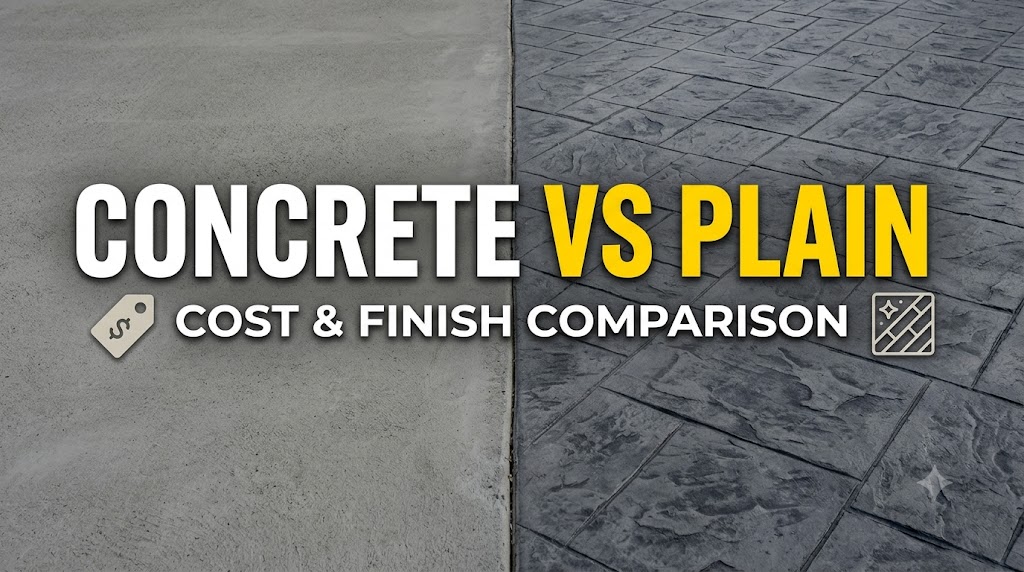
Stamped concrete costs $12–$22 per sq ft ($129–$237 per m²) installed, versus $5–$8 per sq ft ($54–$86 per m²) for plain broom-finished concrete. The gap is driven by colour hardener, release agent, stamps, and significantly more labour — not by any difference in the underlying mix design.
To compare your specific project, run both scenarios through the Stamped Concrete Calculator and the Concrete Cost per Square Foot Calculator. The gap widens with pattern complexity, number of colours, and total area — smaller jobs absorb the stamp setup cost less efficiently.
Side-by-side cost and specification comparison
| Factor | Stamped Concrete | Plain Broom-Finished Concrete |
| Installed cost (US) | $12–$22/sq ft ($129–$237/m²) | $5–$8/sq ft ($54–$86/m²) |
| Installed cost (AU) | AUD $110–$195/m² | AUD $65–$90/m² |
| Installed cost (UK) | £85–£150/m² | £45–£75/m² |
| Materials premium | +$3–$6/sq ft for colour, release, sealer | Standard concrete only |
| Labour hours (500 sq ft / 46 m²) | 40–60 hours (crew of 3) | 16–24 hours (crew of 2) |
| Sealing requirement | Every 1–3 years (mandatory) | Every 3–5 years (recommended) |
| Lifespan (well maintained) | 25–40 years | 30–50 years |
| Repair visibility | High — colour matching is difficult | Low — patches blend with grey |
| Slip resistance | Moderate (pattern-dependent) | Good (broom finish) |
| Freeze-thaw performance | More susceptible (sealer critical) | More resilient |
What drives the cost difference between stamped and plain concrete?
Materials
The underlying concrete mix is identical — typically 3,000–4,000 psi (20–28 MPa) for residential flatwork. The cost difference comes from three finishing materials that plain concrete does not require:
Colour hardener: Broadcast dry-shake colour hardener hardens the surface to 6,000–8,000 psi (41–55 MPa) and provides the base colour. Applied at 60–100 lbs per 100 sq ft (2.9–4.9 kg/m²), it costs $0.80–$1.50 per sq ft ($8.60–$16.15 per m²) for materials.
Release agent: Powder or liquid release prevents stamps from bonding to the fresh concrete while adding a secondary accent colour. At 1 lb per 10 sq ft (0.49 kg/m²), it adds $0.30–$0.60 per sq ft ($3.25–$6.45 per m²)
Sealer: Stamped concrete must be sealed immediately after finishing to protect the colour and pattern. Acrylic sealer costs $0.20–$0.50 per sq ft ($2.15–$5.40 per m²) in materials per application and needs reapplying every 1–3 years. A 500 sq ft (46.5 m²) driveway accumulates $500–$1,250 in sealer costs over a decade — an ongoing expense that plain concrete largely avoids.
Labour
Stamping requires a full crew working quickly: concrete is stampable for approximately 20–40 minutes depending on temperature and mix design, and the entire surface must be stamped in one continuous operation. Each tool (stamp mat) covers 2–4 sq ft (0.19–0.37 m²). A 500 sq ft (46.5 m²) patio requires constant, coordinated work from at least 3 experienced finishers. A broom finish on the same slab needs 2 workers and a fraction of the skill. Labour accounts for 50–60% of the total cost premium for stamped work.
Finish options and where each works
| Finish | Appearance | Texture / Slip Resistance | Best Application |
| Broom finish (plain) | Uniform grey, parallel lines | High — 5 mm grooves | Driveways, sidewalks, utility slabs |
| Exposed aggregate (plain) | Stone texture, varied colour | High — natural stone profile | Pool decks, walkways, patios |
| Stamped — ashlar slate | Large stone blocks | Moderate — shallow texture | Patios, courtyards |
| Stamped — cobblestone/fan | Interlocking round pattern | Moderate | Driveways, walkways |
| Stamped — wood plank | Timber board grain effect | Low to moderate | Pool decks, covered patios |
| Stamped — flagstone | Irregular natural stone | Moderate | Garden paths, patios |
Exposed aggregate is often the better choice when you want visual interest at closer to plain concrete cost. It achieves texture through washing the surface before cure to expose the coarse aggregate — no stamps, no colour hardener, just a surface retarder and pressure washing. Installed cost is typically $6–$10 per sq ft ($65–$108 per m²), splitting the difference between plain and stamped.
Where stamped concrete fails and plain concrete holds up
Freeze-thaw cycling is the primary durability weakness of stamped concrete. Colour hardener is broadcast on the surface — it is not a full-depth treatment. Surface delamination (the hardener layer separating from the base concrete) occurs when water infiltrates and freezes beneath the hardened cap. This is most common in USDA hardiness zones 5 and below (Canadian prairies, northern US states, most of the UK outside London).
Sealing prevents the problem when done on schedule. Miss one cycle — a missed re-seal after winter — and spalling can begin within one season. Plain broom-finished concrete does not carry this vulnerability because there is no applied surface layer to delaminate.
Repair is the other significant practical difference. A cracked or spalled section of plain grey concrete is repaired with a colour-matched patch — which is to say, grey concrete. It blends. A matching repair on stamped concrete requires the same colour hardener, the same release agent, the same stamp pattern, and an experienced finisher. Even then, new vs weathered colour is visible for years. Do not choose stamped concrete for any application where heavy vehicle loads, point loads from heavy equipment, or tree root intrusion is likely.
Common mistakes when choosing between stamped and plain concrete
Choosing stamped without accounting for ongoing maintenance cost. The installed price is the headline figure, but a 500 sq ft (46.5 m²) stamped driveway that needs sealing every 2 years at $0.40/sq ft materials plus 4 hours labour adds up to $1,000–$1,500 in maintenance costs per decade. Over 20 years, that narrows the gap with higher-end alternatives like pavers significantly.
Specifying stamped concrete in a freeze-thaw climate without a sealing commitment. This is the most common failure path. If you will not reliably seal every 1–2 years, the correct choice in a northern climate is plain concrete or exposed aggregate — both of which are more tolerant of the occasional missed maintenance cycle.
Using standard concrete mix for stamped work. Stamped concrete should be specified at 4,000 psi (28 MPa) minimum with a water-cement ratio below 0.45 and no more than 3–4 inches (75–100 mm) of slump. High-slump, wet mixes reduce colour hardener bond strength and increase bleed water — both of which cause finish defects. Contractors who quote low prices often achieve them by pouring a cheaper, wetter mix.
Underestimating the repair cost at the quote stage. A cracked stamped panel is not a $50 fix. Matching and re-stamping a 4 sq ft (0.37 m²) section can cost $200–$400 in labour alone because of the colour matching, mobilisation for a small job, and skill required. Factor realistic repair contingency into your project budget.
Related calculators you might need
If you are still deciding on scope, the Concrete Patio Calculator and Concrete Driveway Calculator give you base concrete volumes for the most common stamped applications. For a full financial comparison that includes labour, materials, and delivery, run both options through the Full Concrete Project Estimator. If you are comparing stamped concrete against an asphalt driveway instead, the Concrete vs Asphalt Driveway Cost Comparison runs both scenarios side by side.
Frequently asked questions
Is stamped concrete worth the extra cost? For patios and decorative applications where aesthetics drive value: generally yes, if you maintain it. For driveways in cold climates or anywhere you are unlikely to seal consistently: probably not. The 2x–3x cost premium buys appearance only — the underlying structural performance is identical. Exposed aggregate is worth considering as a middle option.
How long does stamped concrete last? A well-maintained stamped slab lasts 25–40 years. The colour hardener surface layer starts to show wear at 10–15 years without regular sealing, at which point resurfacing or full replacement becomes the only realistic options. Plain concrete in the same conditions lasts 30–50 years
Can stamped concrete be repaired to match the original? Partially. Colour matching is the primary obstacle — concrete colour changes as it ages and as the sealer weathers. A repair done within 2–3 years of the original pour has a reasonable chance of matching. After 5+ years, an exact match is effectively impossible. Some contractors mitigate this by resealing the entire surface after a repair to create uniform colour across old and new material.
What PSI concrete is used for stamped concrete? A minimum of 4,000 psi (28 MPa) is recommended for stamped concrete, which is the same specification used for garage floors and light commercial flatwork. Residential plain concrete is often poured at 3,000 psi (21 MPa). The higher strength specification helps the colour hardener bond properly and reduces the likelihood of surface delamination under freeze-thaw cycling.
Does stamped concrete get slippery when wet? It can. Deep-pattern stamps (cobblestone, rough slate) have sufficient texture for safe foot traffic when wet. Shallow patterns (wood plank, smooth stone) approach the slip resistance of polished stone — which is to say, dangerous around pool areas when wet. If the application is a pool deck, specify an anti-slip additive in the sealer or choose a deep-texture pattern. Use the Concrete Pool Deck Calculator if you are pricing a pool surround.

Concrete is the most widely used building material on Earth, yet some of the most important decisions behind it are still made with rough guesses, outdated spreadsheets, and conflicting advice from random websites.
We thought that was a problem worth fixing.
Every calculator and guide on this platform exists for one reason: to replace uncertainty with reliable numbers. Whether you’re estimating a slab, planning footings, calculating reinforcement, comparing mix designs, or budgeting a project, the goal is the same—help you make decisions with confidence before concrete is poured.
We don’t publish calculators for the sake of having calculators. Every formula is researched, tested, and built around real construction requirements. Every guide is written to answer practical questions that contractors, builders, engineers, and homeowners actually face on job sites—not questions invented for search engines.
Because concrete is unforgiving.
A small mistake in volume estimation can waste thousands of dollars. An undersized footing can create structural problems. Incorrect reinforcement calculations can compromise performance. Once concrete is placed, many mistakes become expensive—or impossible—to undo.
That’s why accuracy matters.
Our approach is simple: start with the engineering, verify the calculations, explain the reasoning, and present the results in a way that anyone can use. No inflated claims. No copied content. No generic formulas stripped of context.
Just practical tools, clear guidance, and calculations designed to solve real-world construction problems.
The internet has plenty of articles about concrete.
We’re building a resource that helps people work with it.